


I often find myself contemplating the nature of intelligence. Not just human intelligence, or even artificial intelligence, but something far grander. As we unravel the complexities of our brains and build sophisticated AI models, a truly mind-bending question arises: could the entire universe itself function like a gargantuan neural network? It's a concept that blurs the lines between cosmology, theoretical physics, and computer science, inviting us to see the cosmos not just as a collection of stars and galaxies, but as a vast, interconnected system processing information on an unimaginable scale.
The idea isn't new, but recent advances in our understanding of both the universe's large-scale structure and the computational power of biological and artificial networks have given it fresh impetus. I’ve always been fascinated by how complex patterns emerge from simple interactions, and when I look at the universe, I see a prime example of this fundamental principle.
The Cosmic Web: The Universe's Wiring Diagram
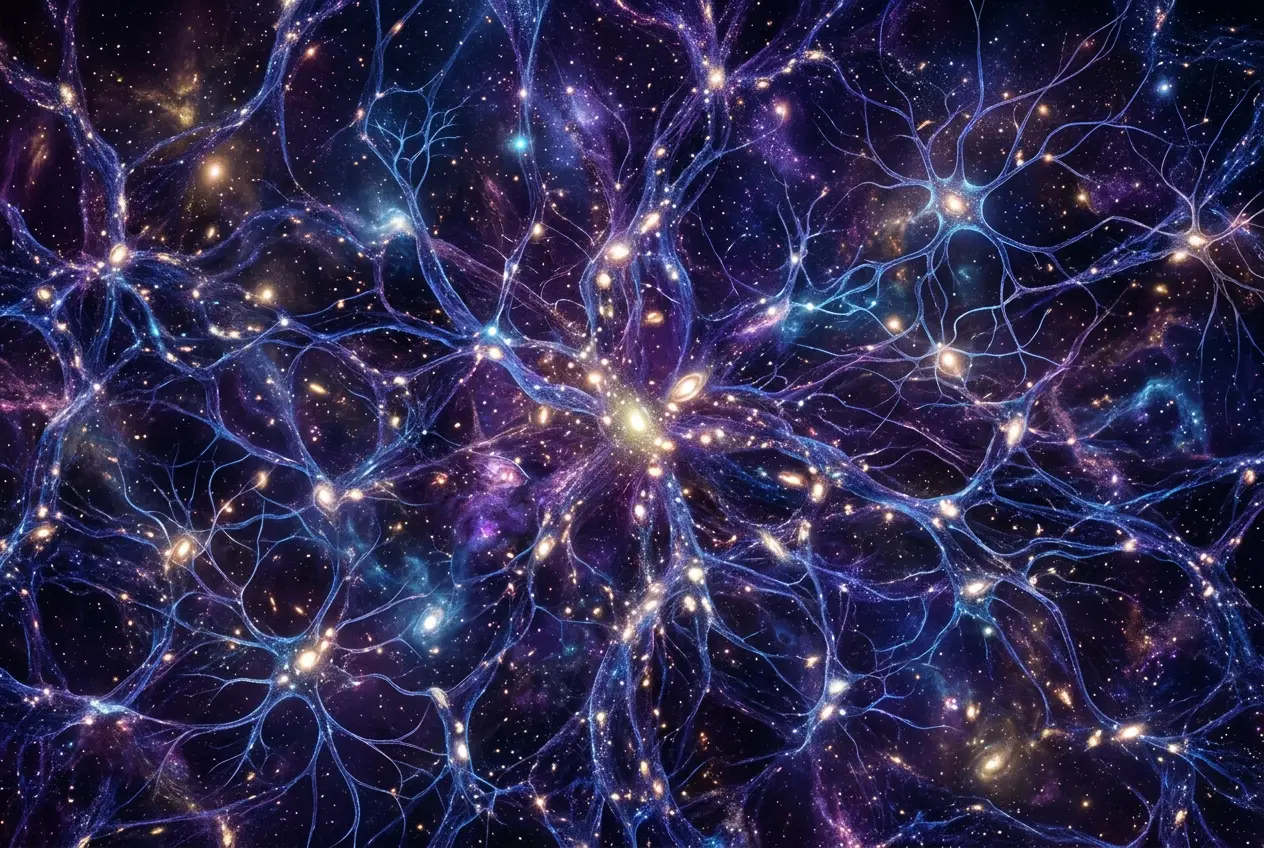
To truly appreciate this analogy, we first need to visualize the universe on its grandest scale. It’s not a uniform soup of matter; rather, it’s organized into an intricate, filamentary structure known as the Cosmic Web. Imagine vast threads of galaxies, clustered together like glowing pearls on cosmic strings, separated by immense, empty voids. These filaments and clusters make up the largest known structures in the universe, stretching for hundreds of millions of light-years.
This "Cosmic Web" is the skeleton of the universe, shaped primarily by gravity and the mysterious influence of dark matter. Dark matter, which we cannot directly observe, is believed to make up about 27% of the universe's mass, far outweighing the ordinary matter that forms stars and planets. It acts as a gravitational scaffolding, drawing galaxies together into these massive structures. Without dark matter, the universe would look very different—much more diffuse and less structured. You can learn more about the Cosmic Web and its formation on Wikipedia (opens in a new tab).
When I first saw detailed simulations of the Cosmic Web, I was immediately struck by its uncanny resemblance to the intricate neural networks within our own brains. The similarities are more than skin deep; they extend to how information might be processed and organized within such a system.
Echoes of Intelligence: Comparing Brains and Galaxies
Let’s delve deeper into the striking parallels between the cosmic web and a biological neural network.
| Feature | Biological Neural Network | Cosmic Web |
|---|---|---|
| Fundamental Unit | Neurons (cells that transmit electrical and chemical signals) | Galaxies (collections of stars, gas, dust, and dark matter) |
| Connections | Synapses (junctions where neurons communicate) | Gravitational interactions, dark matter filaments linking galaxies |
| Structure | Densely interconnected network of nodes and pathways | Filaments, clusters, and voids forming a vast, interconnected web |
| Information | Electrical impulses, neurotransmitters, and emergent patterns | Gravitational waves, light, cosmic rays, and potentially unknown dark matter interactions |
| Emergence | Consciousness, thought, complex behaviors | Structure formation, cosmic evolution, and potentially higher-level cosmic phenomena |
Just as individual neurons fire and connect to form thoughts and consciousness, so too might galaxies, clusters, and the dark matter that binds them, interact to "process" the universe's evolution. The universe is a dynamic system, constantly evolving, and these interactions could be seen as a form of cosmic computation. This idea relates to the concept of the Computational Universe Hypothesis, which posits that the universe is fundamentally a giant computer or a simulation. While this remains highly speculative, the structural similarities with neural networks provide a compelling visual and conceptual foundation. For those curious about how such systems can process information, I recommend reading about the basics of artificial neural networks on Wikipedia (opens in a new tab).
Dark Matter: The Cosmic Synapses?
The role of dark matter in this cosmic neural network analogy is particularly intriguing. If galaxies are the neurons, then dark matter filaments could be the synapses, the crucial connections facilitating "communication" and interaction across vast cosmic distances. Dark matter doesn’t interact with light, so it’s "silent" to our telescopes, yet its gravitational pull is what truly shapes the Cosmic Web.
Imagine dark matter as the unseen infrastructure, the optical fibers of the cosmos, silently transmitting information or influence. Its pervasive nature and gravitational dominance make it an ideal candidate for mediating these cosmic "computations." It's almost as if dark matter provides the hidden pathways for cosmic information to flow, allowing the universe to self-organize and evolve. Could this unseen network even be a form of cosmic communication? Some theories explore if dark matter is a cosmic communication network, a fascinating idea I’ve explored before.
The Universe as an Emergent System
One of the most profound aspects of both neural networks and the cosmic web is the concept of emergence. In a neural network, individual neurons don't "think," but their collective interactions give rise to consciousness and complex thought. Similarly, individual galaxies don't "compute," but the collective dynamics of billions of galaxies, dark matter, and cosmic forces could lead to emergent properties of the universe itself.
What could these emergent properties be? Perhaps the very laws of physics, or the conditions necessary for life, or even a form of cosmic awareness. This is where the analogy takes a leap into the realm of philosophy and high-level speculation, but it's a leap grounded in scientific observation of pattern and structure. The universe, in this view, is not just expanding and cooling; it is actively processing and evolving, shaping itself through an incredibly complex, decentralized network.
It makes me wonder about the scale of such a system. Our brains have billions of neurons, but the observable universe contains hundreds of billions of galaxies. The sheer number of potential "connections" and interactions is staggering, suggesting a computational capacity that dwarfs anything we can conceive.
Philosophical Implications and Unanswered Questions
If the universe is indeed a cosmic neural network, what does this imply for our existence? Does it suggest a form of cosmic consciousness, or simply an incredibly efficient self-organizing system? This question touches upon concepts similar to whether our brain is a quantum machine, delving into the fundamental nature of reality and information processing.
It also raises profound questions about the universe's purpose, if any. Is it an observer? A creator? Or simply a magnificent, intricate machine running an endless calculation? While we might not have answers to these questions anytime soon, the analogy provides a powerful framework for thinking about the cosmos in a new light. It encourages us to look beyond the individual components and consider the universe as a holistic, interconnected entity.
Moreover, understanding the universe through this lens could offer new insights into areas like artificial intelligence. Perhaps by studying the self-organizing principles of the cosmos, we can glean clues for building even more robust and intelligent AI systems. Conversely, our growing understanding of AI and neural networks might provide new mathematical tools to model and understand cosmic phenomena, potentially even black holes, which some have theorized could be nature's ultimate quantum computers.
The concept of a cosmic neural network remains largely theoretical, driven by intriguing structural resemblances and our evolving understanding of complex systems. It's a hypothesis that continually pushes the boundaries of our imagination, inviting us to ponder whether the universe isn't just a place where things happen, but a dynamic, processing entity itself. As we continue to explore the depths of space and the intricacies of intelligence, I believe we'll uncover even more surprising connections that challenge our current perceptions of reality.
The universe is full of mysteries, and this theory is one of the most compelling. It urges us to keep looking, keep questioning, and keep wondering about the true nature of the grand cosmic tapestry we are all a part of.
Conversation0
No comments yet. Be the first to share a thought — the best questions often become new stories.