I remember the first time I watched a modern robot perform a complex task, welding parts on an assembly line with chilling precision. My mind immediately flashed back to sci-fi films and futuristic visions. But what if I told you that the concept of automated machines, of self-moving figures, isn't a modern invention at all? What if, millennia ago, the brilliant minds of ancient Greece were already tinkering with what we might call the world's first automatons – their own versions of "robots"?
The idea seems almost fantastical. We often picture ancient Greece as a land of philosophers, democratic ideals, and epic myths, not necessarily a cradle of robotics. Yet, delve into their history, their myths, and their surviving texts, and a fascinating picture emerges: one where the line between intricate mechanical marvels and mythological beings blurs, hinting at a technological prowess far more advanced than many of us imagine.
### The Mythological Seeds: From Talos to Hephaestus's Helpers
Before we even touch documented historical figures, the very fabric of Greek mythology is interwoven with tales of automatons. Perhaps the most famous is **Talos**, a giant bronze automaton said to have been crafted by Hephaestus, the god of blacksmiths, artisans, and fire. Talos guarded the island of Crete, patrolling its shores three times a day, throwing massive boulders at approaching ships, and embracing intruders with his fiery body. He was, in essence, a weaponized, self-operating robot designed for defense.
Hephaestus himself is often depicted with a workshop full of wonders, including golden handmaidens who could walk, talk, and even assist him in his craft. These weren't mere statues; they were sentient, mobile entities. Homer describes them in the *Iliad*: "Golden handmaidens who resembled living young women... possessed of reason and speech, and knowledge of how to work." While undeniably mythological, these stories planted the seed of mechanical life, reflecting a cultural fascination with the possibility of artificial beings.
This mythological backdrop isn't just creative storytelling; it often served as a conceptual framework for what was technically feasible or desirable. For a culture to dream of such complex automatons, there must have been some foundational understanding of mechanics, hydraulics, and pneumatics.
### The Dawn of Mechanical Engineering: Real-World Automata
Fast forward from myth to documented history, and we find tangible evidence of ancient Greek ingenuity in building sophisticated mechanical devices. The Hellenistic period, in particular, saw a flourishing of engineering talent. Figures like Ctesibius of Alexandria, Philon of Byzantium, and most notably, **Hero of Alexandria**, penned treatises describing a plethora of self-operating machines.
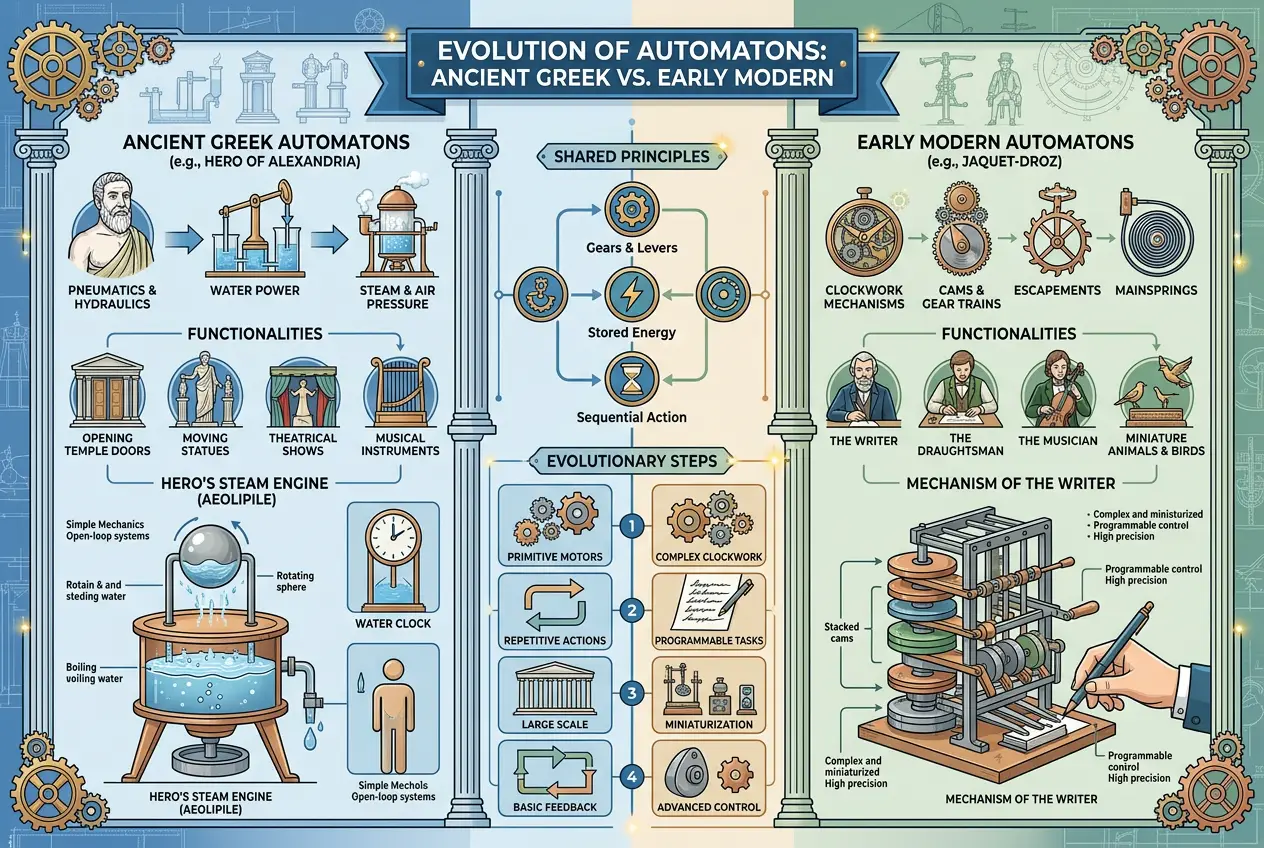
**Hero of Alexandria**, who lived in the 1st century AD, is often considered the pioneer of ancient automatons. His works, *Automata* and *Pneumatica*, detail designs for devices that could perform actions without direct human intervention. He described:
* **Self-opening temple doors:** Powered by fire on an altar that heated air, pushing water into a bucket that acted as a counterweight, causing the doors to swing open.
* **Mechanical birds that sang:** Using air pressure and water to create sounds.
* **Animated figures in theatrical performances:** Complex systems of ropes, weights, and flowing water were used to make figures move, tell stories, and even stage miniature plays. One remarkable example was a theatre with puppets that moved, changed scenes, and performed actions, all mechanically driven.
* **The Aeolipile:** Often called "Hero's engine," this was a steam-powered turbine, a spherical vessel rotated by steam jets. While not an automaton itself, it demonstrated a profound understanding of steam power and rotational motion, principles crucial for later automatons. You can learn more about Hero's inventions on [Wikipedia](https://en.wikipedia.org/wiki/Hero_of_Alexandria).
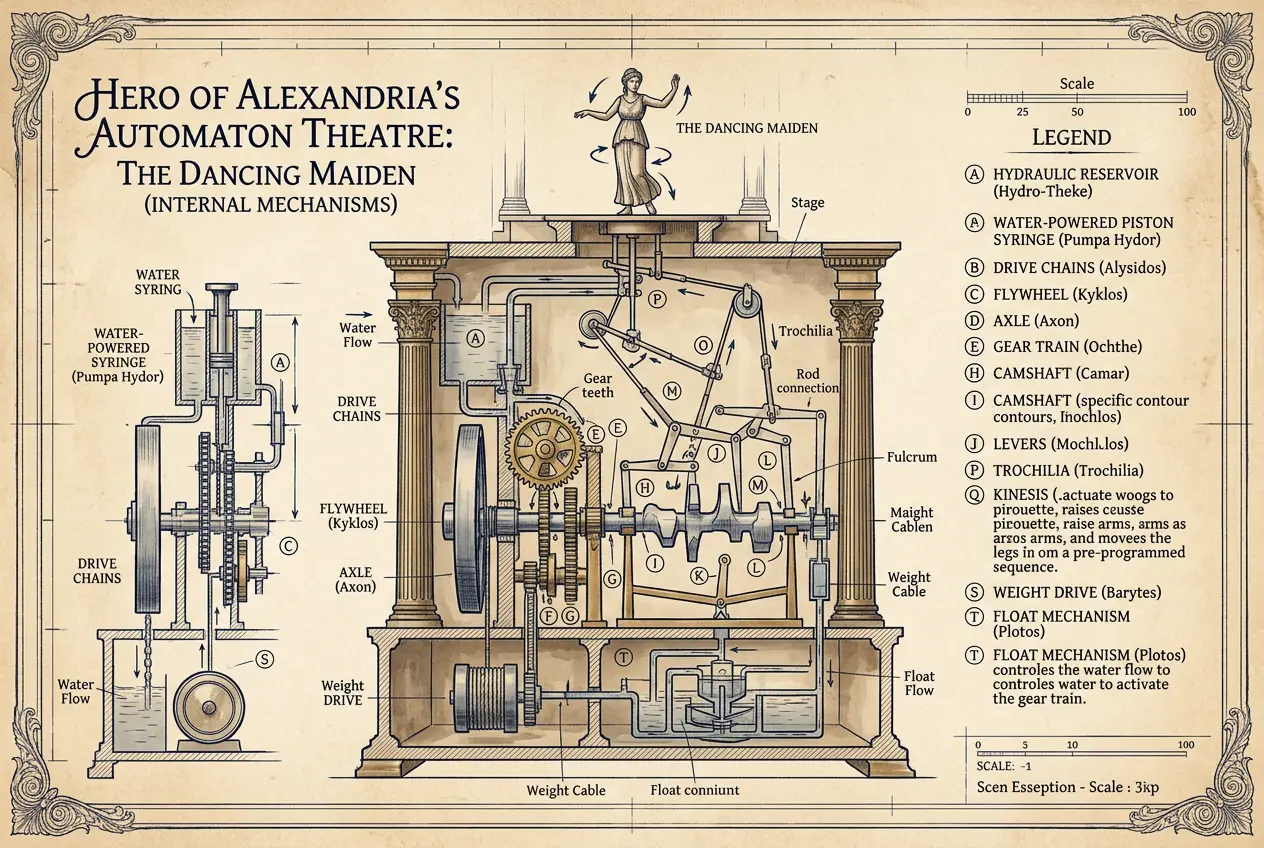
These weren't simple toys. Many required intricate gear systems, sophisticated hydraulic and pneumatic principles, and a meticulous understanding of physics. The precision needed to craft these devices, especially without modern tools, speaks volumes about the skill of ancient craftsmen. These aren't far removed from the "impossible artifacts" that challenge our understanding of historical tech, a topic we explored in [Impossible Artifacts: Clues to Lost Ancient Tech?](/blogs/impossible-artifacts-clues-to-lost-ancient-tech-2132).
### The Principles Behind Ancient Automatons
How did they achieve such feats? The key lay in their mastery of fundamental scientific principles:
1. **Hydraulics and Pneumatics:** The manipulation of water and air pressure was central. Many of Hero's devices used heated air to create pressure, or flowing water to activate levers and gears.
2. **Leverage and Gears:** Simple machines were employed in complex configurations. While the full extent of their gearing knowledge is still debated, mechanisms like the Antikythera (a complex astronomical calculator, though not an automaton in the sense of a moving figure, it shows advanced gearing) demonstrate a high level of mechanical sophistication.
3. **Counterweights and Balances:** Clever use of weights and counterweights allowed for controlled, sequential movements.
4. **Timing Mechanisms:** Some automatons required precise timing for different actions, achieved through controlled flow rates of water or air, or specific gear ratios.
Consider the precision required for these self-assembly concepts. It echoes themes we discussed in [Ancient Tech: Did Lost Cultures Master Self-Assembly?](/blogs/ancient-tech-did-lost-cultures-master-self-assembly-3555), where complex structures hint at methods beyond simple construction.
### Why Build Automatons? More Than Just Entertainment
While many ancient automatons were used for entertainment or to impress temple-goers with "miracles" (like self-opening doors), their significance goes deeper.
* **Religious and Political Influence:** Demonstrating control over seemingly magical mechanisms enhanced the authority of priests and rulers. A statue that poured wine or spoke seemingly on its own would inspire awe and reverence.
* **Scientific Experimentation:** These devices were practical applications of theoretical physics and engineering. They allowed inventors to test principles of mechanics, pneumatics, and hydraulics, laying groundwork for future innovations.
* **Philosophical Inquiry:** The creation of automatons touched upon profound philosophical questions about life, intelligence, and the nature of existence. If a machine could mimic life, what truly defined it?
* **Technological Advancement:** Each automaton built was a step in a larger technological journey. The techniques and knowledge gained from constructing these intricate devices contributed to a broader understanding of mechanics and material science.
### The Legacy and The Lost Knowledge
The decline of the Roman Empire and the subsequent periods saw much of this advanced knowledge either lost, forgotten, or not actively pursued for centuries. Many of Hero's texts survived only through Arabic translations, eventually making their way back to Europe during the Renaissance, where they influenced inventors and thinkers for centuries to come. It’s a recurring theme in history, where advanced techniques like those for Damascus steel, as explored in [Damascus Steel: Was Ancient Tech Stronger Than Modern?](/blogs/damascus-steel-was-ancient-tech-stronger-than-modern-7964), are rediscovered much later.
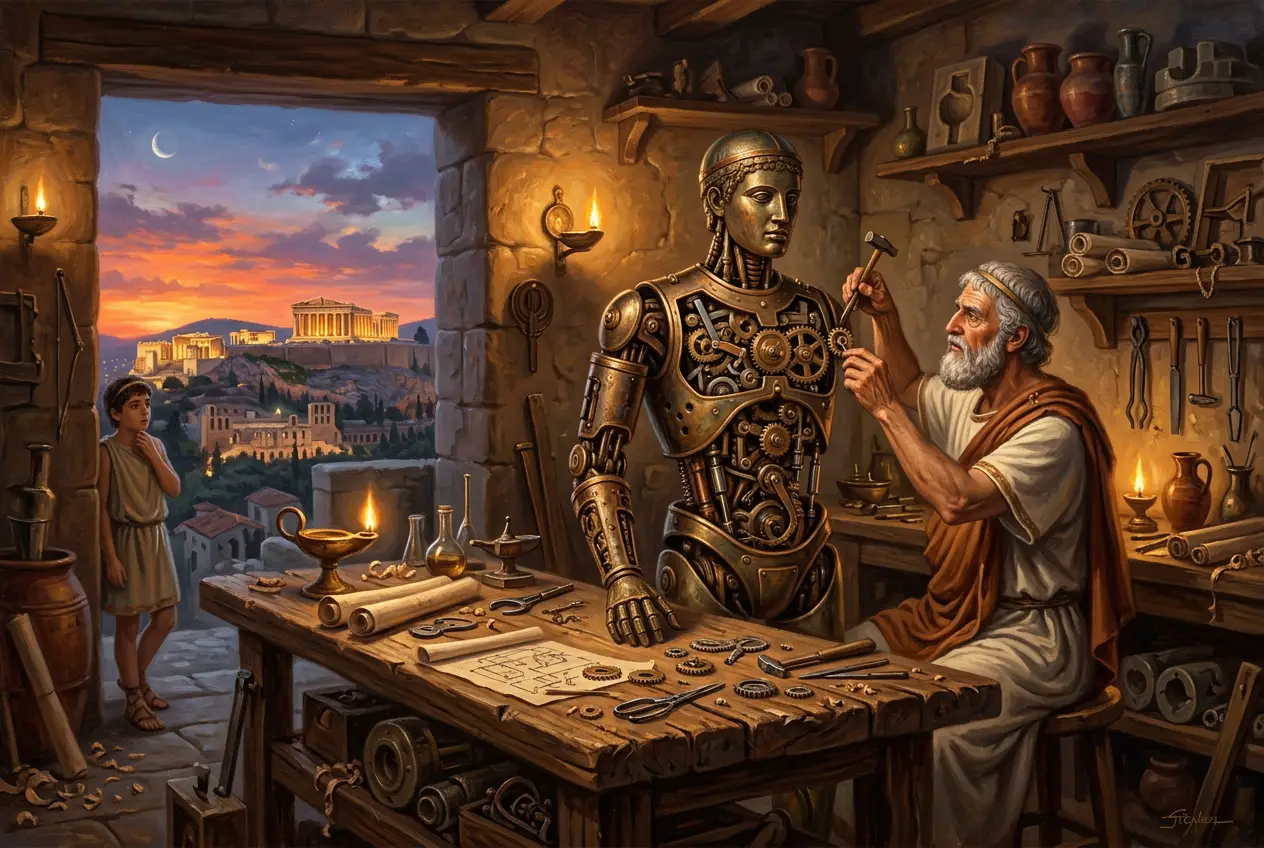
The tantalizing question remains: what other sophisticated automatons might have been created that simply didn't survive in written record or archaeological evidence? The accounts we have often hint at a broader practice. Could more complex, possibly even humanoid, automatons have existed, perhaps as unique, one-off creations for wealthy patrons or powerful leaders?
While we can't definitively say the ancient Greeks built "robots" in the modern sense of AI-driven, programmable machines, they certainly laid the groundwork for automation. Their automatons were complex, self-operating mechanical wonders that demonstrated an astonishing grasp of engineering principles. They remind us that human ingenuity is a constant, capable of pushing the boundaries of what's possible, even with seemingly limited tools.
So, the next time you see a robot, pause and consider its distant ancestors. They might just be the bronze handmaidens and mechanical birds dreamed up by the brilliant, curious minds of ancient Greece, still inspiring wonder across millennia.
Frequently Asked Questions
No, ancient Greek automatons were not programmable in the way modern robots are. They operated based on fixed mechanical, hydraulic, or pneumatic sequences, often triggered by external factors like fire or water flow, rather than adaptable code or sensors.
Ancient automatons were primarily constructed from materials available at the time, including bronze, wood, and various metals for intricate gears and moving parts, along with clever uses of water and air for power and movement.
Yes, other notable figures include Ctesibius of Alexandria, who invented various hydraulic devices and water organs, and Philon of Byzantium, who also wrote on mechanics and automatons, describing innovative vessels and war machines.
While many were for spectacle, the underlying principles developed for automatons had practical applications in other areas. For example, hydraulic systems were used in water clocks, pumps, and even some early medical instruments, advancing general mechanical understanding.
Much of the knowledge, particularly from Hero of Alexandria, was preserved through Arabic translations during the Islamic Golden Age. These texts later made their way to Europe during the Renaissance, significantly influencing European inventors and engineers in the development of clocks, automata, and early modern machinery.
Verified Expert
Alex Rivers
A professional researcher since age twelve, I delve into mysteries and ignite curiosity by presenting an array of compelling possibilities. I will heighten your curiosity, but by the end, you will possess profound knowledge.
Leave a Reply
Comments (0)
No approved comments yet. Be the first to share your thoughts!
 Join Us



 Alex Rivers






























Leave a Reply
Comments (0)