


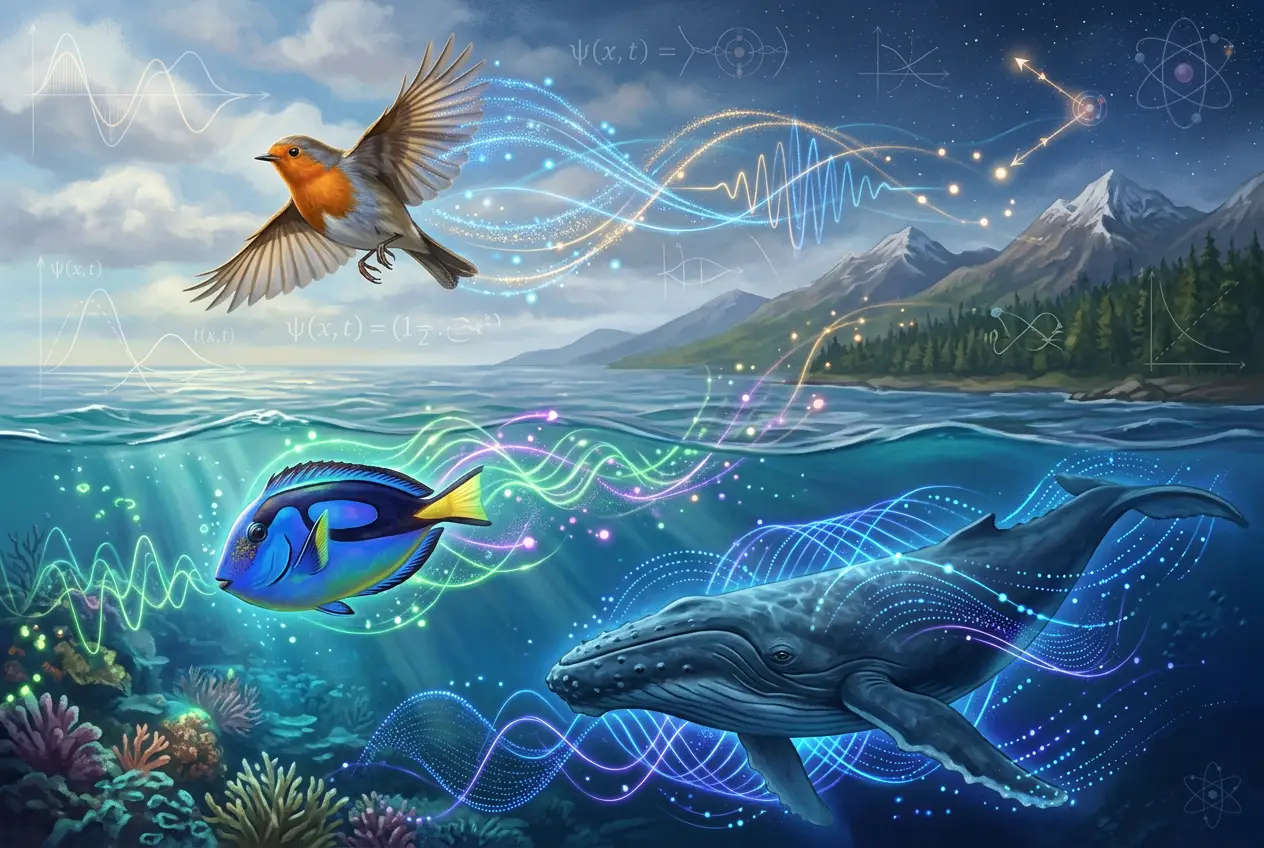
I remember a childhood fascination with how animals seemed to possess abilities far beyond our human comprehension. Birds migrating thousands of miles without a map, sharks sensing a single drop of blood from afar, or even dogs sniffing out diseases that doctors miss. For the longest time, science attributed these "super senses" to complex chemistry and evolved biological structures. But what if there's a deeper, more fundamental mechanism at play? What if, at the heart of these incredible abilities, lies the enigmatic world of quantum mechanics?
Recently, I've been diving deep into the emerging field of quantum biology, and it's nothing short of mind-boggling. It proposes that certain biological processes, traditionally explained by classical physics, might actually harness quantum phenomena like superposition, entanglement, and tunneling. It's like finding a microchip in a biological organism, using principles we typically associate with supercomputers and atomic particles, not living cells.
The Unseen Navigator: Birds and Earth's Magnetic Field
Imagine flying thousands of miles across continents, navigating through storms and changing landscapes, without a GPS, a compass, or even a basic map. This is the reality for many migratory birds. For centuries, the mechanism behind their uncanny ability to sense the Earth's magnetic field—a phenomenon known as magnetoreception—remained a profound mystery. While theories abound, classical physics struggled to fully explain how such a weak magnetic field could be detected and translated into a biological compass.
Enter quantum biology. The leading hypothesis revolves around a specific class of proteins called cryptochromes, found in the retina of a bird's eye. When blue light hits these cryptochromes, it triggers a chemical reaction that creates a pair of "radicals" – molecules with unpaired electrons. These electrons, it turns out, are quantum entangled. This means their quantum states are intrinsically linked, no matter how far apart they are. As the bird moves, the Earth's magnetic field subtly influences the entangled electrons, altering their spin states. This change in spin state then affects the rate at which the chemical reaction proceeds, effectively creating a visual "map" of the magnetic field in the bird's eye.
I find it astonishing to think that a bird's survival could hinge on a quantum phenomenon typically observed in controlled lab environments. It's not just a fancy theory; experiments have shown that even a slight alteration of specific light frequencies can disrupt a bird's magnetic sense, lending strong support to the cryptochrome mechanism. This truly highlights how sensitive and finely tuned these natural systems are. For a deeper dive into the complexities of magnetoreception, you can explore the detailed explanations available on Wikipedia's magnetoreception page (opens in a new tab).
Quantum Sniffers: The Mystery of Olfaction
Our sense of smell, or olfaction, is another biological marvel. How do we distinguish between millions of different odors, some with incredibly similar chemical structures? The conventional "lock and key" theory suggests that odor molecules fit into specific receptors like keys in locks, triggering a signal. While this explains many aspects, it struggles with certain anomalies, such as molecules with identical shapes but different smells, or vastly different shapes that smell the same.
A controversial but compelling quantum theory, proposed by biophysicist Luca Turin, suggests that olfaction might depend on quantum tunneling – the ability of a particle to pass through an energy barrier even if it doesn't have enough energy to overcome it classically. In this model, the vibrational frequencies of an odor molecule's chemical bonds, rather than its shape alone, are what the receptors "read." When an odor molecule binds to a receptor, it allows an electron to quantum tunnel through it only if the molecule's vibrational frequency matches a specific energy level in the receptor. This quantum tunneling event then triggers the olfactory signal.
It's a bold idea, suggesting our noses are not just chemical detectors but sophisticated quantum spectrometers. The elegance of this theory lies in its ability to explain those perplexing exceptions to the lock-and-key model. Imagine if our understanding of how information is processed could be expanded by such subtle quantum interactions, much like how we discuss the potential for parallel universes in other complex systems. If you're intrigued by the idea of interconnectedness, you might find our previous discussion on quantum entanglement bridging parallel universes thought-provoking.
The Efficiency Enigma: Quantum Photosynthesis
One of the most fundamental processes on Earth is photosynthesis, where plants convert sunlight into energy. It's incredibly efficient, almost defying classical physics. How do plants manage to capture nearly every photon of sunlight and transport its energy to the reaction center with minimal loss? This efficiency puzzled scientists for a long time.
Classical physics would predict that a significant amount of energy would be lost as heat during the energy transfer. However, quantum biology suggests that the energy isn't just "hopping" randomly from molecule to molecule. Instead, it's thought to travel via quantum coherence. This means the energy exists in multiple places at once, exploring all possible pathways simultaneously, effectively "choosing" the most efficient route to the reaction center. It's akin to a quantum search algorithm running within a plant cell.
This wavy, delocalized energy transfer ensures that very little energy is wasted. Researchers have observed quantum coherent states in photosynthetic light-harvesting complexes, even at ambient temperatures. This mechanism isn't just fascinating; understanding it could revolutionize our development of solar energy technologies, leading to far more efficient solar cells. For more information on this vital process, Wikipedia's page on photosynthesis (opens in a new tab) provides extensive details.
Other Whispers of Quantum Wonders
The examples don't stop there. Scientists are exploring potential quantum effects in various other biological phenomena:
- Enzyme Catalysis: Quantum tunneling might play a role in the speed and efficiency of enzyme reactions, allowing protons to tunnel through energy barriers, accelerating chemical processes vital for life.
- DNA Mutation: Could quantum tunneling be responsible for some spontaneous DNA mutations? If a proton tunnels from one base pair to another during replication, it could lead to a mispairing, explaining some genetic variations without external mutagens.
- Animal Echolocation: While largely explained by classical sound waves, some researchers are exploring whether quantum coherence might enhance the precision of echolocation in bats and dolphins, enabling them to construct incredibly detailed sonic maps of their environment. This could add another layer to how animals interpret their surroundings, a topic we touched upon when exploring the universe's echoes as a cosmic language.
The Skeptic's Corner and Future Horizons
It's important to acknowledge that quantum biology is a young and still heavily debated field. One of the main challenges is the "warm, wet, noisy" environment of biological systems. Quantum effects are typically observed in cold, isolated conditions, making their persistence in a bustling cellular environment seem improbable to some. The phenomenon of decoherence, where quantum states lose their coherence due to interaction with their environment, is a major hurdle.
However, proponents argue that biological systems have evolved sophisticated ways to protect and harness these fragile quantum states, perhaps by creating "quantum coherent pockets" or by utilizing phenomena that are robust even at physiological temperatures. The increasing body of evidence, especially in photosynthesis and magnetoreception, suggests that these aren't just theoretical musings but active areas of experimental research. As our understanding of these subtle interactions grows, we might even uncover connections to mysterious phenomena like dark matter acting as a cosmic communication network, pushing the boundaries of what we consider possible in biology and physics.
Conclusion: A Quantum Leap in Understanding Life
The idea that quantum mechanics, the strange rules governing the subatomic world, could be woven into the fabric of life itself is truly revolutionary. It forces us to reconsider what "life" is and how it functions. From a bird's silent compass to a plant's efficient solar panel, the natural world might be performing quantum calculations that we are only just beginning to decipher.
This field holds immense promise, not just for fundamental biological understanding but also for applications in medicine, energy, and even the development of next-generation quantum technologies. As I reflect on these possibilities, I can't help but feel a profound sense of wonder at the universe's boundless ingenuity. The more we learn, the more we realize how little we truly know, and that, perhaps, is the most exciting discovery of all.



Conversation0
No comments yet. Be the first to share a thought — the best questions often become new stories.