I've always been captivated by the minds that dared to peek behind the curtain of reality, those who saw the universe not as a chaotic mystery but as an intricate machine waiting to be understood. If there's one figure who epitomizes this relentless pursuit of knowledge, it’s **Sir Isaac Newton**. His name evokes images of falling apples, prism-split light, and profound mathematical equations that, for centuries, governed our understanding of the cosmos. Yet, the true breadth of his genius, the depth of his character, and the sheer volume of his contributions are often underestimated. This will be a very long journey, a deep dive into the extraordinary life of a man who didn't just study science but fundamentally rewrote its rulebook, shaping the trajectory of human thought and technological advancement for generations.
### The Solitary Spark: Early Life and a Troubled Beginning
Born on Christmas Day in 1642 (under the Julian calendar, or January 4, 1643, Gregorian) in Woolsthorpe, Lincolnshire, Isaac Newton’s life began under less than ideal circumstances. He was a **premature baby**, so small that, as his mother later recounted, he could fit into a quart pot. His father, also named Isaac Newton, had died three months before his birth, leaving his mother, Hannah Ayscough Newton, a widow. When Isaac was three, his mother remarried Barnabas Smith, a wealthy rector, and moved to his parish, leaving young Isaac in the care of his maternal grandmother. This early abandonment is often cited as a profound influence on Newton's famously solitary, introverted, and at times, intensely insecure personality.
Growing up, Newton was not initially a brilliant student by all accounts. He was often described as undistinguished, prone to daydreaming, and had a childhood marked by isolation and an evident dislike for farming, which his stepfather had intended for him. He developed a keen interest in mechanical devices, crafting sundials, water clocks, and even miniature windmills, powered by a mouse. These early mechanical fascinations hinted at the methodical, observational genius that would later define his scientific work. His mother, recognizing his lack of aptitude for farm work and possibly his intellectual inclinations, eventually allowed him to return to grammar school in Grantham, where he finally distinguished himself. It was here, living in the apothecary's house, that he likely encountered his first scientific texts and started building a foundation for his future endeavors.
### Cambridge and the Year of Wonders: The Genesis of Genius
In 1661, Newton enrolled at Trinity College, Cambridge. Initially, he worked as a sizar, a type of student who performed duties for the college in exchange for tuition and board. Cambridge at the time was still heavily influenced by Aristotelian philosophy, but Newton was drawn to the more modern ideas of Descartes, Galileo, and Kepler. He devoured books on mathematics, optics, and astronomy, often outside the official curriculum.
His true intellectual awakening, however, coincided with a period of enforced isolation: **the Great Plague**. From 1665 to 1667, Cambridge University closed its doors to prevent the spread of the deadly disease, sending students home. Newton returned to Woolsthorpe Manor, his birthplace. Far from being a setback, these two "Plague Years" (or *annus mirabilis*, "year of wonders") proved to be the most fertile period of his scientific life. Without the distractions of university life, he had the freedom to think, experiment, and develop his groundbreaking ideas.
It was during this period that Newton laid the foundations for:
* **Differential and Integral Calculus (Fluxions):** He developed a new mathematical framework to understand change and motion, an independent discovery also made by Gottfried Wilhelm Leibniz, leading to a bitter priority dispute later.
* **Theories of Light and Color:** Through experiments with prisms, he discovered that white light is composed of a spectrum of colors, challenging the prevailing belief that prisms *tinted* light.
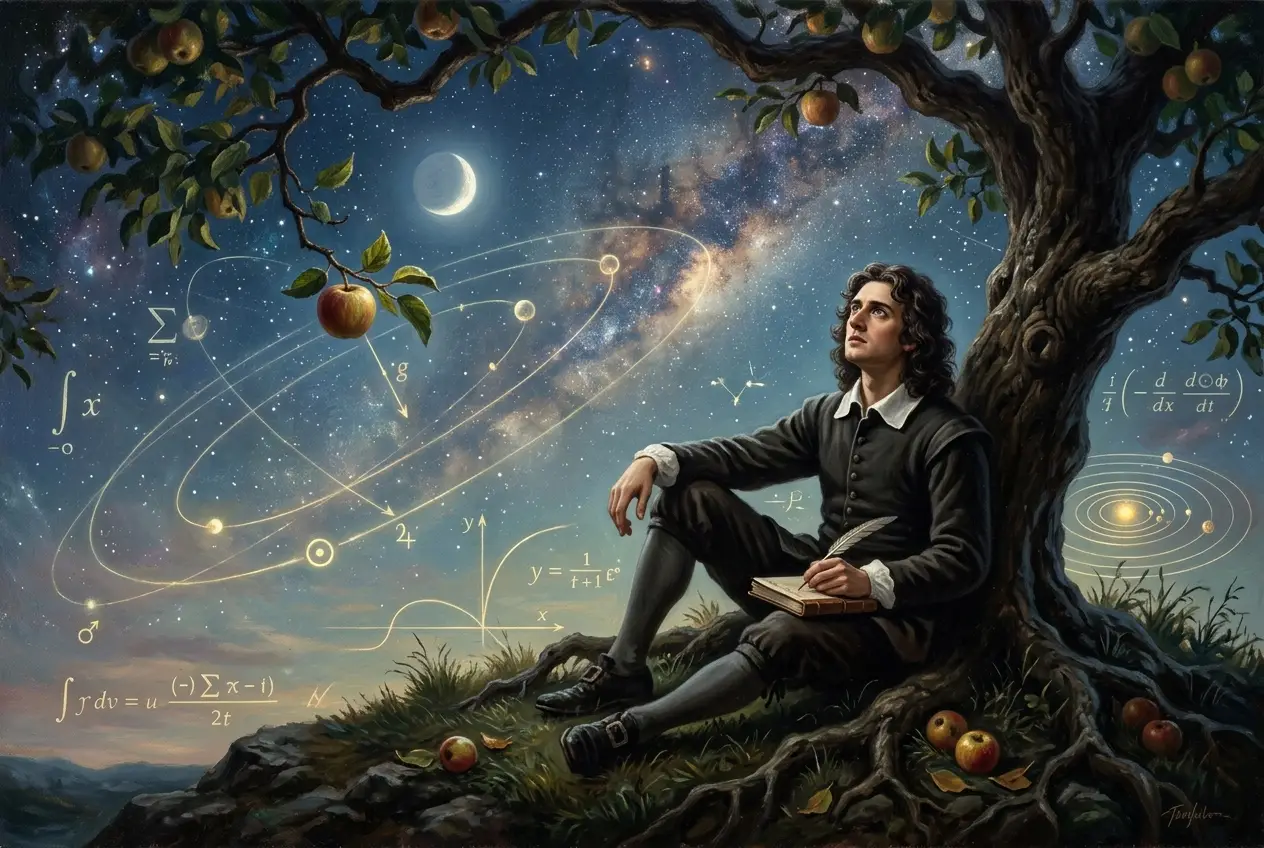
* **The Law of Universal Gravitation:** The famous anecdote of the apple falling in his garden is often used to illustrate this moment. While the apple didn't literally hit him on the head and reveal the formula, it served as a powerful metaphor for his realization that the same force causing an apple to fall to Earth also kept the Moon in orbit around it, and planets around the Sun.
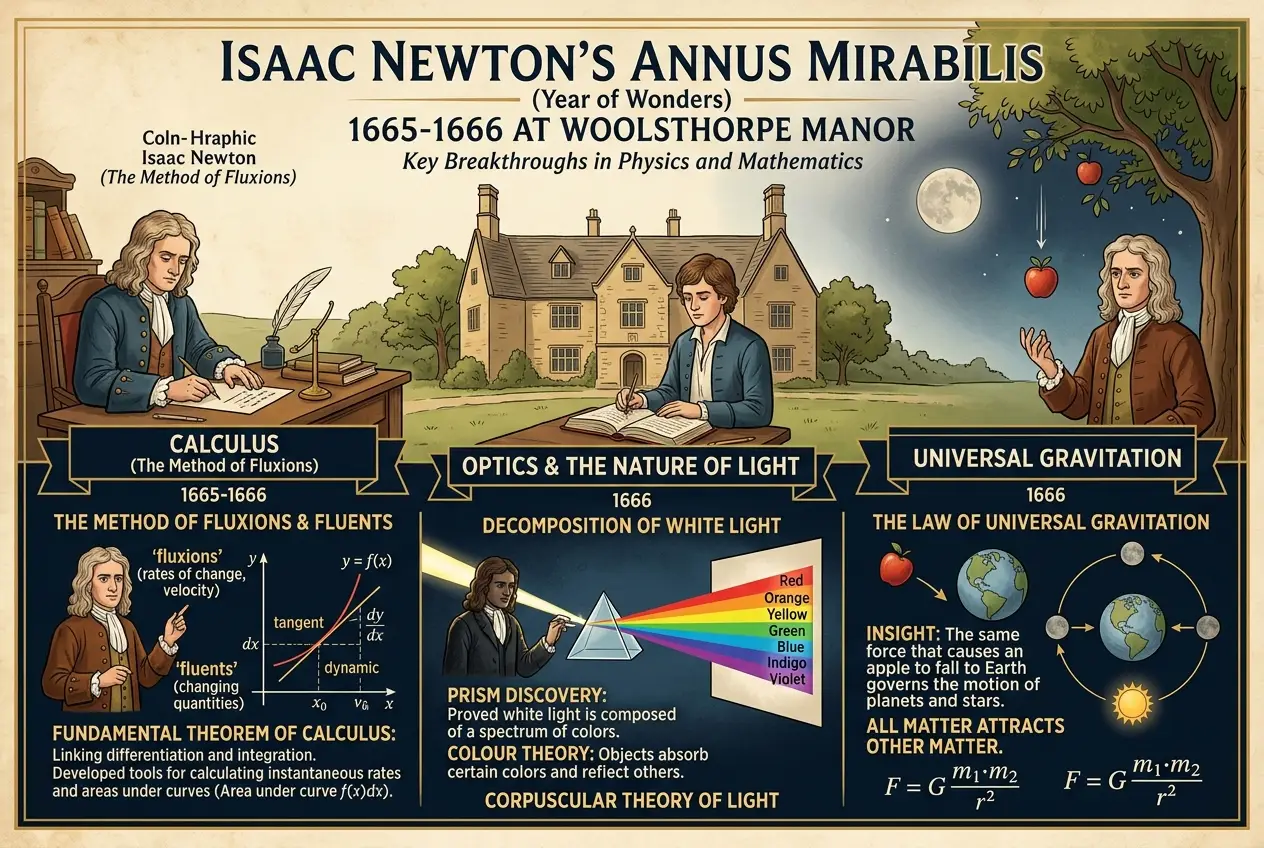
Newton's insights during these years were nothing short of revolutionary, but he famously kept many of them to himself for years, a trait that would define much of his early career.
### Early Career and the Apple of Discord: Conflicts and Contributions
After the plague subsided, Newton returned to Cambridge. In 1669, at just 26 years old, he succeeded his mentor, Isaac Barrow, as the **Lucasian Professor of Mathematics**, one of the most prestigious academic chairs in the world. This position required him to give lectures, but he often found himself lecturing to empty rooms, as his material was complex and advanced.
His first public scientific contributions were in **optics**. In 1671, he invented the **reflecting telescope**, which used mirrors instead of lenses, eliminating chromatic aberration (the distortion of colors) that plagued refracting telescopes. This invention immediately brought him recognition and led to his election as a Fellow of the Royal Society in 1672, a significant milestone for any scientist.
However, his entry into the scientific community was not without friction. When he presented his theory of light and color to the Royal Society, it sparked immediate controversy, most notably with **Robert Hooke**. Hooke, a prominent scientist of the time, claimed that Newton's findings were not entirely new and criticized his methodology. This marked the beginning of a long and bitter rivalry between the two men, which profoundly affected Newton. Sensitive to criticism and intensely private, Newton often recoiled from public debate, sometimes threatening to withdraw from scientific discourse altogether. This trait meant that many of his discoveries remained unpublished for extended periods. For instance, his work on fluxions was only fully published much later, leading to the infamous dispute with Leibniz over who invented calculus first. You can read more about the Royal Society's pivotal role in early scientific discourse on [Wikipedia](https://en.wikipedia.org/wiki/Royal_Society).
### The Principia Mathematica: The Universe Mechanized
The towering achievement of Newton's life, and arguably one of the most important scientific books ever written, is the **"Philosophiæ Naturalis Principia Mathematica"** (Mathematical Principles of Natural Philosophy), usually referred to simply as the *Principia*. Published in 1687, it was the culmination of years of intense work, often spurred on by the persistent encouragement and financial support of **Edmond Halley** (of Halley's Comet fame).
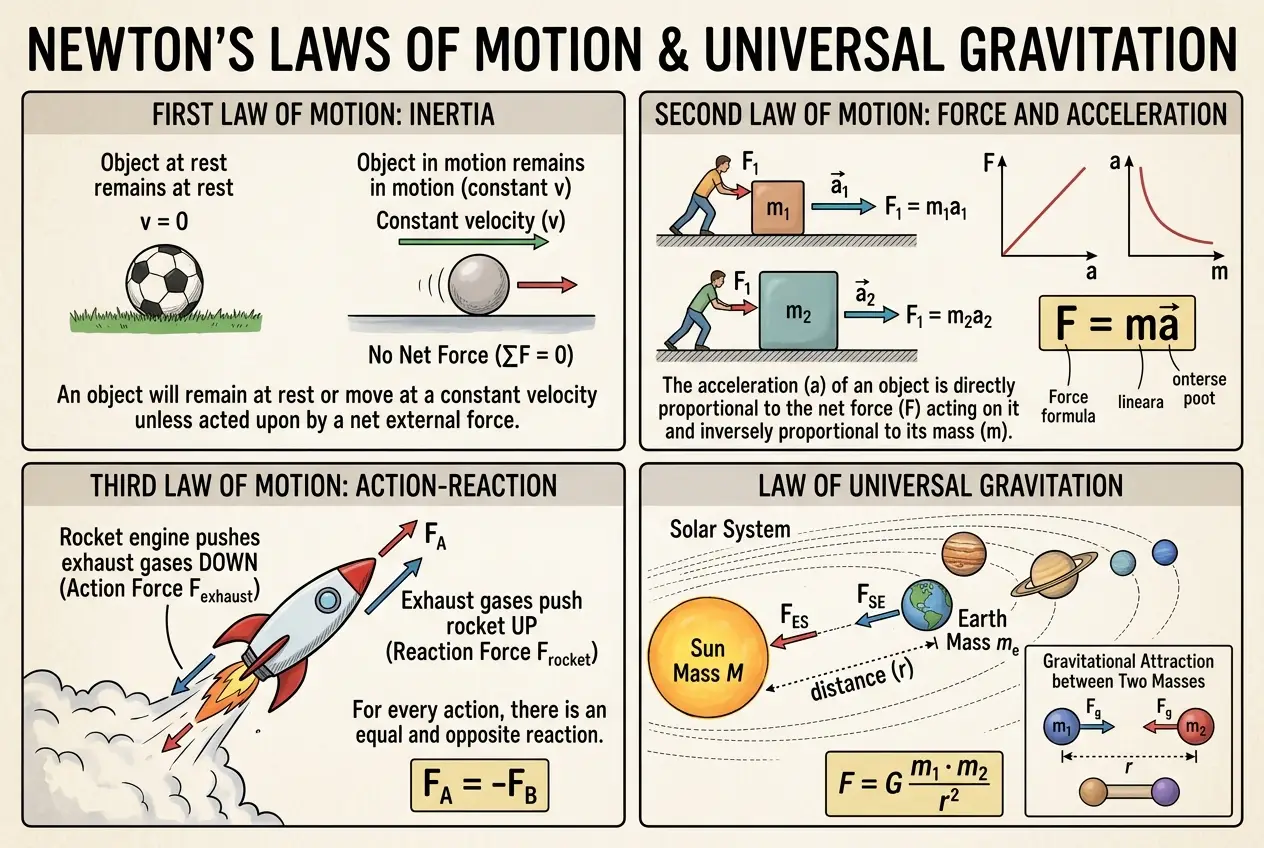
The *Principia* laid out Newton's three **Laws of Motion**:
1. **Law of Inertia:** An object at rest stays at rest, and an object in motion stays in motion with the same speed and in the same direction unless acted upon by an unbalanced force.
2. **Law of Acceleration:** The acceleration of an object as produced by a net force is directly proportional to the magnitude of the net force, in the same direction as the net force, and inversely proportional to the mass of the object (F=ma).
3. **Law of Action-Reaction:** For every action, there is an equal and opposite reaction.
More profoundly, the *Principia* introduced the **Law of Universal Gravitation**, demonstrating that the same force that governed falling objects on Earth also governed the orbits of planets, moons, and comets throughout the cosmos. This was a monumental unification of terrestrial and celestial mechanics, previously thought to be governed by different rules. Newton presented a universe that operated according to precise, mathematical laws, a grand machine wound up by a divine creator, but understandable through human reason.
The impact of the *Principia* was immediate and profound. It provided a coherent, predictive framework for understanding the physical world, enabling astronomers to predict planetary movements with unprecedented accuracy and engineers to design structures with new precision. It laid the groundwork for classical physics, which dominated scientific thought for over two centuries, until the advent of Einstein's relativity and quantum mechanics. The philosophical implications were equally immense, fostering an era of Enlightenment thought that emphasized reason, empiricism, and the belief in an orderly, knowable universe.
Newton's work in the *Principia* wasn't just theoretical; it was practical. It provided the mathematical tools for future explorations, from designing better cannons to plotting interstellar trajectories. It showed that complex cosmic phenomena could be broken down into simple, elegant equations. To understand how these fundamental principles underpin modern technological marvels, consider how our understanding of gravity is crucial for everything from satellites to space probes. We’ve explored the concept of [can wormholes really connect two universes](https://www.curiositydiaries.com/blogs/can-wormholes-really-connect-two-universes-science-vs-theory) and even [how our digital legacy might survive a dark age](https://www.curiositydiaries.com/blogs/our-digital-legacy-can-data-survive-a-dark-age-1519), but it all started with fundamental laws like Newton's.
### The Mysteries of Light: Optics and Experimentation
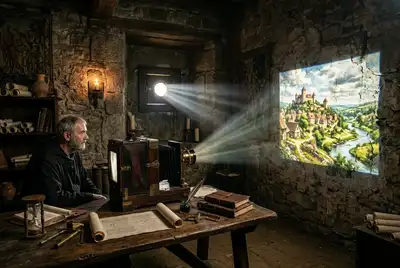
While the *Principia* solidified Newton's reputation as the greatest physicist and mathematician of his age, his earlier work in **optics** was equally revolutionary and perhaps more accessible to the public. His book *Opticks*, published in 1704, detailed his extensive experiments with light. In this work, he meticulously described how he used prisms to demonstrate that white light is a composite of different colors, each with its own refrangibility (ability to bend). He showed that these colors could be recombined to form white light again. This directly contradicted the Aristotelian view that color was a modification of light.
Newton also proposed a **corpuscular theory of light**, suggesting that light consisted of tiny particles (corpuscles). While this theory explained phenomena like reflection and refraction, it struggled with diffraction and interference, which were later better explained by a wave theory proposed by Christiaan Huygens. The debate between particle and wave theories of light would rage for centuries, only to be resolved in the 20th century with the development of quantum mechanics, which revealed light's dual wave-particle nature.
Newton's experiments were characterized by their precision and meticulous detail. He constructed his own apparatus, carefully documented his observations, and used mathematical reasoning to interpret his results. His *Opticks* became a model for experimental science, influencing generations of physicists and chemists. The book itself was written in English, making it more accessible to a wider audience than the Latin *Principia*, further cementing his public image as a scientific pioneer.
### The Alchemist and The Theologian: Newton's Hidden Pursuits
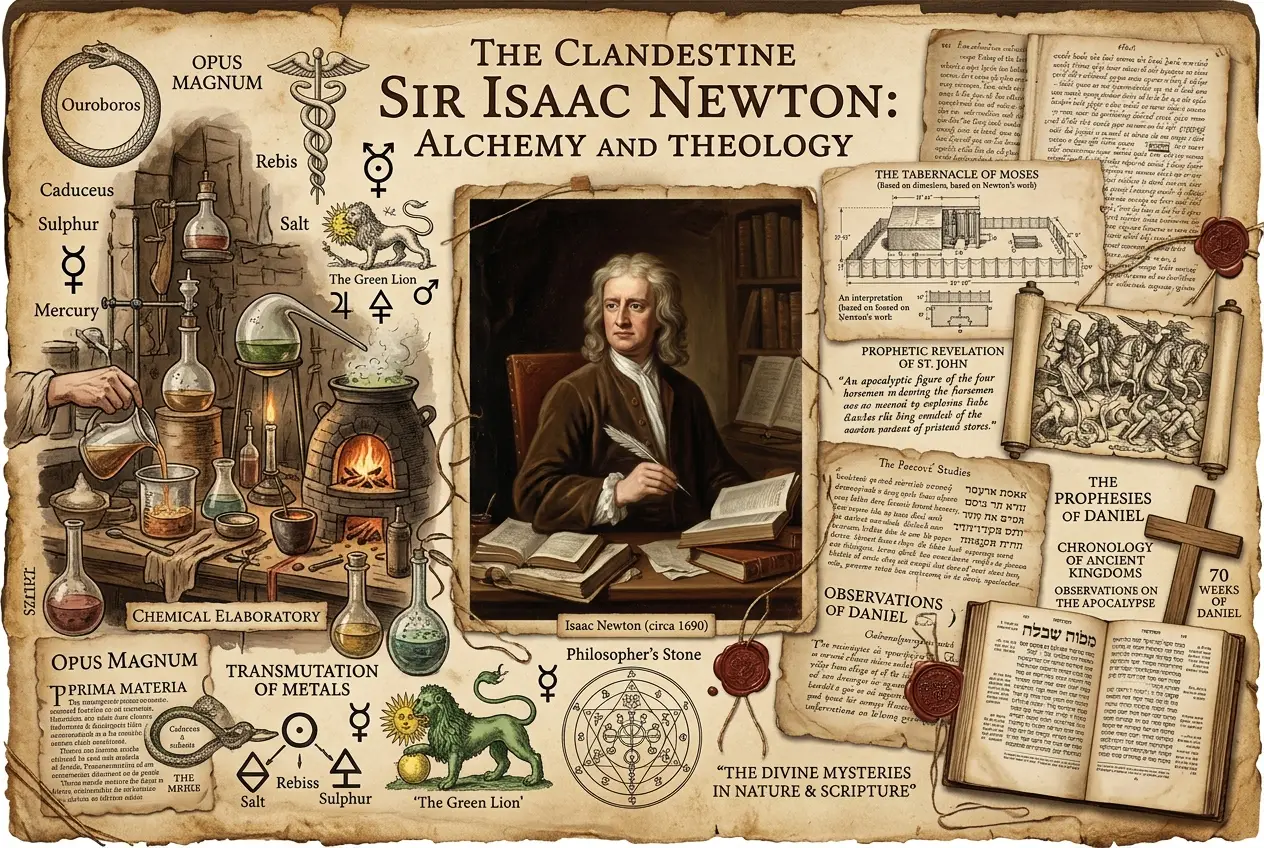
One of the most surprising and often overlooked aspects of Newton's intellectual life was his deep engagement with **alchemy** and **theology**. For much of his life, he spent as much, if not more, time studying ancient texts, biblical prophecies, and alchemical manuscripts as he did on physics and mathematics. He wrote over a million words on these subjects, much of which remained unpublished until long after his death.
Newton viewed alchemy not as a quest for personal wealth through turning lead into gold, but as a mystical pursuit to understand the fundamental forces and transformations of nature. He believed that ancient texts and myths contained hidden knowledge, a "prisca sapientia" (ancient wisdom), that could reveal the secrets of the universe, including the nature of matter and God's interaction with creation. His alchemical notes contain thousands of experiments and detailed observations, demonstrating the same methodical approach he applied to his optical and gravitational studies. Some historians even suggest that his alchemical studies, with their focus on hidden forces and interactions, might have subtly influenced his concept of gravity as an invisible force acting at a distance.
His theological writings were equally extensive. Newton was a devout, albeit unorthodox, Christian. He rejected the doctrine of the Holy Trinity (a form of Arianism), believing it to be a corruption of early Christian teachings. He meticulously studied biblical chronology and prophecies, attempting to calculate the dates of biblical events and the end of the world. He saw science and theology as two complementary paths to understanding God's grand design, with the universe as His clockwork creation. These "secret" pursuits reveal a more complex and multifaceted Newton than the popular image of the purely rational scientist.
### Master of the Mint: Public Service and a Different Kind of Precision
In 1696, Isaac Newton left his academic life at Cambridge and moved to London to take on a public service role as **Warden of the Royal Mint**. Three years later, he was promoted to **Master of the Mint**, a position he held until his death. This was not a ceremonial role; it was a demanding and crucial office, particularly during a time when England was undergoing a massive recoinage.
Newton took his duties at the Mint with the same intense dedication he applied to his scientific research. He meticulously reformed England's currency, standardizing coinage and cracking down ruthlessly on counterfeiters. He personally oversaw investigations, interviewed suspects, and played a direct role in the prosecution of criminals, often using his sharp intellect to expose fraudulent practices. Under his leadership, the Mint became more efficient, and the quality of English currency improved significantly. His tenure at the Mint showcased his administrative abilities, his sense of justice, and his willingness to engage directly with the practical affairs of the state. It was a remarkable second act for a man primarily known for abstract theoretical work.
During this period, he also became President of the Royal Society in 1703, a position he held until his death. His presidency was marked by a strong, sometimes autocratic, hand. He used his authority to promote his own scientific views and interests, and, unfortunately, to further his long-standing dispute with Leibniz over the invention of calculus.
### The Leibniz-Newton Calculus Controversy: A Battle of Giants
The dispute over the priority of inventing calculus was one of the most bitter scientific controversies in history. **Gottfried Wilhelm Leibniz**, a German mathematician and philosopher, independently developed calculus around the same time as Newton, albeit with different notation. While Newton had developed his "method of fluxions" earlier (in the 1660s), Leibniz published his work first (in the 1680s).
The controversy escalated in the early 18th century, largely fueled by nationalistic pride and the actions of Newton's associates and himself, as President of the Royal Society. Accusations of plagiarism flew back and forth. Newton, through the Royal Society, essentially appointed a committee to investigate the claims, a committee that was largely composed of his allies, and predictably sided with him. The dispute cast a shadow over both men's legacies and highlighted Newton's sometimes-vindictive nature and his fierce protectiveness of his intellectual property.
While history now recognizes both men as independent inventors of calculus, Leibniz's notation (e.g., ∫ and dy/dx) proved to be more versatile and is the one primarily used today. This episode serves as a powerful reminder that even the greatest minds are not immune to human failings like pride and jealousy.
### Newton's Legacy: A Universe Transformed
Sir Isaac Newton died on March 31, 1727, at the age of 84, and was buried with full honors in Westminster Abbey, becoming the first scientist to receive such an honor. His epitaph reads: "Let mortals rejoice that there has existed such and so great an ornament of the human race."
His legacy is immense and multifaceted:
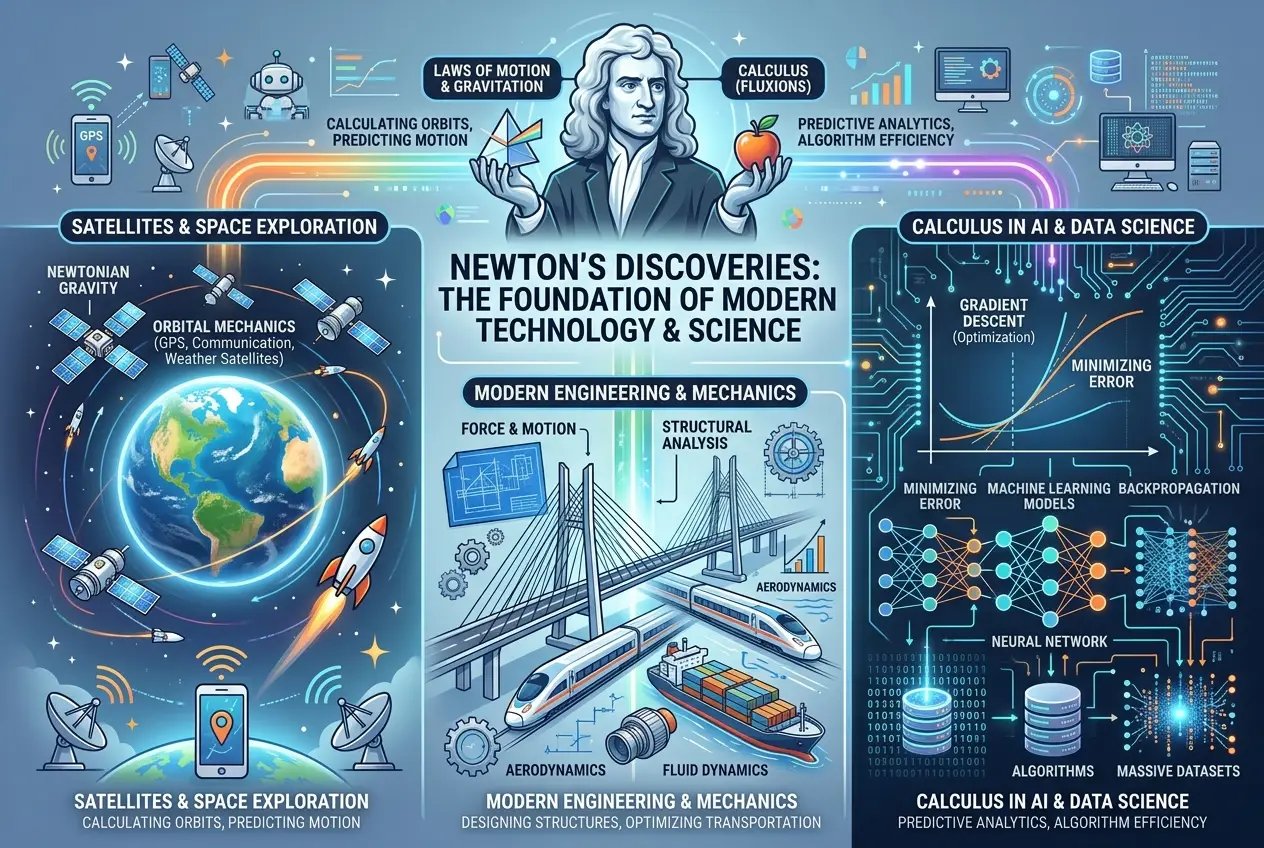
* **Foundation of Classical Physics:** His laws of motion and universal gravitation provided the bedrock for classical mechanics, predicting everything from the trajectory of cannonballs to the return of comets. This framework dominated scientific thought until the early 20th century.
* **Calculus:** A revolutionary mathematical tool essential for understanding change, motion, and continuous systems, indispensable in nearly every branch of science and engineering.
* **Optics:** His experimental methodology and theories on light and color transformed our understanding of vision and the nature of light itself.
* **Scientific Method:** Newton's rigorous combination of observation, experimentation, and mathematical formulation became the gold standard for scientific inquiry.
* **The Enlightenment:** His vision of a lawful, intelligible universe fueled the intellectual movement of the Enlightenment, promoting reason and empiricism over dogma and superstition.
* **Technological Advancement:** His principles are fundamental to space exploration, engineering, and countless modern technologies. The precision he brought to understanding physical forces still guides fields like robotics and advanced materials, echoing similar principles to those found in [memory metals that store hidden information](https://www.curiositydiaries.com/blogs/memory-metals-do-alloys-store-hidden-information-1925).
Beyond his scientific achievements, Newton's life reveals a complex individual: a genius driven by an insatiable curiosity, yet also private, fiercely competitive, and deeply religious. He was a man who saw the universe through a mathematical lens, yet also sought its spiritual truths in ancient texts and prophecies.
### The Unseen Newton: Quirks and Personal Life
Newton was a solitary man throughout his life. He never married, and there is little evidence of any romantic relationships. His dedication to his work was absolute, often leading to periods of intense concentration where he would forget to eat or sleep. He was known for his extreme absentmindedness and his introverted nature.
Despite his immense public recognition in later life, Newton remained a private individual. His few close friends and colleagues often spoke of his reserved demeanor and his reluctance to engage in casual conversation. He had a profound fear of criticism, which caused him to delay publishing many of his most significant works. This sensitivity, combined with an undeniable intellectual arrogance, made him a formidable, if sometimes difficult, figure in the scientific community. His life was a testament to the power of sustained intellectual focus, even at the cost of social conventionality.
### The Enduring Enigma
Isaac Newton remains one of humanity's most towering intellectual figures. He didn't just contribute to science; he forged a new way of understanding the world, a mechanical, mathematical paradigm that unlocked untold possibilities. From the smallest apple to the farthest star, he showed us that the universe speaks a language we can learn, a language of precise laws and elegant mathematics. His work continues to be taught in schools, applied in laboratories, and celebrated as a cornerstone of human achievement.
His journey reminds us that genius is often complex, sometimes contradictory, and always driven by an unyielding desire to understand the **Curiosity Diaries** of the universe.
**Conclusion:**
Sir Isaac Newton's life was a testament to the power of the human mind to unravel the most profound mysteries. He gifted humanity with a scientific framework that not only explained the universe but also provided the tools to navigate and manipulate it. From the laws that govern celestial bodies to the very fabric of light, Newton's legacy is etched into the foundations of modern science and technology. His story is a powerful reminder that sometimes, the most revolutionary discoveries emerge from moments of quiet contemplation, far from the madding crowd, echoing the sentiment of "If I have seen further than others, it is by standing upon the shoulders of giants."
Frequently Asked Questions
Before his major scientific breakthroughs, Isaac Newton was a somewhat undistinguished student with a deep fascination for mechanical devices. He briefly pursued farming but showed no aptitude for it. His true intellectual blossoming occurred during his time at Trinity College, Cambridge, and especially during the 'Plague Years' when he returned home to Woolsthorpe Manor and laid the groundwork for calculus, optics, and gravitation.
Newton's relationship with Robert Hooke was largely one of rivalry and antagonism. Hooke, a prominent member of the Royal Society, often criticized Newton's work, particularly his theories on light and color, and later claimed priority on aspects of gravitation. This rivalry deeply affected Newton, contributing to his reluctance to publish his findings and his withdrawal from scientific debate.
No, Isaac Newton also spent a significant portion of his life studying alchemy and theology. He meticulously conducted alchemical experiments, viewing them as a way to understand the fundamental forces of nature. His extensive theological writings reflect his deep, though often unorthodox, Christian faith, where he sought to reconcile science with divine creation and biblical prophecy.
Newton served as Warden and later Master of the Royal Mint. He took this role very seriously, implementing rigorous reforms to standardize English coinage and actively prosecuting counterfeiters. His tenure at the Mint showcased his administrative abilities and commitment to public service, proving he was more than just an abstract theoretician.
The calculus controversy arose because both Isaac Newton and Gottfried Wilhelm Leibniz independently developed calculus around the same time. Newton developed his 'method of fluxions' earlier but published later, while Leibniz published his version first. This led to a bitter, nationalistic dispute over who deserved credit for the invention, with both sides accusing the other of plagiarism, a conflict that unfortunately marred both their legacies.
Newton was known for being intensely private, solitary, and introverted. He never married and was often deeply engrossed in his work to the point of forgetting basic necessities. He was also famously sensitive to criticism, which often made him withdraw from public scientific discourse. Despite his genius, he could be quite vindictive and fiercely protective of his intellectual discoveries, particularly in the Leibniz controversy.
Verified Expert
Alex Rivers
A professional researcher since age twelve, I delve into mysteries and ignite curiosity by presenting an array of compelling possibilities. I will heighten your curiosity, but by the end, you will possess profound knowledge.
Leave a Reply
Comments (0)
No approved comments yet. Be the first to share your thoughts!
 Join Us
 Unknown Author






















Leave a Reply
Comments (0)