


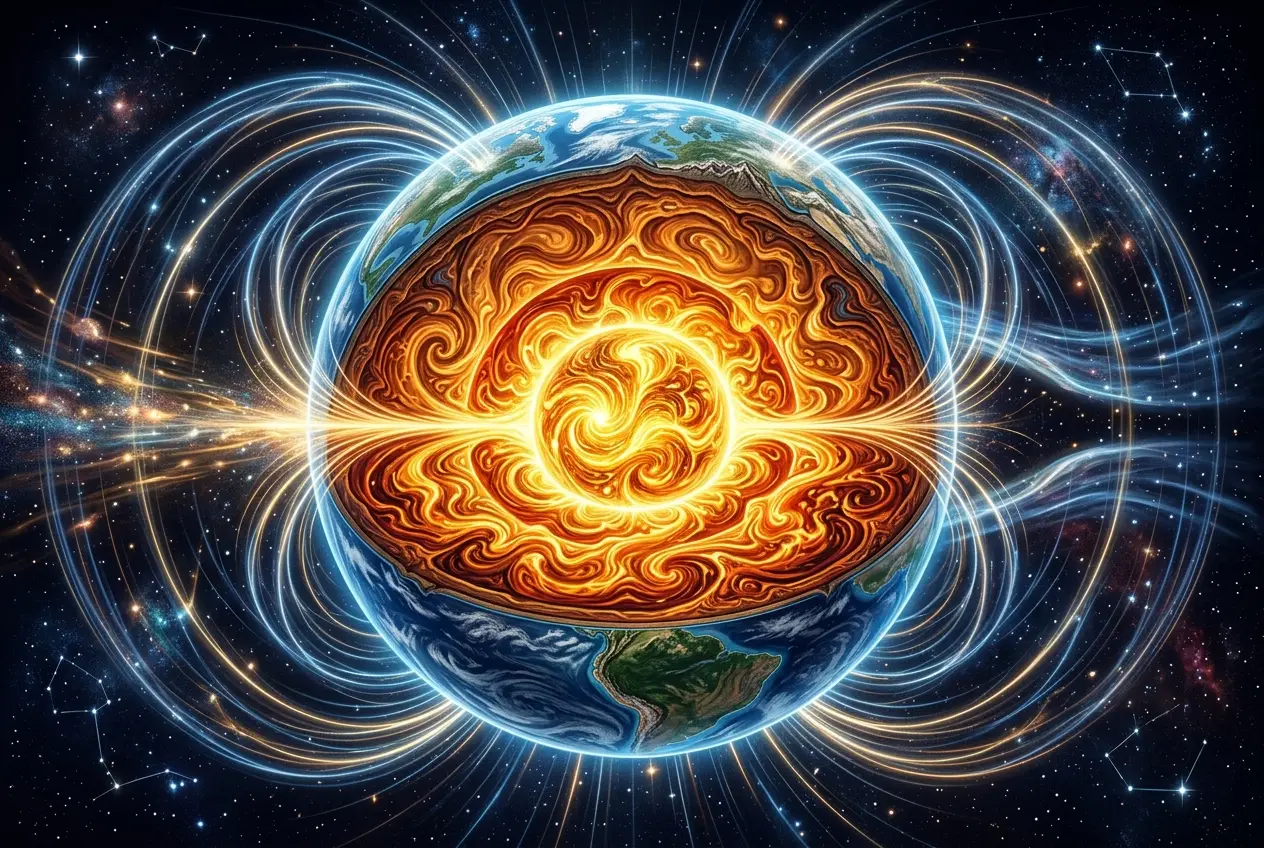
I often find myself gazing at the night sky, lost in the cosmic ballet of stars and galaxies. It’s easy to forget that beneath our very feet lies an equally profound and dynamic universe – the Earth’s core. We live on the surface, shielded, sustained, and largely oblivious to the incredible power plant operating thousands of kilometers below us. This isn't just a static ball of rock; it’s a colossal, churning engine that generates the very force field protecting us from the harsh realities of space. I'm talking about the Earth's geodynamo, a truly magnificent natural phenomenon that acts like a cosmic shield and a planetary supercomputer, constantly calculating and recalibrating its output.
The Unseen Shield: What Powers Our Planet's Magnetism?
Imagine stepping out into space without protection. The Sun, our life-giver, would also be our destroyer, bombarding us with lethal solar radiation and energetic particles. What saves us from this cosmic assault? It’s not some advanced alien technology, nor is it a forgotten ancient artifact, but rather an invisible, pervasive force field generated by the Earth itself: its magnetic field. This field extends far into space, forming a protective bubble known as the magnetosphere, diverting harmful solar winds and cosmic rays. Without it, our atmosphere would be stripped away, oceans would boil, and life as we know it would cease to exist.
But how exactly is this crucial shield generated? The answer lies deep within the Earth, specifically in its core. For centuries, scientists pondered the origin of geomagnetism. Early theories were speculative, but with advancements in seismology and planetary physics, a clearer picture began to emerge. The prevailing and most robust explanation today is the geodynamo theory.
Diving Deep: Understanding the Geodynamo
The geodynamo isn't a single, solid object, but rather a dynamic process occurring within the Earth's core. To grasp it, we need to understand the structure of our planet's interior. The Earth is composed of several layers: the solid crust, the semi-solid mantle, and finally, the core. The core itself has two distinct parts: a solid inner core and a liquid outer core.
The inner core is a solid ball, primarily made of iron and nickel, with temperatures comparable to the surface of the Sun (around 5,200 °C or 9,392 °F). It’s under immense pressure, keeping it solid despite the extreme heat. Surrounding this fiery heart is the outer core, a vast ocean of molten iron, nickel, and lighter elements. This liquid state is crucial for the geodynamo.
Here's a breakdown of the key elements that drive this planetary engine:
-
Convection Currents: The outer core is not static. Heat from the solid inner core, combined with the cooling and crystallization of molten iron onto the inner core's surface, creates immense temperature differences within the liquid outer core. Hotter, less dense material rises, while cooler, denser material sinks. This continuous circulation forms powerful convection currents, similar to what you see when water boils in a pot, but on a planetary scale. These currents are fluid movements of electrically conductive material.
-
Earth's Rotation and the Coriolis Effect: As these vast convection currents move through the molten outer core, they are significantly influenced by the Earth's rotation. The Coriolis effect, a force that deflects moving objects on a rotating frame of reference (like Earth), twists these currents into helical, spiral patterns. Imagine a giant, invisible blender churning molten metal into intricate, rotating columns. You can learn more about this fascinating force on Wikipedia's Coriolis effect page (opens in a new tab).
-
Electromagnetism: The Dynamo Effect: This is where the "dynamo" part comes in. The molten iron and nickel in the outer core are excellent electrical conductors. When these conductive fluids move in complex, swirling patterns (driven by convection and twisted by the Coriolis effect) across existing magnetic fields (even weak residual ones), they generate new electric currents. These electric currents, in turn, produce their own magnetic fields. This self-sustaining feedback loop is known as the dynamo effect. Essentially, the moving conductive fluid acts like the coils and magnets in an electric generator, continuously creating and maintaining a powerful planetary magnetic field. You can delve deeper into the mechanics of the geodynamo on its dedicated Wikipedia page (opens in a new tab).
The "Computer" Analogy: More Than Just a Shield
When I think about the geodynamo, I can't help but draw parallels to an incredibly complex, analog computer. It's constantly processing data – temperature gradients, rotational forces, fluid dynamics, and electromagnetic interactions – to maintain its output: the Earth's magnetic field.
- Self-Correction: The geodynamo isn't perfectly stable. It undergoes periods of strengthening and weakening, and famously, magnetic pole reversals. While scientists are still unraveling the full mechanisms behind these reversals, they show the geodynamo's capacity for complex, long-term self-regulation. Our planet has experienced countless such reversals throughout its history, with the last major one occurring about 780,000 years ago. Such events highlight the dynamic nature of this planetary engine. We've even explored how such a reversal might impact our tech in our blog, Earth's Magnetic Flip: How Will Our Tech Survive?.
- Predictive Power: While not predicting the future in a human sense, the geodynamo’s continuous operation ensures the long-term habitability of Earth. It "computes" the necessary magnetic field to protect our atmosphere and surface, a vital calculation performed billions of times a second without any silicon chips or algorithms we recognize.
- Data Generation: The magnetic field itself is a form of data, constantly interacting with external cosmic phenomena like solar storms. Studying these interactions allows us to understand both the Sun's activity and the geodynamo's internal workings. Our blog, Do Solar Storms Erase Earth's Ancient Magnetic Records?, touches on this fascinating interplay.
Probing the Depths: How Do We Study the Unseen?
Since we can't physically drill down to the Earth's core, how do scientists understand such a complex, inaccessible system?
- Seismology: This is our primary tool. Earthquakes generate seismic waves that travel through the planet. By studying how these waves propagate, reflect, and refract through different layers, scientists can infer the composition, density, and physical state (solid or liquid) of the Earth's interior, including the inner and outer cores. You can find comprehensive information about Earth's core and its properties on Wikipedia (opens in a new tab).
- Geomagnetic Observations: Satellites and ground-based observatories continuously monitor the Earth's magnetic field. Changes in field strength, direction, and anomalies provide crucial data about the processes occurring within the geodynamo.
- Numerical Simulations: Supercomputers play a vital role. Scientists create complex 3D mathematical models of the Earth's core dynamics, simulating the flow of molten metal, heat transfer, and magnetic field generation. These simulations help to test hypotheses and predict the behavior of the geodynamo over geological timescales.
- Laboratory Experiments: While impossible to replicate planetary conditions precisely, experiments with rapidly rotating liquid metal spheres can offer insights into dynamo action on a smaller scale.
The Mysteries That Remain
Despite significant progress, the geodynamo still holds many secrets. I find this aspect particularly captivating.
- The Energy Source: While we understand that convection drives the flow, pinpointing the exact energy budget and sources (e.g., latent heat from inner core crystallization, radioactive decay, gravitational potential energy) is an ongoing area of research.
- Magnetic Field Reversals: The triggers and full dynamics of magnetic pole reversals are not completely understood. Why do they happen? How quickly? What are the precise internal mechanisms that lead to such a dramatic global event?
- Inner Core Dynamics: The solid inner core itself rotates, seemingly at a different rate than the rest of the planet, influencing the outer core's flow. But how this rotation varies and its precise interaction with the geodynamo is still being investigated. Some of these questions tie into discussions about the core's slowing, which we explored in our blog, Is Earth's Core Slowing? A Cosmic Time Shift?.
Understanding the geodynamo is more than just academic curiosity. It’s fundamental to comprehending our planet's past, present, and future. It influences everything from the protection of life to the accuracy of compasses and the stability of our satellite communication systems.
This intricate, self-sustaining system reminds me that even the most seemingly inert parts of our planet are alive with activity, working in concert to create the world we inhabit. It’s a natural marvel, a testament to the complex physics that govern our universe, right here, beneath our very feet. The Earth’s inner core isn't just a hot rock; it's the heart of a cosmic-scale generator, a true giant geodynamo that safeguards our existence. It’s a remarkable piece of planetary engineering that dwarfs any human invention in its scale and importance.
Conclusion
The Earth's geodynamo is an awe-inspiring natural engine, responsible for generating the magnetic field that protects our planet and all life on it. Far from being a simple, static core, it's a dynamic, complex system of molten metal, convection currents, and electromagnetic forces, constantly interacting and evolving. While we’ve made incredible strides in understanding this planetary powerhouse, many mysteries remain, urging scientists to continue their quest to unravel the secrets of our planet's fiery heart. It truly is one of nature's most magnificent and critical "machines."





Conversation0
No comments yet. Be the first to share a thought — the best questions often become new stories.