



The night was unusually still, the air thick with anticipation. It was a few hours before the devastating L’Aquila earthquake in Italy in 2009. Witnesses described something truly bizarre: flashes of light, eerie glows, and silent flames appearing from the ground itself. These weren’t lightning, nor were they fireworks. They were Earthlights – a phenomenon so enigmatic it straddles the line between scientific observation and folklore. For centuries, across cultures, tales have emerged of strange lights preceding or accompanying seismic events. As a tech enthusiast and a curious mind, I can't help but wonder: are these just natural, albeit rare, geophysical phenomena, or could they be a subtle signal, a tell-tale sign of unseen forces or even a hidden geological technology we're only just beginning to understand?
The idea sounds like science fiction, doesn't it? But delve deeper into the science of Earthlights, also known as Earthquake Lights (EQLs), and you’ll find a fascinating intersection of geology, plasma physics, and a dash of genuine mystery. They are fleeting, unpredictable, and often appear as bright flashes, glowing clouds, or even sustained luminous phenomena in the sky or near the ground, typically over active fault lines.
The Enigma of Earthlights: A Historical Perspective
The earliest recorded sightings of EQLs stretch back millennia. Ancient texts from Greece, Rome, and China describe skies lighting up before major tremors. In 373 BC, the Greek historian Thucydides reported "flames and smoke" preceding a massive earthquake that destroyed the cities of Helike and Boura. Fast forward to the 17th century, and accounts from Italy detail "fires in the air" during seismic activity.
One of the most compelling modern observations occurred during the 1966 Tashkent earthquake, where large, luminous phenomena were widely reported. More recently, during the 2008 Sichuan earthquake in China, and the aforementioned 2009 L’Aquila earthquake, numerous video recordings and eyewitness accounts documented these perplexing lights. I’ve personally watched some of these videos, and they’re truly captivating – a blend of natural wonder and unsettling power.
These historical and modern accounts paint a consistent picture: Earthlights are a recurring, albeit rare, natural anomaly connected to seismic stress. But what causes them? And more importantly, could these seemingly random flashes be the manifestation of some intricate, underlying geological 'system' or energy grid that ancient civilizations, perhaps, intuited better than us?
Unpacking the Science: Theories Behind the Glow
Modern science offers several hypotheses for the formation of Earthlights, none of which fully encapsulate every observation, making the phenomenon ripe for deeper investigation.
1. The Piezoelectric Effect: Pressure to Light?
One of the older theories suggests that intense pressure on certain rocks, particularly quartz-rich ones, can generate an electric charge. This is known as the piezoelectric effect. As tectonic plates grind against each other, the immense stress could generate powerful electrical currents. If these currents discharge into the atmosphere, they could ionize the air, producing a visible glow.
While the piezoelectric effect is a proven phenomenon (it’s used in everything from lighters to microphones), its application to large-scale seismic events faces challenges. The sheer amount of quartz required and the conditions for a sustained atmospheric discharge are difficult to replicate or fully explain in typical fault zones.
2. The Peroxy Link Theory: Cracking Under Pressure
A more compelling theory, championed by researchers like Dr. Friedemann Freund, proposes that Earthlights are generated by the activation of peroxy defects within rocks. Freund's research suggests that when certain igneous and metamorphic rocks are subjected to extreme stress, dormant oxygen "holes" (peroxy bonds) in their crystal lattice become active. These activated sites act like tiny batteries, generating p-holes (positive holes), which are highly mobile charge carriers.
These p-holes can then flow rapidly through stressed rock volumes, traveling from deeper crustal regions to the surface. Upon reaching the surface, these intense charge carriers can ionize pockets of air, creating localized plasma that we perceive as light. This theory explains a wide range of EQL observations, including their appearance far from the fault epicenter and their often diffuse, glowing nature. I find this theory particularly intriguing because it suggests rocks themselves are acting as a sort of conductor, mobilizing energy on a scale we rarely consider. You can read more about this fascinating mechanism on Wikipedia's page about Earthquake light (opens in a new tab).
3. Frictional Heating and Plasma Generation
Another hypothesis involves the rapid friction generated along fault lines during an earthquake. This immense friction can superheat rock surfaces, potentially vaporizing rock material and creating localized plasma. This plasma, a highly ionized gas, would then emit light. While this could explain some intense, localized flashes, it doesn't fully account for the more widespread or atmospheric EQLs.
4. Radon Gas Emission
Some theories link EQLs to the emission of radon gas. Radon, a radioactive gas, can escape from the ground through cracks and fissures caused by seismic stress. Its decay can ionize the air, potentially contributing to localized glows. However, the energy released by radon is generally considered insufficient to produce the bright, large-scale phenomena reported.
Earthlights as a ‘Hidden Geological Tech’?
This is where the speculation gets truly exciting, blending science with curiosity. If rocks are capable of generating and transmitting powerful electrical charges or p-holes over vast distances, does this imply a kind of natural geophysical circuitry? Could Earth’s crust, particularly in seismically active areas, be akin to a giant, slow-moving electronic system?
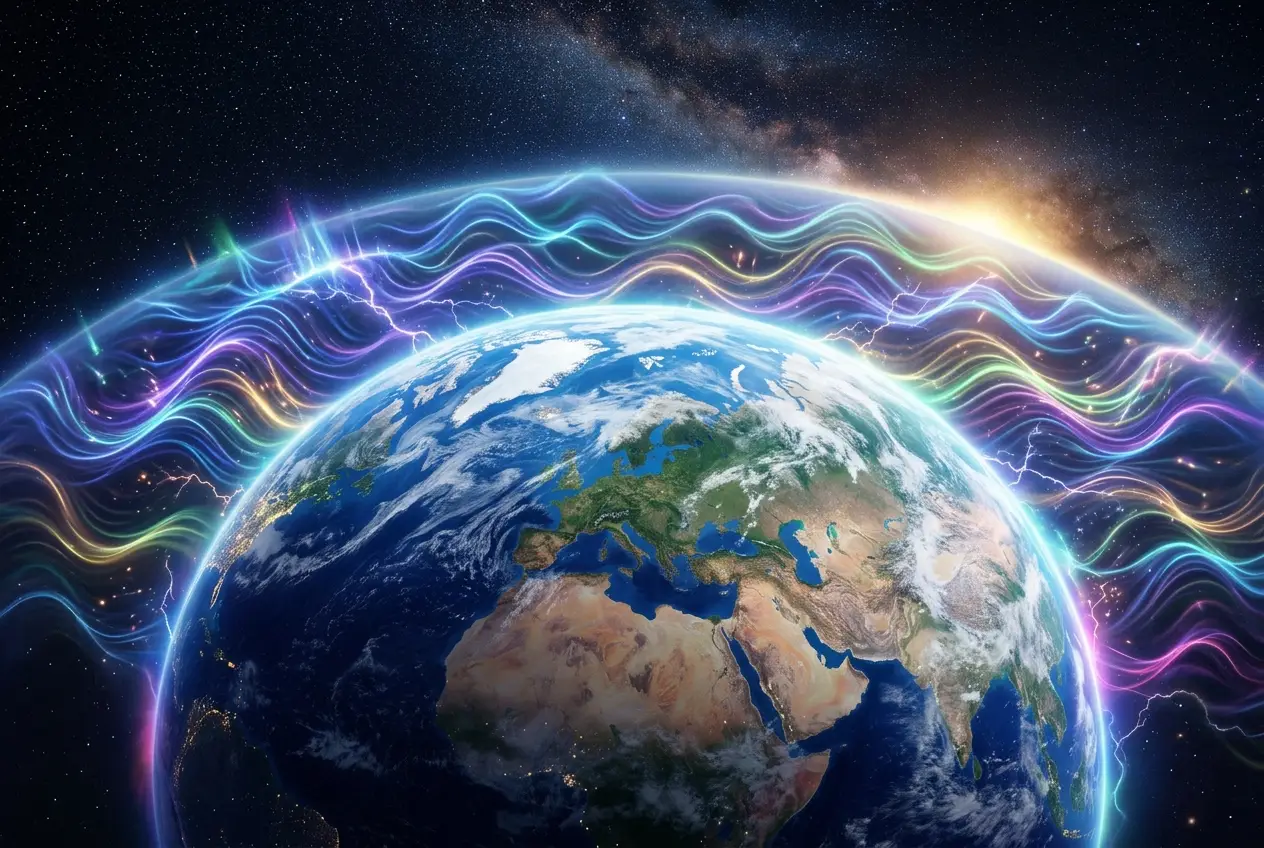
Consider this: our planet already possesses an immense, dynamic energy field. The Earth's magnetic field, driven by the molten outer core, acts as a protective shield and an invisible force field. Furthermore, the very ground beneath our feet is a complex interplay of pressure, heat, and mineral composition. We know that ancient civilizations seemed to be acutely aware of Earth's energies, perhaps even attempting to tap into them. The intricate alignments of structures like the Nazca Lines in Peru or the megalithic sites across Europe have led some to wonder if ancient builders were somehow charting or utilizing Earth's energy grids, as explored in articles like Nazca Lines: Messages or Ancient Energy Grid? or Did Megaliths Tap Earth's Geomagnetic Grid?.
If Earthlights are a direct consequence of stress-activated charge carriers within rocks, it suggests a profound capacity of our planet's geology to process and release energy in ways we're only now quantifying. Imagine if this isn't just a byproduct of seismic activity, but a fundamental property of the Earth’s crust, allowing for energy transmission and communication. Could the 'signals' emitted by Earthlights, then, be akin to the digital anomalies or unexplained behaviors we might see in complex computer systems?
The idea that ancient cultures might have been "reading" these geological signals, not just as omens but as indicators of underlying geological processes, is a thought that sends shivers down my spine. While they certainly wouldn't have understood the p-hole theory, their close observation of natural phenomena could have led to a unique, empirical understanding of Earth's dynamics. For instance, some historical accounts of earthquake prediction methods, though often anecdotal, suggest a heightened awareness of subtle pre-seismic indicators, as we discussed in Ancient Quake Predictors: Did They Use Unseen Signals?.
Differentiating Earthlights from Other Luminous Anomalies
It’s important to distinguish Earthlights from other sky phenomena. They are not meteor showers, nor are they simply atmospheric lightning. They also differ from curious phenomena like the Hessdalen lights in Norway, which are thought to be related to plasma generated by atmospheric conditions or unusual electrical activity, rather than tectonic stress. The Hessdalen lights, as explored in Hessdalen Lights: A Glimpse of Unknown Plasma Tech?, often exhibit complex behaviors and trajectories, distinct from the generally more ephemeral and ground-associated nature of EQLs.
Furthermore, while some might connect Earthlights to the concept of the Earth’s core being a massive reactor, the mechanisms for Earthlights are understood to be much more superficial, occurring within the crust itself, not deep within the mantle or core. However, the general idea of Earth's immense internal energy, explored in Is Earth's Core a Reactor Powering Planets?, still resonates with the wonder these phenomena inspire.
The Future of Earthlight Research
The study of Earthlights is challenging due to their unpredictability and the need for immediate, scientific observation during seismic events. However, advancements in seismology, geological monitoring, and even satellite imaging could provide new avenues for research. Imagine a network of sensors designed not just to detect ground motion, but also to measure subtle electrical and magnetic field changes, and even photographic evidence, during periods of seismic stress.
Could understanding Earthlights help us with earthquake prediction? Perhaps not directly as a standalone predictor, but as part of a multi-parameter monitoring system, they could offer valuable insights. If these lights truly represent the release of geological energy, then better understanding their precursors and manifestations could refine our models of tectonic plate movement and stress accumulation.
A Glimpse into the Potential:
| Theory | Primary Mechanism | Strengths | Challenges |
|---|---|---|---|
| Piezoelectric Effect | Pressure-induced electrical charge in quartz-rich rocks | Proven principle, direct conversion of mechanical to electrical | Requires specific rock composition, difficult to scale to observed phenomena |
| Peroxy Link Theory | Stress-activated charge carriers (p-holes) in rocks | Explains diverse EQL types, flow through various rock types | Requires complex quantum mechanical understanding, difficult to verify directly |
| Frictional Heating | Superheating of rock along fault lines, plasma creation | Explains localized, intense flashes | Limited to immediate fault lines, less explanation for diffuse lights |
| Radon Gas Emission | Ionization by radioactive decay of radon gas | Gas release linked to seismic activity | Insufficient energy for large-scale, bright phenomena |
Conclusion: A Glimmer of Understanding
Earthlights are more than just pretty flashes in the night sky. They are a profound reminder of the dynamic, often mysterious, forces at play beneath our feet. While the idea of a "hidden geological tech" might remain in the realm of speculative science, the research into phenomena like the peroxy link theory is pushing the boundaries of our understanding of Earth's crust as an active, energy-transmitting medium.
I believe that as our technology advances, our ability to detect, measure, and analyze these elusive phenomena will improve. Perhaps one day, we will not only understand precisely what causes Earthlights but also learn to interpret their subtle language, gaining deeper insights into our planet's inner workings and maybe, just maybe, discovering an ancient, intrinsic technology woven into the very fabric of Earth itself. The universe, and our home planet, continues to surprise and intrigue, constantly inviting us to ask, and answer, the most fundamental questions.



Conversation0
No comments yet. Be the first to share a thought — the best questions often become new stories.