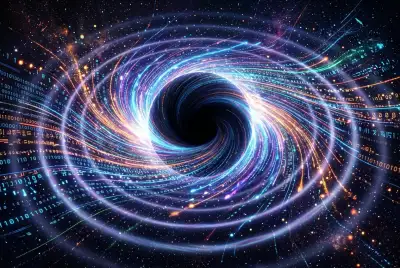
The cosmos, with its unfathomable mysteries, often presents us with phenomena that challenge our very understanding of physics and information. I often find myself pondering the deepest secrets of the universe, and few objects ignite more wonder and theoretical debate than **black holes**. These cosmic behemoths, once thought to be ultimate destroyers, might actually be the universe's most efficient information processors, perhaps even its most sophisticated quantum computers. It’s a mind-bending idea, one that takes us from the crushing gravity of a singularity to the ethereal dance of quantum mechanics.
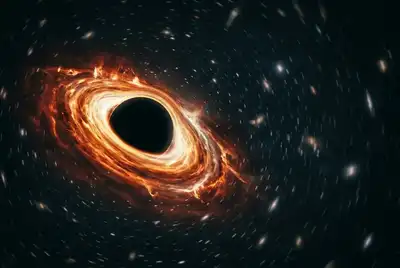
For decades, the prevailing image of a black hole was one of absolute oblivion – a region of spacetime where gravity is so intense that nothing, not even light, can escape. Anything that crosses the event horizon is gone forever, swallowed into an infinitely dense singularity. This traditional view, however, clashes dramatically with one of the most fundamental principles of quantum mechanics: the **conservation of information**. This conflict is famously known as the black hole information paradox, and it’s a scientific puzzle that has led some of the brightest minds to explore truly revolutionary concepts, including the astonishing possibility that black holes are, in essence, giant quantum computers.
### The Information Paradox: A Cosmic Conundrum
To truly grasp this idea, we first need to understand the **information paradox**. Imagine throwing a book into a black hole. According to classical physics, the book, along with all its unique information (the arrangement of atoms, the words written), would simply vanish. However, quantum mechanics dictates that information can never be truly destroyed; it can only be scrambled or transformed. If information is lost inside a black hole, it would violate quantum principles and shatter our understanding of how the universe operates. This is a profound problem, akin to saying energy could just disappear.
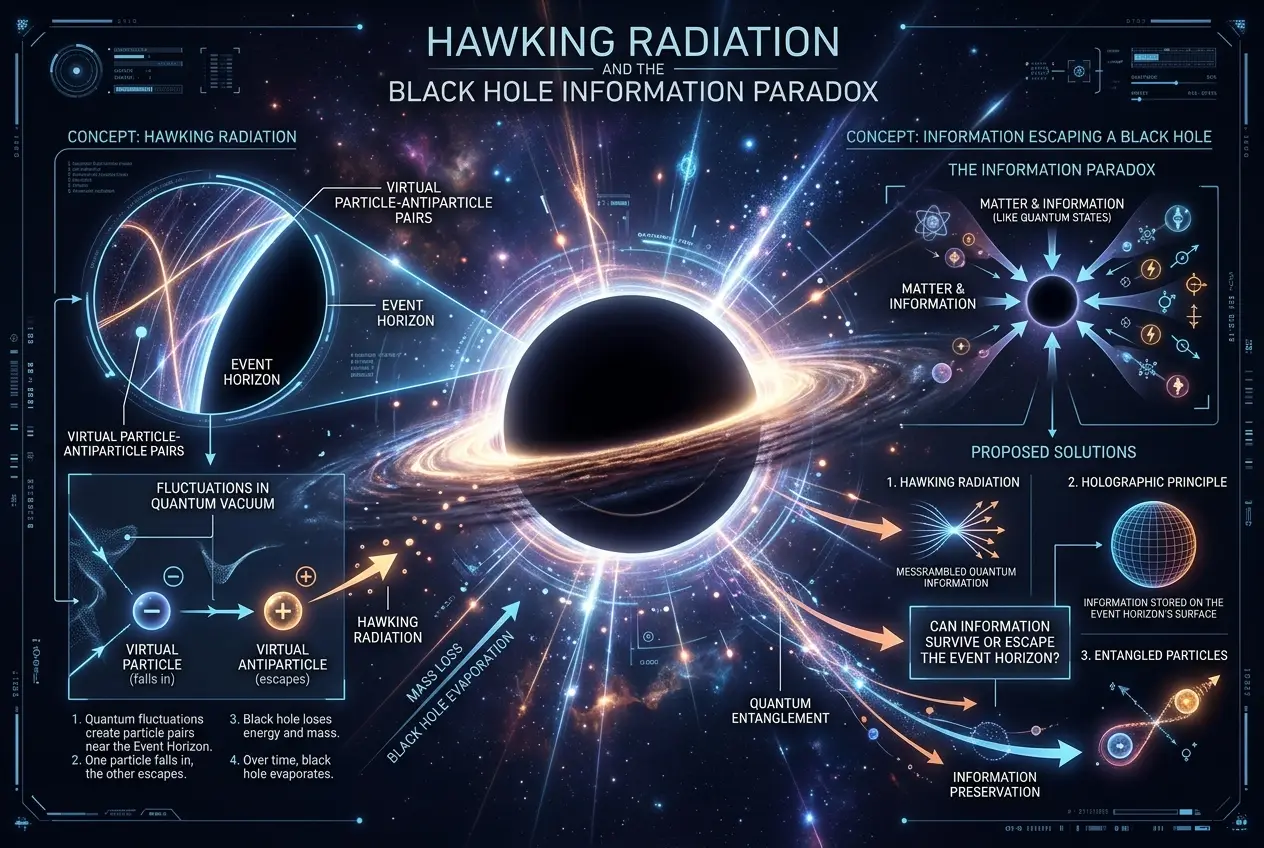
Enter Stephen Hawking, who, in the 1970s, introduced the concept of **Hawking Radiation**. He theorized that black holes aren't entirely black but emit a faint glow of particles due to quantum effects near the event horizon. This radiation causes black holes to slowly evaporate over extremely long periods. The critical question then becomes: what happens to the information of everything that fell into the black hole when it finally evaporates? Does the Hawking radiation carry the original information in some encoded form, or is it truly lost? This is where the idea of black holes as information processing units begins to emerge.
### Black Holes as Information Scramblers
One perspective, often called the "black hole firewall paradox," suggests that information is not lost but is incredibly difficult to retrieve. Black holes act like the ultimate "scramblers" of information. When matter falls in, its information isn't destroyed, but rather it's spread out and entangled across a vast number of particles near the event horizon, making it practically impossible to decode. This scrambling process is so efficient that it resembles the operations of a powerful quantum computer.
A quantum computer uses **qubits** instead of classical bits. While a classical bit can be either 0 or 1, a qubit can be 0, 1, or both simultaneously through a phenomenon called **superposition**. Furthermore, qubits can be **entangled**, meaning their fates are linked, no matter how far apart they are. This allows quantum computers to perform calculations exponentially faster than classical computers for certain problems. For more insights into how this revolutionizes computation, I find exploring concepts like quantum entanglement fascinating, as discussed in /blogs/how-does-quantum-entanglement-defy-space-time-5424.
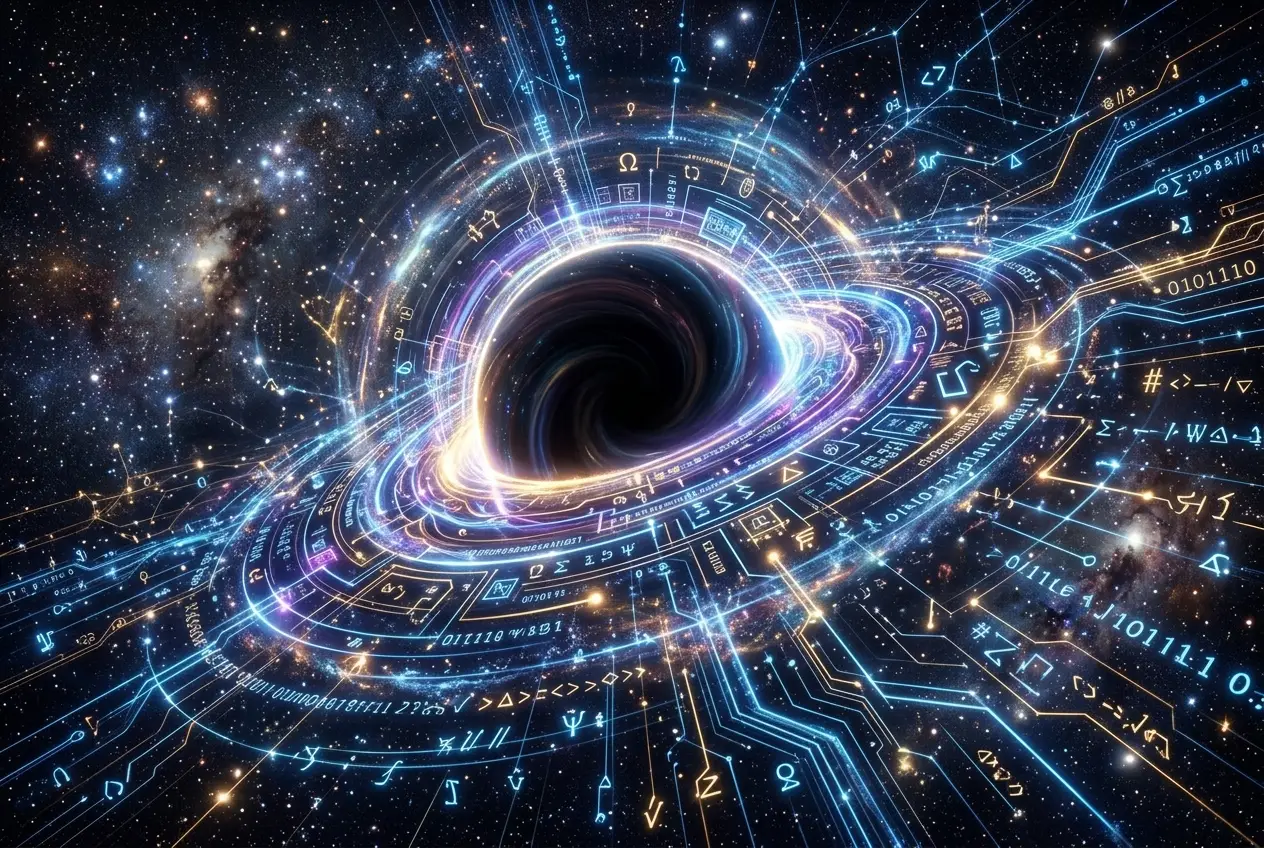
Now, consider a black hole. Its event horizon, the boundary of no return, is thought to be a region of intense quantum activity. The surface of a black hole effectively "stores" information about everything that has ever fallen into it. The sheer density of states and the complex interactions at the quantum level near the horizon make it a perfect candidate for a natural quantum information processor.
### Quantum Gravity and the Holographic Principle
The connection deepens when we consider theories like **quantum gravity** and the **holographic principle**. Quantum gravity attempts to reconcile general relativity (which describes gravity and large-scale structures like black holes) with quantum mechanics (which describes the very small). One of the most intriguing outcomes of this research is the **holographic principle**. This principle suggests that all the information contained within a volume of space can be encoded on its boundary, much like a 3D image is encoded on a 2D hologram.
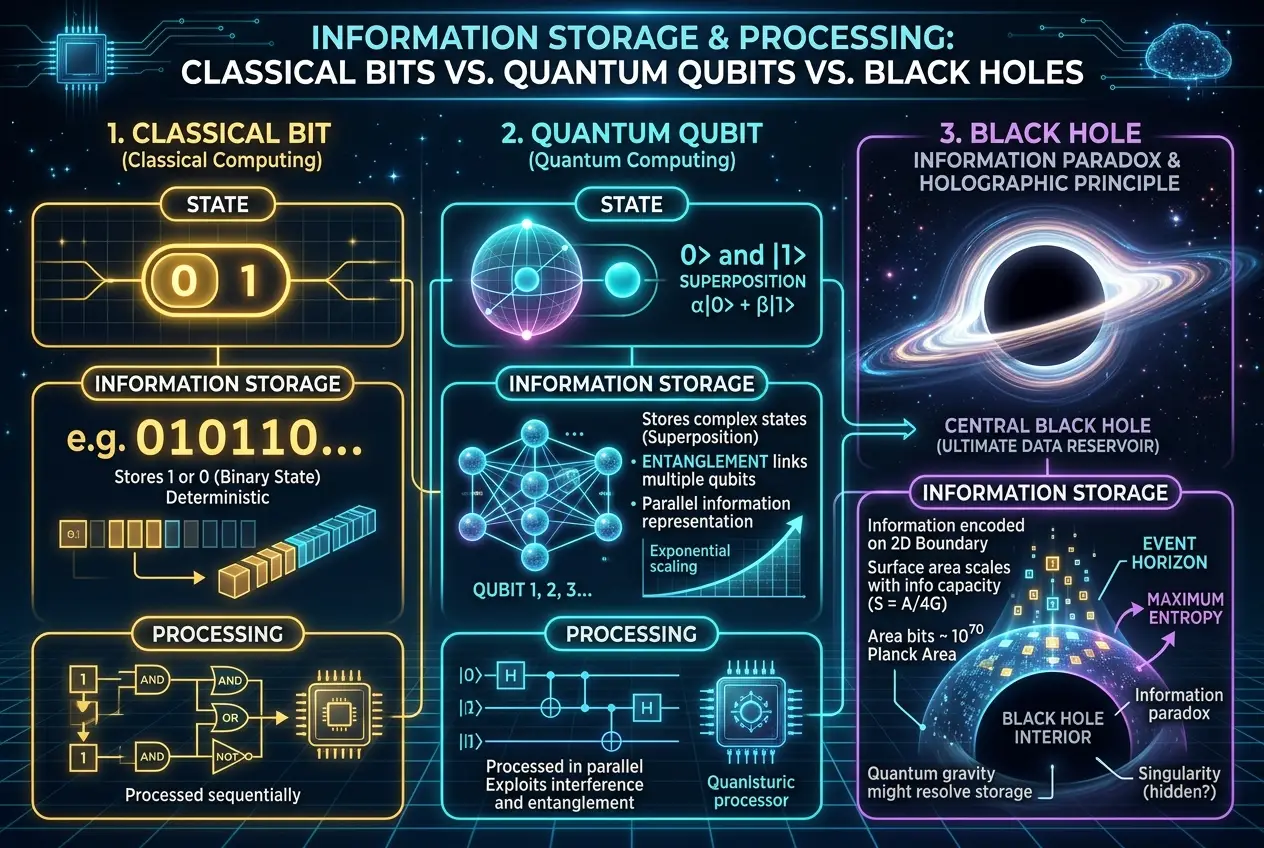
Applied to black holes, the holographic principle posits that all the information about the matter that forms a black hole is encoded on its event horizon, a 2D surface. This is a critical point. If the information is encoded on the surface, it isn't lost in the singularity. This vast amount of information, spread across a quantum-mechanical "surface," behaves precisely like the highly entangled information within a quantum computer. The complexity and capacity for information storage at the event horizon would far exceed any human-made supercomputer. According to some theories, the black hole itself could be performing complex computations on this information.
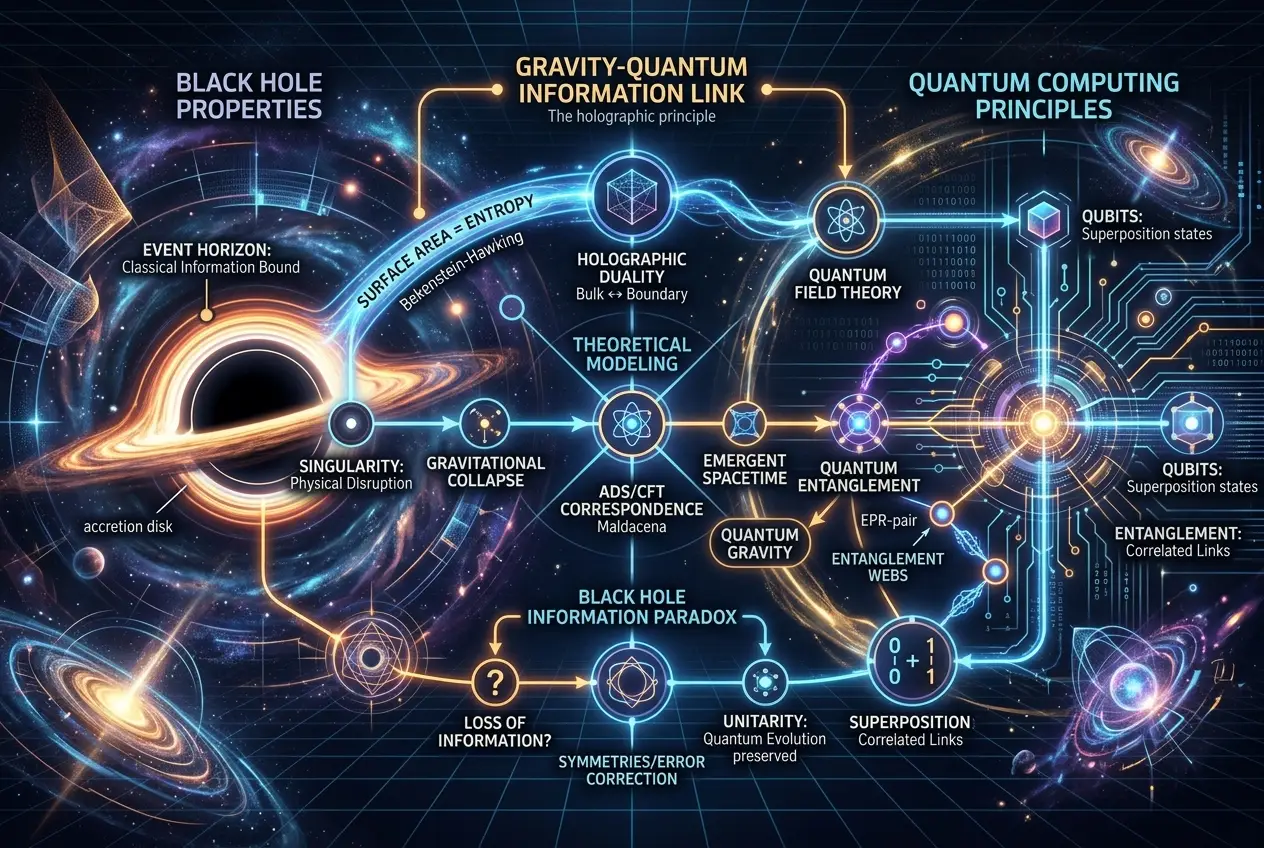
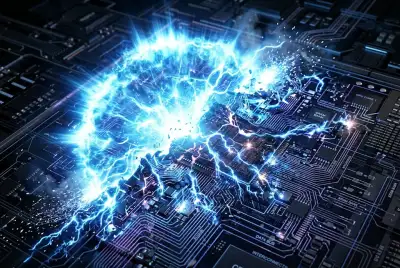
Some theoretical physicists even propose that the very fabric of spacetime near a black hole's event horizon acts as a quantum circuit board, processing information through quantum entanglement and superposition. This idea aligns with the concept that spacetime itself might be an emergent property of underlying quantum information, a notion explored in discussions about whether the universe could be a giant neural network, as explored in /blogs/is-the-universe-a-giant-neural-network-2907.
### Black Holes as Universal Simulators?
If black holes are indeed nature's ultimate quantum computers, what are they computing? The answer might lie in their ability to "scramble" information so perfectly. In quantum mechanics, a process known as "unitarity" requires that information is preserved. Black holes are believed to be "fast scramblers," meaning they process and redistribute incoming information across their degrees of freedom in the fastest possible time. This scrambling efficiency is a hallmark of quantum systems operating at fundamental limits.
"The maximum information capacity of a region of space is given by its boundary area, not its volume, implying that the universe is a hologram," states the **Wikipedia article on the Holographic Principle** [https://en.wikipedia.org/wiki/Holographic_principle]. This profound statement underpins much of the theoretical work linking black holes to information theory.
Consider the potential scale. A black hole's event horizon can store an astronomical amount of information, proportional to its surface area. This capacity far surpasses anything we can conceive of with current silicon-based technology. Could they be running simulations of cosmic events? Encoding the history of the universe? Or perhaps even acting as nodes in a grander cosmic computation?
### The Firewall Paradox and Entanglement
Further complexity arises with the **firewall paradox**. If an astronaut falls into a black hole, they would typically experience nothing unusual when crossing the event horizon, according to Einstein's general relativity. However, if information is indeed conserved and carried out by Hawking radiation, and the outgoing Hawking radiation is entangled with both the infalling matter and earlier outgoing radiation, this creates a contradiction known as the AMPS (Almheiri, Marolf, Polchinski, Sully) paradox. To resolve this, some theories suggest a "firewall" of high-energy particles at the event horizon that would instantly incinerate anything crossing it, implying a drastic breakdown of spacetime itself at this boundary.
This paradox forces us to confront the very nature of spacetime and information at extreme scales, pushing the boundaries of what we understand about the universe. It's a testament to how profoundly entwined the concepts of quantum mechanics, gravity, and information truly are, and why phenomena like black holes are central to solving these puzzles. For more on how quantum theory interacts with gravity, you might find /blogs/can-quantum-computers-break-gravitys-rules-9323 an interesting read.
### Implications for Our Understanding of Reality
The idea of black holes as quantum computers isn't just a theoretical curiosity; it has profound implications for our understanding of reality itself. If the universe's most destructive objects are also its most efficient information processors, it suggests a deeper, computational layer to the cosmos. It implies that information is not merely an abstract concept but a fundamental ingredient of the physical world.
This perspective could even provide clues to developing our own quantum computers. By studying the theoretical models of black hole information processing, physicists might uncover new algorithms or architectural insights that could accelerate the development of truly powerful quantum machines. We are still in the very early stages of quantum computing, but the universe itself might be offering the ultimate blueprint.
As I reflect on these profound connections, I realize that the boundaries between astrophysics, quantum mechanics, and information theory are becoming increasingly blurred. Black holes, once seen as cosmic voids, are transforming into potential cosmic libraries, calculators, and even the ultimate testing grounds for our most radical theories about space, time, and the nature of reality. It's a thrilling journey into the unknown, promising to redefine our place in a universe that might be far more computational than we ever imagined.
**Sources:**
* **Wikipedia on Black Hole Information Paradox:** [https://en.wikipedia.org/wiki/Black_hole_information_paradox]
* **Wikipedia on Hawking Radiation:** [https://en.wikipedia.org/wiki/Hawking_radiation]
* **Wikipedia on Quantum Gravity:** [https://en.wikipedia.org/wiki/Quantum_gravity]
### Conclusion
The question "Are Black Holes Nature's Ultimate Quantum Computers?" remains a subject of intense theoretical debate and ongoing research. While we can't build a black hole in a lab to test these hypotheses, the theoretical frameworks that emerge from this question are pushing the frontiers of physics. They are forcing us to reconsider the very nature of information, gravity, and quantum mechanics, suggesting a universe where even the most extreme phenomena are intimately tied to the fundamental laws of computation. It's a compelling vision, transforming cosmic destroyers into cosmic data centers, inviting us to look at the universe through a new, quantum-computational lens.
Frequently Asked Questions
It's the conflict between the classical idea that black holes destroy information and the quantum mechanical principle that information can never be truly lost, only transformed or scrambled. Scientists are trying to figure out how information might escape or be preserved as a black hole evaporates.
The Holographic Principle suggests that all information within a volume can be encoded on its 2D boundary. For black holes, this means all the information about what fell in might be stored on the event horizon, acting like a vast, quantum-information-rich surface.
Hawking Radiation is the theoretical emission of particles from black holes due to quantum effects near their event horizons, causing them to slowly evaporate. The mystery is whether this radiation carries out the information of what fell into the black hole, or if that information is lost.
These ideas are primarily theoretical and are subjects of active research in quantum gravity and black hole physics. They are frameworks used to understand complex phenomena and resolve paradoxes, but direct experimental verification remains a significant challenge due to the extreme conditions involved.
In a practical sense, harnessing a black hole for computing is far beyond our current technological capabilities and understanding. The concept is more about how the universe itself might be processing information at its most fundamental levels, offering theoretical insights rather than practical applications for human-built computers.
Verified Expert
Alex Rivers
A professional researcher since age twelve, I delve into mysteries and ignite curiosity by presenting an array of compelling possibilities. I will heighten your curiosity, but by the end, you will possess profound knowledge.
Leave a Reply
Comments (0)
No approved comments yet. Be the first to share your thoughts!
 Join Us

 Unknown Author












Leave a Reply
Comments (0)