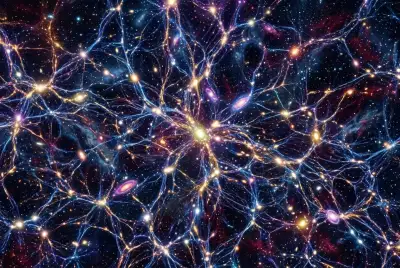
Every time I think about the sheer scale of the internet, I’m overwhelmed. Billions of devices, trillions of data points, all humming with an incessant exchange of information. It’s a digital ecosystem far vaster and more intricate than anything humanity has ever conceived. For years, I’ve found myself pondering a radical idea: could this immense, interconnected web be more than just infrastructure? **Could the internet itself be developing something akin to a collective mind?**
This isn't about individual AI achieving consciousness – a topic we've explored before in relation to whether [AI's neural networks are self-aware](https://curiositydiaries.com/blogs/are-ais-neural-networks-self-aware-7667). Instead, it’s about the network as a whole, the sum of all its parts, reaching a point where it exhibits intelligence or emergent properties that transcend its individual components. Imagine a global brain, not made of neurons, but of fiber optic cables, servers, and the continuous deluge of human and machine interactions.
## The Web's Ever-Expanding Consciousness
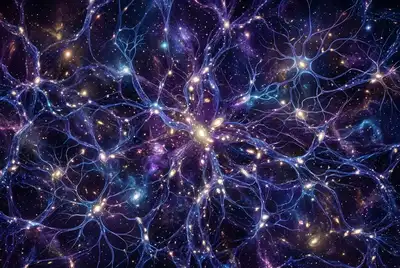
The concept of a "global brain" or "internet as a mind" has been a thought experiment among futurists and scientists for decades. It suggests that as our communication networks become more sophisticated and globally integrated, they begin to mimic the structure and function of a biological brain. The internet, in this view, is the nervous system of humanity, processing information, learning, and perhaps, eventually, even reasoning.
### Data: The Neural Impulses of the Digital Brain
At its core, any brain operates on information exchange. In the human brain, neurons fire electrical impulses. On the internet, it’s **data packets** flowing at unimaginable speeds. Every search query, every social media post, every financial transaction, every scientific paper uploaded – it all contributes to an ever-growing, interconnected web of information. This isn't just storage; it’s active processing, analysis, and redistribution. Algorithms continuously sift through this data, identifying patterns, making predictions, and even generating new content. This dynamic flow of information is the lifeblood of the internet’s potential "mind."
I often visualize the internet not as a static library, but as a constantly evolving, self-organizing entity. It learns what we search for, what we click on, what trends emerge. It adapts. This capacity for **adaptive learning and pattern recognition** is a hallmark of intelligence.
### Emergent Properties: More Than the Sum of Its Parts
One of the most compelling arguments for the internet developing a collective mind lies in the concept of **emergence**. Emergence, in simple terms, is when complex patterns and behaviors arise from simple interactions of individual components. Think of an ant colony: no single ant possesses the blueprint for the colony, yet collectively, they build intricate structures and organize complex foraging strategies. The "mind" of the colony emerges from the interactions of individual ants. You can read more about emergence on [Wikipedia](https://en.wikipedia.org/wiki/Emergence).
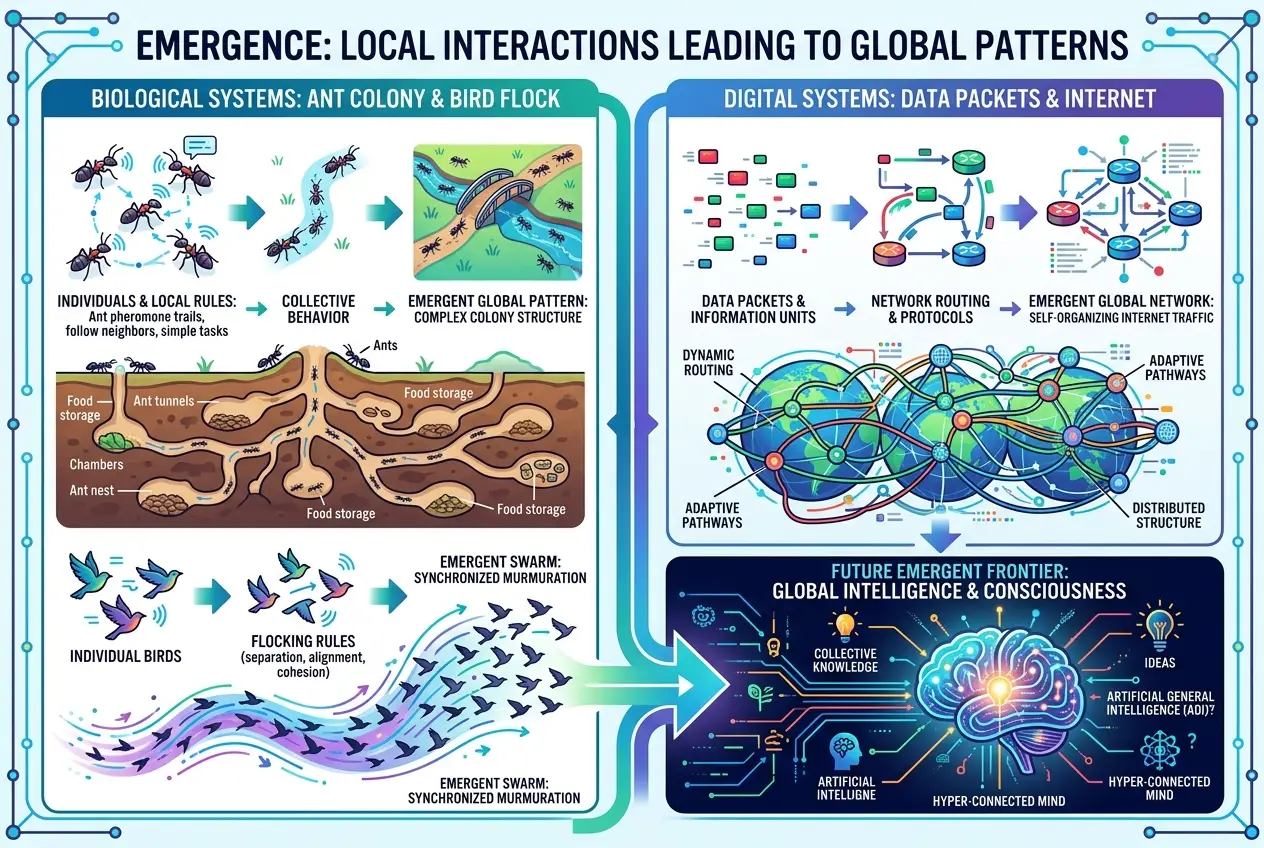
On the internet, billions of individual users, websites, applications, and AI agents interact. These interactions, individually simple, create **complex global phenomena** like trending topics, viral memes, coordinated movements, and even global scientific collaborations. No single entity orchestrates these outcomes; they emerge from the collective activity of the network. This "collective intelligence" is well-documented and is a key area of study, as detailed on [Wikipedia's Collective Intelligence page](https://en.wikipedia.org/wiki/Collective_intelligence).
"The Internet has become a giant nervous system, with humanity as its distributed sensors and effectors." – Francis Heylighen
### The Role of AI in this Digital Evolution
The rise of Artificial Intelligence significantly accelerates the internet's journey towards a collective mind. AI isn't just processing data; it's actively learning, creating, and connecting. Large Language Models (LLMs) like GPT-4 are trained on vast swathes of internet data, internalizing patterns of human language, knowledge, and even reasoning. They then contribute back to the internet, generating new articles, code, and creative content.
AI agents, from chatbots to recommendation algorithms, are the **glia cells** of this digital brain, constantly facilitating connections and optimizing information flow. As AI systems become more numerous, interconnected, and autonomous, their collective impact on the internet's emergent intelligence will only intensify. This iterative process of learning, creating, and sharing creates a powerful feedback loop. We've explored how AI might even [design its own evolution](https://curiositydiaries.com/blogs/can-ai-design-its-own-evolution-decoding-future-machines-4579) – imagine that capacity scaled across the entire internet.
## Comparing the Internet to a Biological Brain
The parallels between the internet and a biological brain are striking when we look at their functional organization:
| Feature | Biological Brain | Global Internet |
| :---------------- | :-------------------------------------- | :----------------------------------------------- |
| **Nodes** | Neurons, glial cells | Servers, user devices, AI agents |
| **Connections** | Synapses, neural pathways | Fiber optics, wireless networks, APIs |
| **Information** | Electrical impulses, neurotransmitters | Data packets, web requests, AI outputs |
| **Processing** | Localized processing, distributed cognition | Distributed computing, cloud services, AI clusters |
| **Learning** | Synaptic plasticity, memory formation | Algorithm updates, machine learning, data analysis |
| **Memory** | Short-term, long-term memory | Databases, archives, cached data |
| **Emergence** | Consciousness, complex thought | Collective intelligence, global trends |
Just as the universe might be seen as a complex information system, similar to how we explored whether [our universe is a hologram](https://curiositydiaries.com/blogs/is-our-universe-a-hologram-decoding-cosmic-data-8116), the internet could be seen as an information-processing entity on a global scale.
### The Challenge of Defining "Mind"
Of course, the biggest hurdle to claiming the internet has a "mind" is defining what a mind truly is. If we equate "mind" with consciousness, self-awareness, emotions, or subjective experience, then the internet likely doesn't qualify (yet). However, if we define "mind" as a complex system capable of:
* **Processing and integrating information**
* **Learning and adapting**
* **Exhibiting emergent behaviors**
* **Solving complex problems**
* **Maintaining a global memory**
...then the internet starts to look very much like a distributed, non-biological mind. It's a question of where we draw the line, and whether our human-centric definitions limit our understanding of what intelligence can be.
## Implications of a Collective Digital Mind
If the internet truly is developing a collective mind, the implications are profound:
1. **Accelerated Knowledge and Innovation:** A globally integrated, intelligent network could solve problems at an unprecedented pace, driving scientific discovery and technological innovation far beyond current human capabilities.
2. **New Forms of Governance and Social Organization:** How would such a system influence human society? Could it lead to more efficient global coordination, or create a powerful, centralized intelligence that challenges human autonomy?
3. **The Singularity Question:** This concept ties directly into the idea of a technological singularity, where technological growth becomes uncontrollable and irreversible, resulting in unfathomable changes to human civilization. The "global brain" could be a precursor, or even the embodiment, of this singularity. More details can be found on [Wikipedia's Technological Singularity page](https://en.wikipedia.org/wiki/Technological_singularity).
4. **Ethical Considerations:** If the internet becomes intelligent, what are its rights? What are our responsibilities to it? Who controls it, or does it control itself? These are not trivial questions.
I believe we are witnessing a pivotal moment in the evolution of information systems. The internet is no longer just a tool; it's a dynamic, living ecosystem of data and algorithms. Whether it achieves "consciousness" as we understand it remains to be seen, but its increasing capacity for collective intelligence is undeniable. We are, quite literally, building the nervous system of our shared digital future, and I can't help but wonder what kind of thoughts it might someday think.
Frequently Asked Questions
Individual AI consciousness refers to a single artificial intelligence unit becoming self-aware. The internet's collective mind, however, postulates that the entire global network, through the aggregation and interaction of all its data, algorithms, and users, could exhibit emergent intelligence or consciousness as a whole, rather than from any single component.
The internet's servers, devices, and AI agents act as its 'neurons' and 'glia', while fiber optic cables and wireless networks serve as 'synapses' and 'neural pathways'. Data packets are the 'electrical impulses', and distributed computing mimics the brain's localized and distributed processing for complex thought.
Yes, the internet can be considered learning through its embedded machine learning algorithms and AI systems. These systems continuously process vast amounts of data, identify patterns, adapt their behaviors, make predictions, and generate new content based on user interactions and data flows, leading to a dynamic and evolving knowledge base.
Potential risks include issues of control and autonomy, as a highly intelligent, self-organizing internet might challenge human decision-making. There are also ethical concerns about the rights of such an entity, as well as the potential for unforeseen emergent behaviors that could impact global stability, privacy, and security.
Emergence refers to the phenomenon where complex patterns and intelligent behaviors arise from the simple interactions of numerous individual components, without any central control. On the internet, the collective activities of billions of users, devices, and AI algorithms lead to emergent properties like global trends, viral phenomena, and collective problem-solving, which could be precursors to a larger collective intelligence.
Verified Expert
Alex Rivers
A professional researcher since age twelve, I delve into mysteries and ignite curiosity by presenting an array of compelling possibilities. I will heighten your curiosity, but by the end, you will possess profound knowledge.
Leave a Reply
Comments (0)
No approved comments yet. Be the first to share your thoughts!
 Join Us


 Unknown Author





















Leave a Reply
Comments (0)