


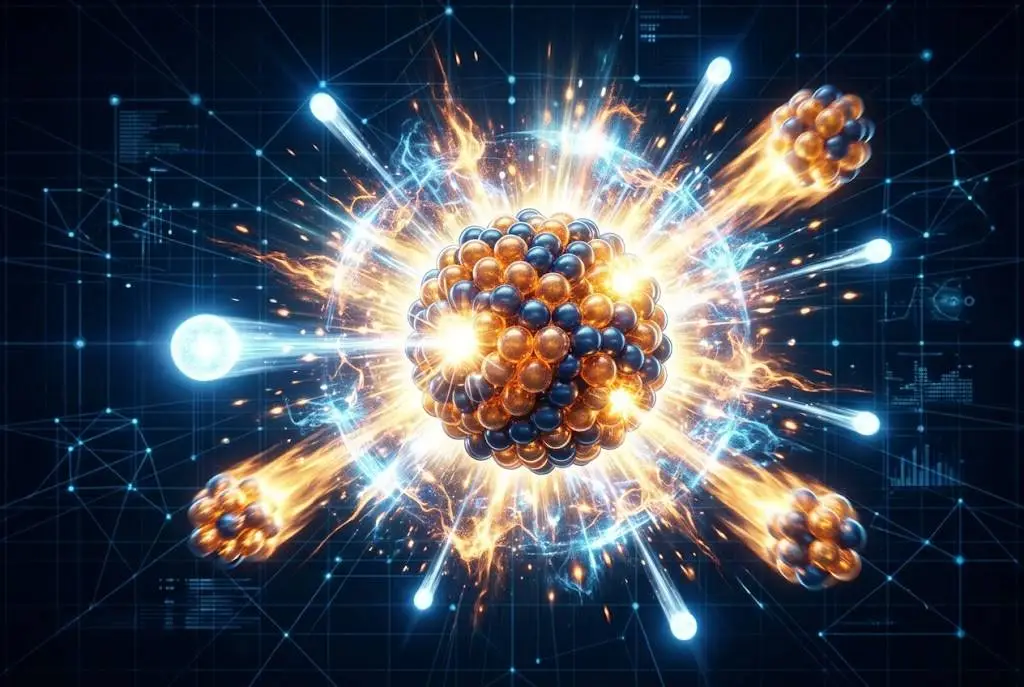
I was looking at a high-resolution replica of a nuclear core casing recently, and it struck me just how surprisingly compact these devices actually are. From the outside, early atomic weapons looked like little more than oversized steel teardrops. Yet inside those metal shells lay a mechanism capable of releasing the destructive power of tens of thousands of tons of TNT in less than a microsecond.
We often hear about the historical impact of nuclear weapons, but how do they actually function on a physical level? How does manipulating subatomic particles—things so small they can't be seen under a regular microscope—create a force capable of leveling an entire city?
The answer lies in a delicate dance of high-speed subatomic physics, precision engineering, and the famous equation that redefined our understanding of mass and energy.
The Core Principle: Splitting the Atom
At the heart of every atomic bomb is a process called nuclear fission (opens in a new tab). Fission occurs when the nucleus of a heavy, unstable atom is hit by a free neutron. Instead of absorbing the neutron peacefully, the heavy nucleus violently splits into two smaller fragments, releasing a massive burst of energy alongside two or three extra neutrons.
[Free Neutron] ---> (Unstable Heavy Nucleus)
                           │
                           ├──> (Smaller Fragment A) + Energy
                           ├──> (Smaller Fragment B) + Energy
                           └──> [2 to 3 Free Neutrons]
These newly freed neutrons don't just disappear into space. If there are enough heavy atoms packed tightly around them, those extra neutrons slam into neighboring nuclei, causing them to split as well. This creates a self-sustaining exponential chain reaction.
Within a fraction of a millisecond, trillions upon trillions of atoms split simultaneously. According to Albert Einstein’s formula, , a tiny fraction of the lost physical mass transforms directly into pure kinetic and thermal energy.
The Critical Mass Threshold
You can't just pile nuclear material together and expect an instant explosion. In a small piece of nuclear material, most neutrons escape through the outer surface before hitting another atom. The reaction simply fizzles out.
To create a nuclear explosion, weapons designers must achieve critical mass—the minimum amount of fissile material needed to sustain a continuous nuclear reaction. To make a bomb, however, you need to go even further and achieve supercritical mass, where the reaction escalates at a dizzying, catastrophic rate.
The two primary isotopes used to achieve this are:
- Uranium-235 (): A rare natural isotope of uranium that easily undergoes fission when struck by slow or fast neutrons.
- Plutonium-239 (): A synthetic element manufactured inside nuclear reactors that is exceptionally eager to split.
How the Bomb Triggers: Two Unique Designs
To prevent a bomb from exploding prematurely, the fissile material is kept in a "subcritical" state during storage. When it is time to detonate, the bomb must rapidly combine or compress this material into a supercritical mass before the reaction can blow itself apart.
Historically, weapon designers used two primary mechanical approaches developed during the Manhattan Project (opens in a new tab).
1. The Gun-Type Mechanism
The gun-type design is deceptively simple. Inside a long steel barrel, two separate pieces of enriched uranium (opens in a new tab) are kept apart. Each piece is subcritical on its own.
When the trigger fires, conventional explosives shoot one piece of uranium down the barrel at high speed directly into the second piece. Upon impact, the two halves form a single supercritical mass. A neutron emitter fires at the exact millisecond of impact, initiating the cascade.
| Component | Function in Gun-Type Assembly |
|---|---|
| Conventional Explosive | Drives the bullet-like uranium wedge down the barrel |
| Uranium Target Piece | Receives the incoming uranium plug to reach supercriticality |
| Neutron Initiator | Floods the combined core with initial neutrons to start fission |
This design was used in the "Little Boy" bomb. While reliable, it is inefficient because it requires a large amount of rare Uranium-235.
2. The Implosion Mechanism
Plutonium-239 reacts far too fast for a gun-type barrel; it would blow itself apart before the two halves fully merged, resulting in a low-yield "fizzle." To solve this, scientists created the implosion design.
Instead of firing two pieces together, a solid sphere of plutonium sits at the center of the bomb. Surrounding this core are carefully shaped high-explosive charges called explosive lenses. When detonated simultaneously, these explosives create a inward-focused shockwave.
This violent compression crushes the solid plutonium sphere down to a fraction of its original volume. By packing the atoms much closer together, the density increases dramatically, driving the mass straight into a supercritical state in a few microseconds.
Real-Life Connection: Why Don't Nuclear Reactors Explode Like Bombs?
A question I often see asked is: If nuclear power plants use uranium, why don't they explode like atomic bombs during an accident?
The secret comes down to concentration and physics:
- Bomb-Grade Fuel: Weapons require fuel enriched to around 90% Uranium-235 to sustain an uncontrolled, ultra-fast chain reaction.
- Reactor-Grade Fuel: Commercial nuclear power plants use uranium enriched to only 3% to 5% Uranium-235.
Because the vast majority of fuel in a reactor is non-fissile Uranium-238, it absorbs excess neutrons without splitting. Even during a serious meltdown, reactor fuel physically cannot sustain the explosive runaway reaction of an atomic bomb. While nuclear plants handle power generation through controlled reactions—much like how clean energy concepts explore plasma stream generation—they lack the density required for a nuclear blast.
Understanding atomic physics also reveals fascinating insights into natural systems. For instance, the intense nuclear decay heating deep inside our planet is what fuels Earth's core, demonstrating how radioactive material generates tremendous heat even without human intervention. Scientists have even investigated whether micro-scale reactions could be safely isolated, as discussed in our deep-dive into lab-grown black hole physics.
The Sequence of an Atomic Blast
Once supercriticality is achieved, the energy release happens in distinct, rapid stages:
- Thermal Radiation: A blinding flash of light releases extreme radiant heat, capable of causing thermal burns miles away within fractions of a second.
- Blast Wave: Superheated air expands outward faster than the speed of sound, creating a high-pressure air wall that crushes structures.
- Ionizing Radiation: Immediate gamma rays and neutron bursts radiate outward, damaging biological tissues.
- Residual Radioactive Fallout: Irradiated debris drawn into the mushroom cloud cools, condenses, and falls back to Earth as toxic radioactive dust.
Understanding the physics behind these weapons doesn't just demystify historical technology—it highlights why global safeguards surrounding enriched materials remain so vital today.



Conversation0
No comments yet. Be the first to share a thought — the best questions often become new stories.