


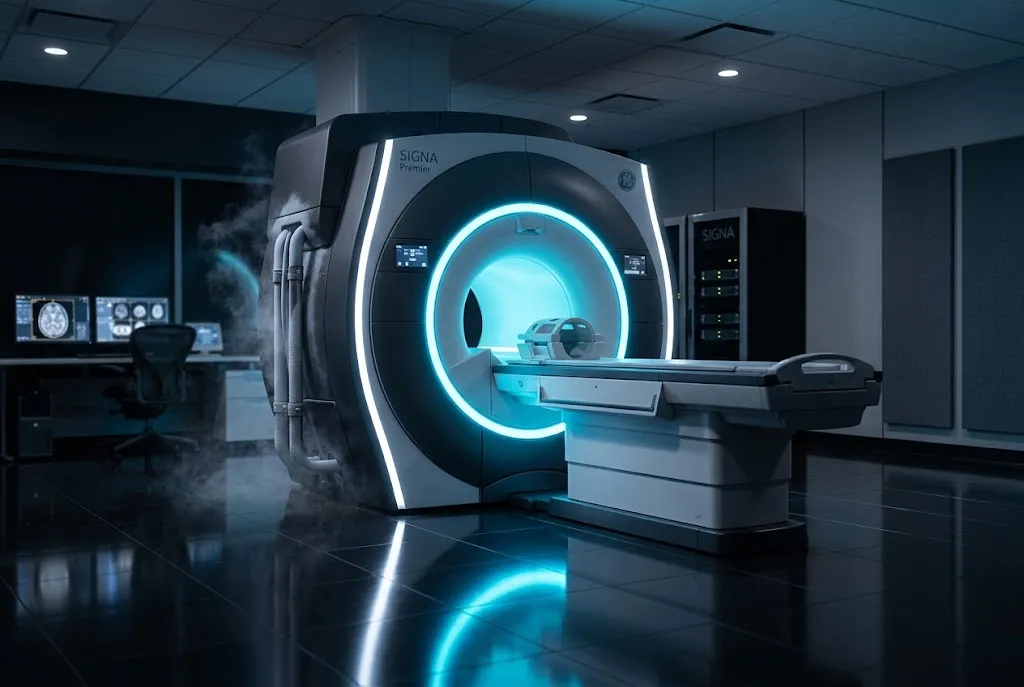
I watched a medical patient slide smoothly into a gleaming white tube that immediately began clanking like a pneumatic drill on concrete. Twenty minutes later, the radiologist pulled up a cross-sectional map of the brain so detailed you could trace individual nerve bundles. Yet, despite producing clearer soft-tissue images than any medical scan on Earth, the patient received zero millirems of radiation.
If you have ever had an X-ray or a CT scan, you know the routine: the technologist steps behind a lead-lined wall before blasting high-energy X-ray photons through your body. Dense bone blocks the beam, casting a shadow on the film, while soft tissue lets the radiation pass right through. But an MRI scanner works on a completely different physical principle—one that bypasses ionizing radiation altogether.
The Secret Lies in the Water Inside You
To understand how an MRI sees through flesh without burning it with radiation, I had to look at what human tissue is actually made of. About 60% of your body is water (), which means your organs, muscles, blood vessels, and brain are packed with hydrogen atoms.
At the center of every single hydrogen atom sits a single proton. In quantum mechanics, protons possess an intrinsic property called spin. You can imagine each hydrogen proton as a microscopic spinning compass needle. Under normal conditions, trillions of these atomic needles float around inside your cells, pointing in completely random directions—up, down, sideways, and diagonal—canceling each other out.
When a physician orders a Magnetic Resonance Imaging (opens in a new tab) scan, the machine does not shoot anything into you to capture an image. Instead, it coaxes those trillions of hydrogen compasses to broadcast their own subtle radio signals.
This is why an MRI can map your brain, ligaments, or liver with astonishing detail while revealing virtually nothing about your dense bones—water concentration is where the signal comes from.
STEP 1: Forcing Trillions of Protons to Attention
The moment you step inside an MRI scanner room, you are walking into one of the most powerful magnetic environments on the planet. The core component of the scanner is a massive main magnet that generates a field usually rated between 1.5 and 3.0 Tesla. To put that in perspective, a 3-Tesla magnet is roughly 60,000 times stronger than Earth's magnetic field.
To achieve field strengths that massive without melting the electrical wiring, engineers use superconducting magnets (opens in a new tab) bathed in liquid helium at a bone-chilling -269°C (-452°F). At near absolute zero, electrical resistance drops to absolute zero, allowing hundreds of amperes of current to flow continuously without generating heat.
When you lie down inside the bore, the giant magnetic field () grabs those trillions of randomly pointing hydrogen protons inside your body and forces them to align along its axis. About half point toward your head and half point toward your feet, creating a uniform microscopic equilibrium across your tissue.
STEP 2: Knocking Atoms Off Balance with Radio Waves
Once the hydrogen protons are aligned, the scanner turns on its second system: radiofrequency (RF) coils. These coils blast a short burst of electromagnetic radio waves directly at the body part being imaged.
This is where the "resonance" in magnetic resonance imaging comes into play. The radio waves are tuned to match the exact natural frequency at which hydrogen protons wobble in a magnetic field—a precise calculation known as the Larmor frequency.
When the RF pulse hits the aligned hydrogen protons at their resonance frequency, the protons absorb that energy and tip over on their sides, spinning wildly out of alignment.
Unlike the high-frequency ionizing radiation of X-rays, RF waves sit on the same safe, low-frequency spectrum as FM radio stations. Unlike ionization tech explained in our look at how smoke detectors sense fire without dangerous radiation, magnetic resonance relies strictly on non-ionizing RF energy that cannot knock electrons out of human DNA.
As pioneer Paul Lauterbur once described the breakthrough in nuclear magnetic resonance (opens in a new tab): "You can ask the nuclei where they are, and if you listen carefully, they will tell you in their own radio language."
STEP 3: Listening to the Atomic Echo
The instant the scanner shuts off the radio wave pulse, the tipped-over hydrogen protons begin relaxing back to their original alignment with the main magnet. As they snap back into place, they shed the energy they just absorbed, releasing tiny micro-pulses of radio signals back into the room.
This radio echo is picked up by sensitive antenna coils placed around your body. And here is the brilliant part: hydrogen protons in different types of tissue relax at completely different speeds.
- Fat tissue: Protons shed energy quickly because carbon molecules suck up the motion.
- Pure water or spinal fluid: Protons relax slowly, releasing their radio echo over a longer duration.
- Diseased or inflamed tissue: Contains excess fluid, altering its relaxation signature compared to healthy surrounding muscle.
By measuring how fast the radio echo decays across thousands of tiny points, the scanner's computer calculates the precise water concentration and chemical environment of every cubic millimeter of your body.
Why Does an MRI Make Such a Deafening Noise?
If the machine uses smooth magnetic fields and invisible radio waves, where does that terrifying jackhammer sound come from?
To map where a signal originates in 3D space, the scanner uses a third set of magnets called gradient coils. These smaller electromagnetic coils switch on and off rapidly to slightly alter the main magnetic field across your body's X, Y, and Z axes. Just as thermal cameras isolate infrared wavelengths to map heat, MRI gradient coils isolate spatial coordinates to construct a 3D pixel grid.
When massive pulses of electricity surge through the gradient coils inside a intense magnetic field, the coils experience immense mechanical forces called Lorentz forces. The physical coils flex and vibrate against their mountings thousands of times per second, creating the signature 110-decibel clanking sound.
Comparing Medical Imaging Technologies
To see how MRI stands apart from traditional radiation-based diagnostics, it helps to compare the three core hospital imaging modalities side by side:
| Imaging Modality | Primary Energy Source | Ionizing Radiation? | Primary Diagnostic Use |
|---|---|---|---|
| X-Ray | High-energy photons | Yes (~0.1 mSv) | Dense bone fractures, dental checks, chest screening |
| CT Scan | 360-degree rotating X-ray beam | Yes (~2 to 10 mSv) | Complex bone trauma, acute internal bleeding, organ damage |
| MRI | Magnetic fields & RF pulses | No (0 mSv) | Brain, spinal cord, torn ligaments, soft tissue tumors |
The Ultimate Trade-Off: Safety vs. Speed
If MRI provides stunning soft-tissue clarity with zero radiation risk, why don't doctors use it for every medical evaluation?
First, time is a critical factor. A CT scan takes less than 30 seconds, making it ideal for trauma patients in emergency rooms. An MRI scan can take anywhere from 20 to 60 minutes, during which the patient must remain completely motionless.
Second, the extreme 3-Tesla magnetic field creates strict safety constraints. Any ferromagnetic metal—such as steel paperclips, oxygen tanks, or older pacemakers—will be violently dragged toward the magnet bore at lethal speeds.
Yet, by harnessing quantum proton spins, superconducting refrigeration, and radio echo listening, magnetic resonance imaging remains one of the greatest feats in modern physics—giving medicine a window deep inside human flesh without ever disturbing a single strand of DNA.


Conversation0
No comments yet. Be the first to share a thought — the best questions often become new stories.