


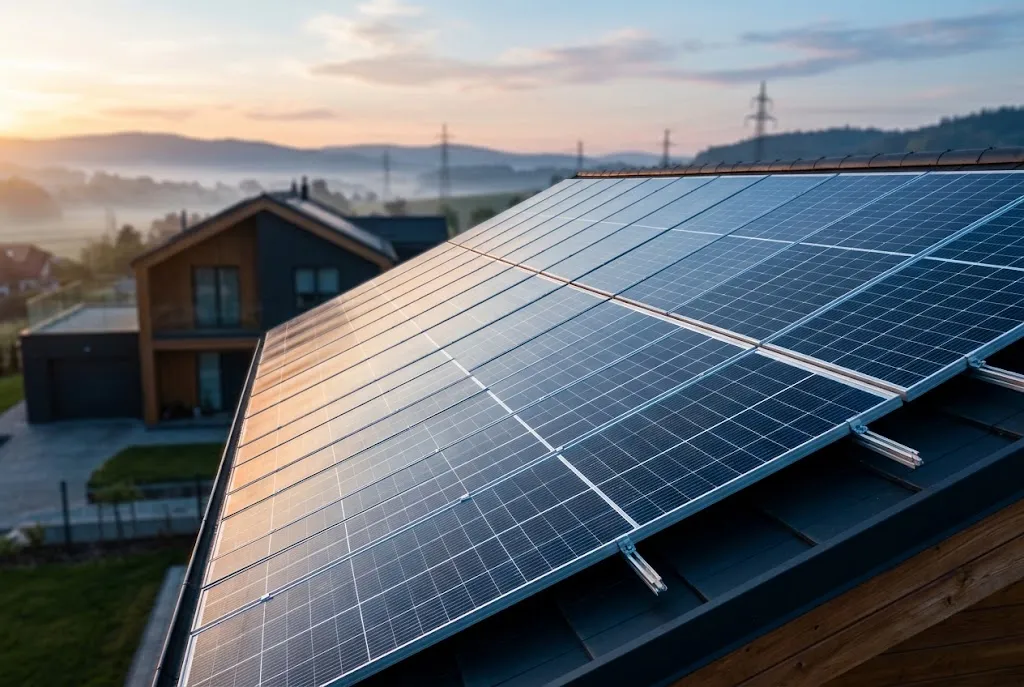
The Strange Part: Sunlight Becomes Usable Electricity
How do solar panels work? The basic idea sounds almost too simple: sunlight hits a panel, and electricity comes out. But when I look closely at what is happening inside a photovoltaic cell, the trick becomes much more interesting. The panel is not storing sunlight, and it is not simply heating something until a generator spins. It is using the energy carried by light to push electrical charges through a circuit.
That process is called the photovoltaic effect. It was observed in the 19th century, but modern solar panels rely on semiconductor materials and manufacturing techniques that can produce useful electrical power at enormous scale.
When I first think of sunlight as a collection of tiny packets of energy called photons, the whole system becomes easier to picture. A photon reaches the solar cell, transfers energy to the material, and can help free an electron into a state where that electron can contribute to electric current.
The clever part is that the cell is built so those charges do not simply wander around and cancel each other out. Its internal structure creates a preferred direction for their movement.
What a Solar Cell Is Actually Made Of
Most conventional photovoltaic panels use silicon solar cells. Silicon is a semiconductor, which means it does not behave like a perfect conductor such as copper, but it can be engineered to control how electrical charges move.
A typical solar cell contains silicon layers treated in different ways. One side has an excess of electrons, while another is arranged to have what physicists describe as holes, which act like positive charge carriers. Where those regions meet, a built-in electric field develops.
That boundary is often called a p-n junction. I do not need to picture it as an invisible wall. It is better to think of it as an electrical landscape inside the material that helps separate the charges created when light is absorbed.
This separation is crucial. Without it, the newly energized charges could simply recombine and much of the useful energy would be lost as heat or other forms of energy.
The same broad idea of using waves or electromagnetic radiation to produce a measurable signal appears in other technologies too. For example, the way fiber optics carry information with light (opens in a new tab) shows how carefully engineered materials can turn the behavior of light into something technologically useful.
The Moment Sunlight Hits the Silicon
Now I can follow one photon into the cell.
Sunlight arrives carrying photons with a range of energies. When a suitable photon is absorbed by the silicon, it can transfer enough energy to an electron to move it into a higher-energy state where it can participate in electrical conduction.
The cell's internal electric field then helps separate the resulting charges. Electrons are directed toward one side, while the corresponding positive charge carriers move in the opposite direction inside the semiconductor.
That creates a difference in electrical potential. Connect the cell to an external circuit, and electrons can travel through that circuit to do useful work before returning to the cell.
This is why a solar panel can power something as ordinary as a household light without needing a spinning turbine inside the panel itself. The electric current begins with charge separation inside the semiconductor, driven by incoming light.
It also explains an everyday effect you may have noticed: a panel can produce more power under strong sunlight than under thick clouds. Clouds do not usually reduce solar energy to zero, but they scatter and weaken the incoming light, so the cells receive less usable energy.
Why Dark Panels Get Hot
There is another important detail. Not every photon striking a solar cell turns into electrical output. Some light may not have the right energy to produce the desired electronic transition, while some absorbed energy ultimately ends up as heat.
That is one reason solar panels become warm in sunshine even while generating electricity.
And heat itself matters. For common silicon photovoltaic cells, rising temperature generally reduces the voltage produced by the cell. So the brightest, hottest day is not automatically the day when a panel reaches its highest electrical power.
![Solar cell charge separation diagram]
From One Solar Cell to a Rooftop Panel
A single silicon cell does not produce enough voltage for most practical applications, so manufacturers connect many cells together. Those cells are assembled into a module, commonly called a solar panel.
Inside the panel, fine metal contacts collect the electrical current from the cells. Protective layers shield the fragile semiconductor from moisture and mechanical damage, while glass on the front lets sunlight in and provides a durable outer surface.
The cells can be wired in series to increase voltage, and groups of cells and modules can be combined into larger arrays to increase the total electrical output.
This modular design is one of the reasons solar power scales so well. A calculator might need a tiny photovoltaic cell. A house might use several panels. A utility-scale solar farm can contain thousands or even millions of individual cells working together.
The important distinction is that a panel produces direct current, or DC. Most homes and the wider electrical grid use alternating current, or AC.
That means another piece of technology has to sit between the panel and the appliances.
The Inverter Is the Unsung Hero
The device that handles this job is the inverter. It converts the panel's DC electricity into AC electricity and manages the electrical characteristics needed for the system it is connected to.
Modern inverters do much more than perform a simple conversion. They can track the operating point of the panels, monitor electrical conditions, provide safety controls, and coordinate with batteries or the electrical grid depending on the system design.
This is also why a rooftop solar installation is more than a collection of shiny rectangles. The practical system includes panels, wiring, protection equipment, an inverter, and often monitoring hardware.
I can think of the whole process as a chain:
Sunlight → photovoltaic cell → DC electricity → inverter → AC electricity → home or grid
That chain makes the technology much less mysterious. Each stage solves a different engineering problem.
The same principle matters when solar generation is connected to a larger electrical network, where supply and demand must remain balanced. Understanding how those networks handle changing power sources helps explain why smart grids can reduce the impact of power disruptions.
Why Panels Do Not Produce the Same Power All Day
A panel's output is constantly changing because the light reaching it is constantly changing.
The sun's angle matters. The atmosphere matters. Clouds matter. Dust and dirt matter. Shading from trees, chimneys, or nearby buildings matters. Even the angle at which sunlight strikes the panel changes how effectively the cells receive that light.
Engineers describe panel performance using measurements such as voltage, current, and maximum power point. The maximum power point is the combination of voltage and current at which the panel can deliver its highest power under particular conditions.
An inverter can continually adjust how it interacts with the panel so the system operates near that useful point.
This is why the real-life performance of a rooftop installation can differ from the headline number printed on a panel's specification sheet. A module rated at a certain power level is being tested under defined laboratory conditions, not under every possible combination of temperature, angle, dust, clouds, and shading.
This is why two houses with the same number of solar panels can produce noticeably different amounts of electricity over a year. Their roofs may face different directions, receive different amounts of shade, or experience different local conditions.
What Happens to the Electricity After That?
Once the inverter produces AC electricity, the system has choices.
In a grid-connected home, the electricity can be used immediately by appliances. If the solar system is producing more power than the house needs at that moment, the extra energy can potentially be sent to the electrical grid, depending on the local system and connection rules.
Some systems also include batteries. In that case, excess electricity can be used to charge the battery, which stores energy chemically for later use.
This changes the role of solar from being a daytime-only source into part of a broader energy system. The battery does not make more electricity; it changes when the electricity can be used.
There is also an important limitation: solar cells cannot capture all the energy in sunlight. Material properties, reflection, heat, electrical resistance, and unavoidable physical losses all reduce the amount of incoming solar energy that becomes useful electricity.
That is why engineers care so much about efficiency improvements. A few percentage points can matter enormously when multiplied across huge solar installations.
The Real Magic Is the Engineering, Not the Mystery
When I strip away the futuristic look of a solar farm, the core mechanism is surprisingly elegant. Light arrives as photons. The semiconductor absorbs part of that energy. Charges are separated inside the photovoltaic cell. Those charges create current, and an inverter makes that electricity practical for the devices and networks around us.
There is no hidden battery inside the panel waiting for sunshine to fill it. There is no miniature generator spinning silently under the glass. The panel is directly converting part of the energy carried by light into electrical energy.
That is what makes the technology so fascinating: a sheet of semiconductor material can turn photons arriving from the Sun into a controlled flow of electrons in an ordinary wire.
The next time I see a rooftop covered in dark glass, I can look at it differently. It is not merely collecting sunlight. It is running a carefully engineered chain of physics and electronics every second the light is strong enough to drive it.
Why Efficiency Is Harder Than It Sounds
It is tempting to ask a simple question: if sunlight contains so much energy, why not convert all of it into electricity?
The answer is that a solar cell has to work within the rules of its material. Silicon interacts strongly with some photon energies and less effectively with others. Some incoming light is reflected, some energy becomes heat, and some of the electrical energy is lost through resistance and recombination.
That is why solar-cell research focuses on material quality, surface coatings, cell architecture, and ways to capture more of the sunlight that arrives.
One well-known strategy is the use of anti-reflective coatings, which reduce the amount of light bouncing away from the cell's surface. Another is improving the electrical pathways inside the cell so that charges can reach the contacts with fewer losses.
Researchers also build cells from multiple semiconductor materials in some advanced designs. Different materials can be tuned to absorb different parts of the solar spectrum, potentially capturing more of the incoming energy than a single-junction silicon cell can.
Why a Solar Panel Can Still Work on a Cloudy Day
A cloudy sky changes the light, but it does not normally erase it. Sunlight is scattered through the atmosphere and clouds, so photovoltaic cells can still receive diffuse light from a broad portion of the sky.
Output usually falls because the total usable irradiance is lower. The exact drop depends on cloud thickness, cloud type, the panel orientation, and local conditions.
This is another useful reminder that photovoltaic systems respond to light intensity and spectrum, not simply to whether the sky looks blue.
![Solar panel system energy-flow diagram]
The Bigger Picture: From Roof to Power Grid
Once millions of solar modules are operating, the engineering problem becomes larger than the individual panel.
Solar generation varies with time of day and weather, while electricity demand also changes throughout the day. Grid operators therefore have to manage multiple generation sources, transmission networks, storage systems, and changing loads at the same time.
That does not make solar electricity unpredictable in a mysterious sense. It means the power system has to account for a source whose output depends on sunlight.
Forecasting, batteries, flexible generation, transmission upgrades, and smarter control systems can all help manage those changes.
At the household level, I might notice none of that. I turn on a fan, charge a laptop, or switch on a light, and the electricity simply arrives. Behind that ordinary experience is a chain that may begin millions of kilometers away when photons leave the Sun.
The Takeaway
The real surprise of solar panels is not that they can collect sunlight. It is that engineers found a practical way to turn the energy of individual photons into an organized electric current using semiconductor physics.
Once I understand that sequence, the panel stops looking like a black box. It becomes a machine with a very specific job: absorb useful light, separate charge, move electrons through a circuit, and hand that electrical energy to the electronics and grid around it.
A rooftop panel is therefore doing something deeply physical and wonderfully direct. It is taking energy that arrived as light and giving it another form you can use.


Conversation0
No comments yet. Be the first to share a thought — the best questions often become new stories.