


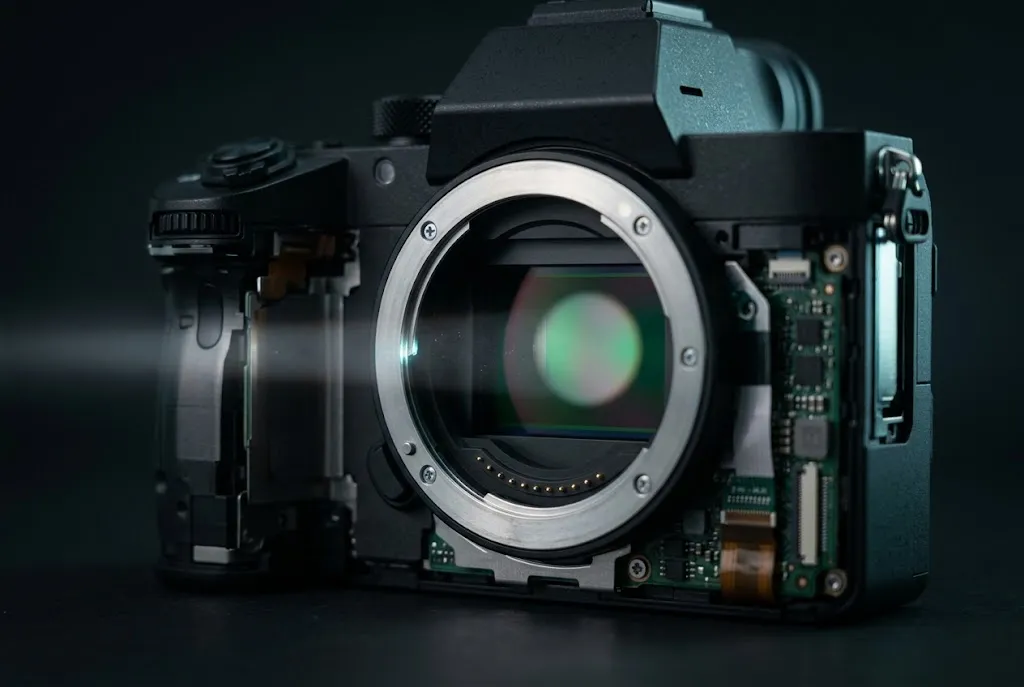
The tiny sensor doing a huge job
I used to think a digital camera was basically a tiny version of my eyes. Light came in, the camera somehow understood the scene, and a picture appeared. That explanation is convenient. It is also wildly incomplete.
The real story starts with the digital camera sensor. It does not see a sunset, a face, or a cup of coffee. It receives incoming light and turns that light into electrical information. After that, a chain of electronics and software turns the numbers into the picture you actually see.
That first step is where the magic feeling disappears and the engineering gets more interesting.
And it happens incredibly fast.
What the sensor is actually sensing
Inside most modern digital cameras is a grid of millions of tiny light-sensitive elements called photosites. They are arranged across a silicon sensor such as a CMOS image sensor. Each photosite gathers incoming photons during the camera's exposure.
A photon is simply a packet of electromagnetic energy. When enough photons reach a photosite, they create an electrical response that can be measured.
Think of each photosite as a microscopic bucket. A bright part of a scene fills the bucket quickly. A dark part fills it slowly. The sensor is not recording "tree," "person," or "sky." It is recording how much light arrived at each tiny position.
That is the first big surprise: a digital photograph begins as a map of light intensity, not a finished image.
This same basic idea is why a camera can struggle in a dim restaurant. There are simply fewer photons available to measure, so the signal becomes weaker and electronic noise becomes harder to ignore.
The relationship between light and the final picture is also why changing exposure matters so much. A longer exposure gives the sensor more time to collect light. A wider aperture lets more light through the lens. Higher ISO does not magically create extra photons; it changes how strongly the captured signal is amplified and processed.
From photons to electrical charge
When light reaches a photosite, the sensor's silicon converts that incoming energy into electrical charge. The exact structures are microscopic, but the core idea is surprisingly simple: more detected light produces a stronger signal.
Once the exposure ends, the camera has millions of tiny measurements to deal with. Those measurements are still analog. The camera needs to convert them into digital numbers before its processor can work with them like data.
That job is handled by an analog-to-digital converter, or ADC.
The sensor therefore sits at an important boundary. On one side is the physical world, full of continuously varying light. On the other is a stream of numerical values that a computer inside the camera can manipulate.
That conversion is one reason modern cameras feel less like traditional optical instruments and more like specialized computers with excellent lenses.
Why a sensor needs a color trick
Here is the part that caught me off guard the first time I looked into camera sensors: a typical photosite does not know what color the light is.
It mainly measures how much light reached it.
So how can a camera produce a red shirt, green leaves, and blue sky?
Most consumer cameras place a color filter array over the photosites. A very common arrangement is the Bayer filter, which uses red, green, and blue filters distributed across the sensor. Each photosite primarily measures one color channel.
The camera then has to estimate the missing color information for each pixel location. This process is called demosaicing.
It is an educated reconstruction. A red-filtered photosite knows something about red light, but nearby green- and blue-filtered photosites help the processor estimate the complete color value for that location.
That means the image you finally see is not a direct, untouched copy of reality. It is the result of measurements followed by reconstruction.
Which is why two cameras can photograph the same scene and still produce noticeably different colors.
The sensor is not the whole camera
Once the raw measurements exist, the camera's image processor gets busy. It can adjust white balance, reduce noise, sharpen edges, correct certain lens effects, map tones, and compress the result into a format such as JPEG.
Some cameras also save a RAW file, which preserves much more of the captured sensor data for later processing.
A RAW file is not simply a prettier JPEG. It is closer to the sensor's measured information before the camera has baked in many of its final image choices.
I find that distinction useful because it explains why editing a RAW photograph can recover detail in shadows or highlights that seems difficult to manipulate in an already processed JPEG. The underlying data has more room to work with.
A modern camera can therefore be thought of as a pipeline: lens, sensor, analog electronics, digital conversion, image processing, and storage. Each stage affects what finally reaches your screen.
For a broader look at how a phone turns visual scenes into digital images, the same basic chain appears in does your phone camera see what you see, although smartphone cameras add their own heavy computational processing.
Why megapixels are not the whole story
I often see camera specifications reduced to one number: megapixels. More sounds better. Sometimes it is. But that number alone tells me very little about how a camera will perform.
A 24-megapixel sensor and a 48-megapixel sensor can behave very differently depending on sensor size, photosite design, lens quality, readout electronics, processing, and the conditions in which the photo is taken.
Sensor size matters because a larger sensor can provide more physical area for collecting light at a given image resolution. That can help with noise performance and gives designers different options for lens and depth-of-field behavior.
Photosite size also changes the engineering trade-offs. Tiny photosites can capture a lot of detail across a compact sensor, but they can receive fewer photons individually under the same exposure conditions.
This is why simply chasing a larger megapixel count can be misleading.
A useful camera is not just a giant grid of pixels. It is a carefully balanced measurement system.
Why cheap cameras look rough at night
This is the part you can actually see with your own eyes.
Imagine taking a photo in a dark room. The sensor receives fewer photons, so the useful signal becomes smaller. At the same time, the camera's electronics still produce small unwanted variations, usually described as noise.
When the camera raises amplification to brighten the captured signal, that noise becomes more visible too.
This is why cheap phone cameras often produce grainy, smeared night photos: the sensor captured a weak light signal, and the processing pipeline has to push that limited information much harder.
Modern computational photography can help by combining multiple frames, aligning them, estimating motion, and reducing random noise. The software is clever, but it cannot change the basic fact that a dark scene contains fewer photons to measure.
That physical limit keeps showing up underneath all the algorithms.
CMOS versus the old CCD approach
Digital imaging did not always look the way it does now. Earlier digital cameras commonly used CCD sensors, while CMOS technology eventually became dominant across many consumer devices.
Both technologies convert light into electrical signals, but they organize and read that information differently.
CMOS became especially attractive because its manufacturing approach fits well with standard semiconductor production, and the architecture can support efficient high-speed readout and additional circuitry close to the sensing area. Those advantages became increasingly important as cameras moved into phones, cars, drones, and other compact devices.
Today, saying "CMOS sensor" does not tell me exactly how a particular camera will perform. Sensor architecture, pixel design, readout speed, processing, and optics all matter.
Still, the shift to CMOS helped make high-quality digital imaging practical across an enormous range of devices.
What happens between the lens and your gallery
The moment you press the shutter, the camera has a surprisingly complicated problem to solve.
Light passes through the lens and is focused onto the sensor. Photosites collect photons during the exposure. Their electrical signals are read out. The ADC turns those analog signals into numerical values. The processor reconstructs color and applies image corrections. Then the camera writes the resulting image into memory.
That whole sequence can happen in a fraction of a second.
And your phone makes the chain even stranger. Computational photography can combine several exposures, detect faces, estimate depth, remove blur, and alter local contrast before the final image is shown. What looks like one instantaneous photograph can actually be the result of a small amount of computation happening at remarkable speed.
The picture in your gallery is therefore not just what the sensor saw. It is what the camera measured, reconstructed, processed, and decided to present.
The surprising limit: cameras cannot capture what never arrived
There is one idea I keep coming back to because it cuts through a lot of camera marketing.
A sensor cannot record photons that never reached it.
Better processors can estimate missing information. Better algorithms can combine frames. Better lenses can deliver more usable light to the sensor. But no software can perfectly recover every physical detail from a signal that was never captured.
That is why optics still matter. It is also why sensor engineering still matters, even in an age of computational photography.
The clever part of a camera is not that it defeats physics. It is that it works incredibly hard within physics.
The photo is really a measurement
I started with the idea that a camera simply "sees". Now I think a better description is that a camera measures light and builds a picture from those measurements.
The sensor provides the raw evidence. The electronics digitize it. The processor interprets it. And the final file becomes the photograph we recognize.
Once you understand that chain, familiar camera behavior starts making sense. Low light gets noisy. Different lenses change the result. Sensor size matters. RAW files give you more editing freedom. More megapixels do not automatically mean a better camera.
Your camera is not copying reality.
It is measuring reality, one tiny patch of light at a time.
Why the same scene can look different on two cameras
Put two cameras on the same tripod, point them at the same street, and shoot at nearly the same exposure. You might expect matching images.
You often won't get them.
One camera may preserve more highlight detail. Another may produce cleaner shadows. A third may render skin tones differently. Those differences can come from the sensor, its readout electronics, the lens, and the image-processing choices made after capture.
This is especially obvious with smartphones. A phone may take several frames almost instantly and combine them into one final photograph. Another phone may apply stronger sharpening or noise reduction. The hardware matters, but the software has become part of the camera itself.
That is why a camera specification sheet can never tell the whole story.
What megapixels actually buy you
Megapixels describe the number of image samples in the finished image. A 24-megapixel image contains roughly 24 million pixel positions.
That can matter. More pixels can provide more detail when the lens, focus, lighting, and processing support it. They can also give you more room to crop a photograph without making the result unusably small.
But detail is not free.
Packing more photosites onto a limited sensor changes the physical size of those photosites. The engineering challenge becomes one of balancing resolution, light collection, noise, readout speed, heat, and processing.
So I would never judge a camera from megapixels alone. The number answers one question. It does not answer the whole question.
A simpler way to think about camera specs
| Camera part | What it mainly affects |
|---|---|
| Lens | Focus, brightness, perspective, optical detail |
| Sensor size | Light collection options and depth-of-field behavior |
| Photosites | How light is sampled across the sensor |
| ISO setting | Signal amplification and exposure behavior |
| Image processor | Color, noise reduction, sharpening, tone mapping |
| RAW capture | How much original sensor information remains editable |
The hidden computer inside every camera
The more I look at modern cameras, the harder it is to call them purely optical machines.
A lens still does something beautifully physical: it bends light into a focused image. But after that, the camera is effectively running a specialized image pipeline at high speed.
The processor has to decide how to turn incomplete color samples into a full-color image. It may detect the scene, adjust exposure, suppress noise, correct distortions, and prepare the file for storage or display.
This processing is one reason the final JPEG can look dramatically different from what a simplified sensor model would suggest.
The camera is not merely recording. It is computing.
Why your phone can make a night photo look brighter than reality
A dark street can appear surprisingly bright in a modern phone photo even though your eyes saw almost nothing.
That can happen because the camera keeps the shutter open long enough to collect more light, increases signal amplification, and may combine multiple frames in software. The finished image is therefore an interpretation designed to make the scene visually useful.
Your phone is effectively asking, "What image can I build from the measurements I managed to capture?"
And that is a very different job from simply pressing a shutter and storing raw sensor values.
The underlying physics still sets the limits, but computation can stretch how close the final image gets to what you wanted.
A final look behind the click
The next time I take a photo, I think about what the camera is doing in those tiny moments between the shutter press and the finished image.
Light crosses the lens. A sensor samples it. Electronics turn charge into numbers. Color gets reconstructed. Algorithms clean and shape the result. Storage saves the final file.
All of that happens before I ever zoom in on the picture.
And suddenly the ordinary camera does not look ordinary at all.
It is a light-measuring machine that learned how to make the measurements look like a photograph.


Conversation0
No comments yet. Be the first to share a thought — the best questions often become new stories.