


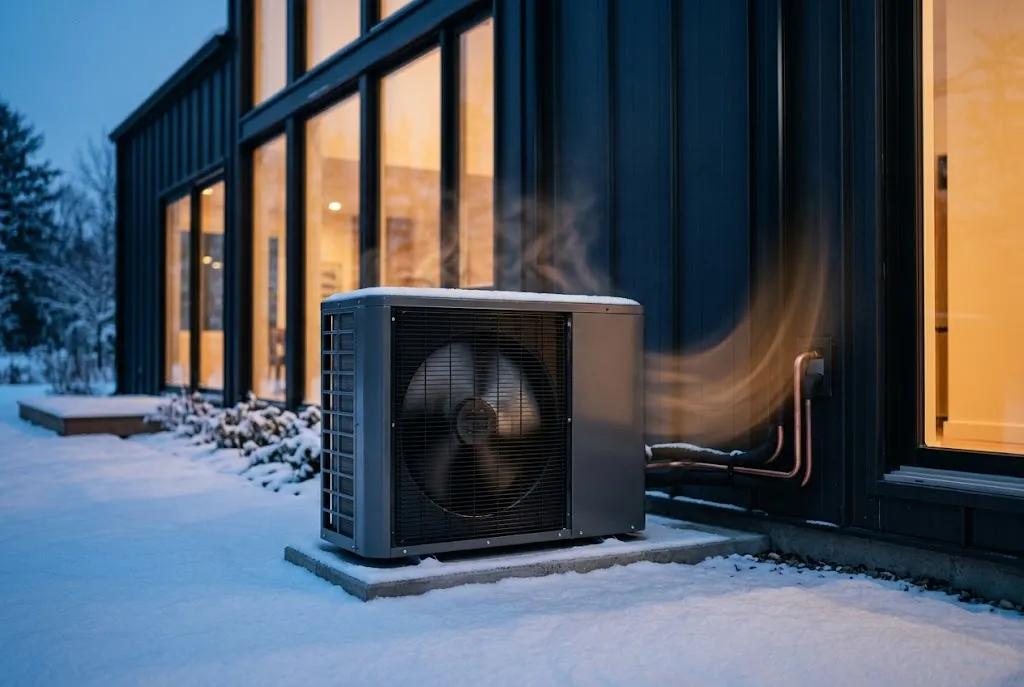
A heat pump sounds like a contradiction
I used to think a heating system had to make heat. Burn something. Heat a coil. Do some obvious, brute-force thing.
A heat pump takes a stranger route. It moves heat from one place to another. That sounds almost too simple until you realize what it means: the same machine can cool your home in summer and heat it in winter, simply by changing the direction of the heat flow.
And yes, that can work even when the outdoor air feels cold.
The basic idea is easier to see with a heat pump explained by the U.S. Department of Energy (opens in a new tab). A heat pump uses a refrigerant, a compressor, heat exchangers, and a control system to collect thermal energy from one side of the system and release it on the other side.
That is the trick.
The key is not creating heat
Inside a heat pump, the refrigerant is a fluid chosen because its physical behavior lets engineers move heat efficiently through changes in pressure and state. The machine repeatedly pushes that refrigerant through a closed loop.
When the refrigerant is at low pressure, it can evaporate at a relatively low temperature. When the compressor squeezes it, its pressure and temperature rise. The hotter refrigerant can then dump heat into a cooler environment before the cycle repeats.
So when the system is heating your house, it does not need the outdoor air to be warmer than the room. It only needs the refrigerant cycle to be able to absorb heat from that outdoor environment and raise the heat to a useful temperature indoors.
That is why a heat pump can still operate during a chilly winter day.
This is why a heat pump can heat a room without having a red-hot heating element inside it: most of the delivered heat was gathered from somewhere else rather than generated electrically from scratch.
The same general idea is why the machine can be dramatically more efficient than resistance heating under suitable conditions. The U.S. Department of Energy's heat-pump guidance (opens in a new tab) explains this distinction in terms of moving heat rather than directly producing it with electric resistance.
And that little difference changes the entire engineering problem.
What actually happens inside the loop
Picture the heat pump's refrigerant leaving the indoor side as a relatively cool, low-pressure fluid. It reaches the outdoor coil, where it can absorb heat from the surrounding air and evaporate.
Now it is a gas.
That gas travels to the compressor. The compressor squeezes it hard, raising both its pressure and temperature. This is the point where the electrical energy entering the machine does some of its most visible work.
The hot, high-pressure refrigerant then travels through the indoor heat exchanger. Here it releases heat into the home's air and condenses back toward a liquid state.
Then comes the expansion device. Pressure drops. The refrigerant becomes cold enough to return to the outdoor coil and absorb more heat.
Round and round it goes.
A simplified view looks like this:
| Stage | What happens to refrigerant | Job in heating mode |
|---|---|---|
| Outdoor coil | Absorbs heat and evaporates | Takes heat from outdoor air |
| Compressor | Pressure and temperature rise | Adds the mechanical energy needed to lift heat to a higher temperature |
| Indoor coil | Releases heat and condenses | Warms the indoor air |
| Expansion device | Pressure drops and refrigerant cools | Prepares it to absorb heat again |
The component names can sound intimidating, but the logic is surprisingly clean: collect heat, raise its temperature, release it, repeat.
There is another important piece. Your indoor heat pump usually contains a blower that moves room air across the indoor heat exchanger, while the outdoor fan pushes outside air across the other coil. The refrigerant does the thermal transfer; the fans help deliver it where it needs to go.
That is also why sizing matters. A heat pump that is too small may struggle during extreme weather, while an oversized system can cycle in ways that hurt comfort and efficiency.
And the outdoor unit is not just sitting there sucking heat through a magical portal. Air physically passes over the coil. The refrigerant physically changes state. The compressor physically does work.
No mystery. Just thermodynamics.
How one machine becomes an air conditioner
Here is the part I find most satisfying.
The same refrigeration cycle can run in reverse.
A component called a four-way reversing valve changes the direction in which the refrigerant flows through the system. The indoor coil that released heat during winter can become the coil that absorbs heat during summer. The outdoor coil takes on the opposite role.
So in cooling mode, heat is collected from the air inside your home and dumped outside.
That means the outdoor unit can feel warm even when the house is getting cooler. The machine is not manufacturing cold and sending it indoors. It is removing heat from the indoor air.
That is exactly why a refrigerator, an air conditioner, and a heat pump feel like cousins rather than completely different inventions. They all rely on refrigeration principles, although their hardware, controls, temperatures, and intended jobs differ.
The basic refrigeration loop is explained clearly by Encyclopaedia Britannica's refrigeration overview (opens in a new tab) and is one of the foundations behind modern heat-pump systems.
But what happens when it freezes?
This is where winter operation gets interesting.
Because the outdoor coil can become colder than the surrounding air, moisture in that air may freeze onto it. A layer of frost is bad news because it interferes with heat exchange.
The heat pump can detect the condition and temporarily switch into a defrost cycle. For a short period, it reverses the refrigeration process so heat reaches the outdoor coil and melts the accumulated frost.
You may notice the outdoor fan change behavior, see steam-like vapor, or hear the system make a sound that seems completely wrong for a heating appliance.
It is usually doing exactly what it was designed to do.
Why heat pumps can be so efficient
I want to be careful here, because efficiency claims often get reduced to a slogan.
A resistance heater converts electricity into heat directly. A heat pump uses electricity mainly to run the compressor, fans, controls, and related hardware while moving thermal energy from one place to another.
That means one unit of electrical energy can support the movement of more than one unit of heat under favorable operating conditions. The exact performance depends on outdoor temperature, equipment design, installation, airflow, refrigerant circuit conditions, and the indoor temperature you are asking the machine to maintain.
Engineers commonly describe heating performance with measures such as the coefficient of performance, or COP. A COP above 1 is not a loophole in physics. It simply reflects the fact that the electricity is powering a heat-transfer process rather than serving as the sole source of the delivered thermal energy.
The ENERGY STAR heat pump information (opens in a new tab) is useful here because real-world efficiency depends heavily on the equipment and installation, not just the words "heat pump" on the label.
And this is where the technology becomes personal.
This is why a heat pump can use less electricity than straight resistance heating for the same heating job, while still giving you warm air from the vents. The electricity is paying for the transfer, not simply paying for every joule of heat from scratch.
The cold-weather question is more complicated than it sounds
I often hear the same objection: if there is barely any heat outside, what is the heat pump supposed to collect?
There is a real physical limit, of course. As outdoor temperatures fall, extracting useful heat becomes harder and system performance usually declines. The compressor may have to work against a larger temperature difference, and the equipment can spend more energy moving the same amount of heat.
But "cold" does not automatically mean "zero thermal energy."
Outdoor air above absolute zero contains thermal energy. The challenge is getting heat from that air to a temperature high enough to be useful indoors, while keeping the process efficient.
Modern cold-climate heat pumps are designed with controls, compressors, heat exchangers, and refrigerant circuits suited to lower outdoor temperatures. Some homes also use a backup heating system for periods when additional capacity is needed.
In other words, there is no magic threshold where a heat pump suddenly stops understanding winter.
Performance just changes.
Where the electricity comes into the story
A heat pump does not make a home electrically independent. It shifts how electricity is used.
During heating or cooling, the compressor is generally the major electrical load, with fans and control electronics adding smaller loads. Because the system's demand changes with weather and thermostat settings, a large number of heat pumps operating at once can affect the electricity grid.
That makes heat pumps interesting beyond the living room. Grid planners care about when homes need heating, how cold the weather is, and how flexible that electrical demand can be. The same broader question appears in discussions of smart-grid technology, where utilities try to keep supply and demand balanced as more electrical equipment enters homes.
And when a home pairs a heat pump with rooftop solar, the relationship gets even more interesting. Solar panels work by converting sunlight into electricity, while the heat pump spends electricity moving heat. They solve very different problems, but they can operate as parts of the same household energy system.
That combination is one reason heat pumps keep turning up in conversations about building energy use rather than being treated as just another kind of air conditioner.
So, is a heat pump actually making cold or heat?
Neither, at least not in the way a stove makes heat.
A heat pump is better thought of as a thermal shuttle. Refrigerant absorbs energy on one side, compression raises the refrigerant's temperature, and the next heat exchanger releases that energy somewhere else.
Flip the refrigerant flow and the destination changes.
That single idea explains the oddest parts of the machine: why it can heat on a cold day, why the outdoor unit can release heat in summer, why frost can appear during winter, and why the same basic equipment can provide both heating and cooling.
I like technologies that become less mysterious the closer you look at them. A heat pump is one of those.
Underneath the fan, coils, pipes, and control boards, the machine is doing one deceptively simple thing: moving heat where you want it to go.




Conversation0
No comments yet. Be the first to share a thought — the best questions often become new stories.