


The Steel Capsule in the Ashes
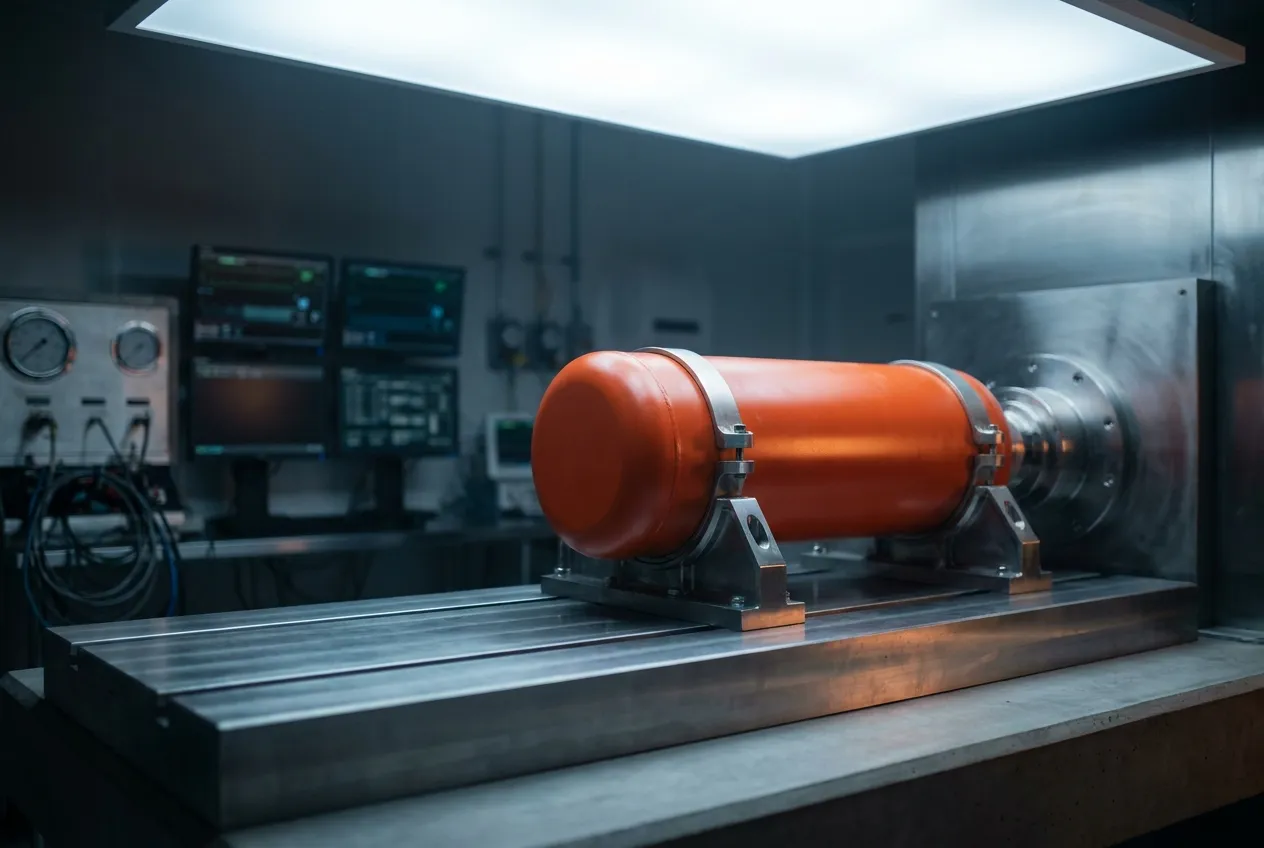
I still remember the first time I held a decommissioned flight recorder in my hands. It wasn't light. It felt like a solid cannonball wrapped in thick, high-visibility orange paint.
When a jet traveling at 500 miles per hour collides with terrain, the kinetic energy involved is catastrophic. Titanium turbine blades shear off, aluminum fuselages shred like paper, and thousands of gallons of jet fuel ignite in an instant. Yet, amid the blackened wreckage, search teams routinely pull out a single, intact cylinder containing every whispered word from the cockpit and thousands of digital flight parameters.
Not a single byte lost. It sounds impossible.
This is why your smartphone screen shatters when dropped onto kitchen tile from waist height, while this fist-sized metal capsule can slam into solid granite at 300 miles per hour and keep its data intact.
First, let's clear up the obvious misnomer: they are never black. Modern regulations require every flight data recorder (opens in a new tab) to be painted a vivid, fluorescent shade known as "international orange," accented with strips of reflective tape. The phrase "black box" likely originated in British aviation and radar development during World War II, where secret electronic avionics were housed in non-reflective black metal housings. Today, aircraft carry two distinct units—the Flight Data Recorder (FDR), which logs mechanical telemetry, and the Cockpit Voice Recorder (CVR), which captures ambient crew audio and radio transmissions.
Protecting those recorded signals is an exercise in extreme materials physics.
Layer by Layer: The Armor That Defies Physics
The secret to this near-invincibility lives inside a specialized subsystem called the Crash-Survivable Memory Unit, or CSMU. The recording circuitry sits inside three distinct protective shells, each engineered to defeat a specific physical threat.
1. The Armored Outer Hull
The outermost shield consists of forged titanium or a quarter-inch-thick shell of hardened stainless steel. This heavy cylinder provides structural integrity against blunt impact and high-velocity projectile punctures during impact.
2. The Thermal Barrier
Directly beneath the steel armor lies a thick barrier of dry silica insulation. When engulfed in high-temperature flames, this material prevents heat from bleeding into the core. Some modern units use an internal chemical insulation matrix: under extreme heat, the material releases trapped moisture as vapor, creating an active cooling cycle inside the sealed walls that regulates core temperatures until the fire burns out.
3. The Shock-Absorbing Core
At the very center sits the electronics board, encased in an elastomeric potting compound or specialized paraffin cushion. Modern units store data on solid-state flash memory (opens in a new tab) chips. Because solid-state chips contain zero moving mechanical parts, they survive violent deceleration far better than the fragile magnetic tape drives used decades ago—a durability shift mirroring how solid-state storage quietly replaced mechanical hard drives across modern consumer computers.
The Brutal Torture Tests of ED-112
Aviation authorities do not simply hope these capsules hold together. Under international standards enforced by the Federal Aviation Administration (opens in a new tab) and European regulators, every CSMU design must survive a battery of laboratory torture tests before it ever steps foot on a commercial aircraft.
Engineers test them ruthlessly:
- Impact Shock: The capsule is loaded into a pneumatic cannon and fired point-blank into an aluminum honeycomb target, subjecting the internal electronics to 3,400 Gs of deceleration force for 6.5 milliseconds.
- Penetration Resistance: A 500-pound steel spike with a hardened steel tip is dropped from a height of ten feet directly onto the unit's thinnest wall.
- Static Crushing: Hydraulic presses apply 5,000 pounds of continuous crushing force across every axis for five minutes straight.
- Fire Endurance: The recorder is roasted inside a propane fireball reaching 1,100°C (2,012°F) for 60 continuous minutes, followed by a secondary 260°C smolder test for ten hours.
Passing requires absolute survivability. If even a single memory chip cracks or desolders during the test, the entire enclosure design gets scrapped.
Surviving the Ocean Abyss and the 37.5 kHz Pinger
Crash sites are not always on land. When a plane goes down in deep water, the recorder faces an entirely different hazard: crushing hydrostatic pressure and corrosive salt brine.
To prevent salt water from corroding the circuit boards, the inner memory stack is hermetically welded shut. Regulatory tests require the capsule to sit submerged in a pressurized salt water tank simulating depths of 20,000 feet (over 6,000 meters) for 30 consecutive days. At that depth, the water pressure exceeds 5,000 pounds per square inch. The forged steel hull does not buckle.
Attached directly to the memory cylinder is an auxiliary cylindrical beacon: the Underwater Locator Beacon (ULB), commonly called the "pinger."
The beacon contains a dedicated lithium battery and a water-activated trigger switch. The moment submergence closes the circuit, it begins pulsing an ultrasonic acoustic ping at exactly 37.5 kHz once every second. That high-frequency pulse cuts through ambient marine noise, allowing sonar crews aboard surface ships to track the signal from miles away. (Modern beacons run for 90 continuous days, upgraded after search operations proved the old 30-day requirement was too brief for deep-sea salvage).
This acoustic ping is why search vessels in deep ocean recoveries deploy towed hydrophone arrays rather than visual camera submersibles during the initial search phase.
What the Telemetry Actually Tells Us
A modern flight recorder tracks several thousand variables in real time. It logs engine RPM, hydraulic line pressure, flap positions, autopilot commands, and pitch angles at multiple samples per second, relying on the same precision principles found in the accelerometers that track motion inside your phone.
I have looked at raw flight telemetry dumps before. (And to be candid, the first time you see a decoded data stream, it looks less like an airplane flight and more like an endless wall of cryptographic hex code).
Yet investigators at the National Transportation Safety Board (opens in a new tab) can take that stream of numbers, feed it into 3D flight reconstruction software, and recreate the exact cockpit instrument display down to the millisecond.
That is the true value of the orange cylinder. It does not exist to assign legal blame. It exists to turn rare catastrophes into actionable engineering data, ensuring that whatever flaw caused the disaster is documented, understood, and corrected across every airplane that ever takes to the sky again.
Conversation0
No comments yet. Be the first to share a thought — the best questions often become new stories.