


The Breath on the Side of the Road
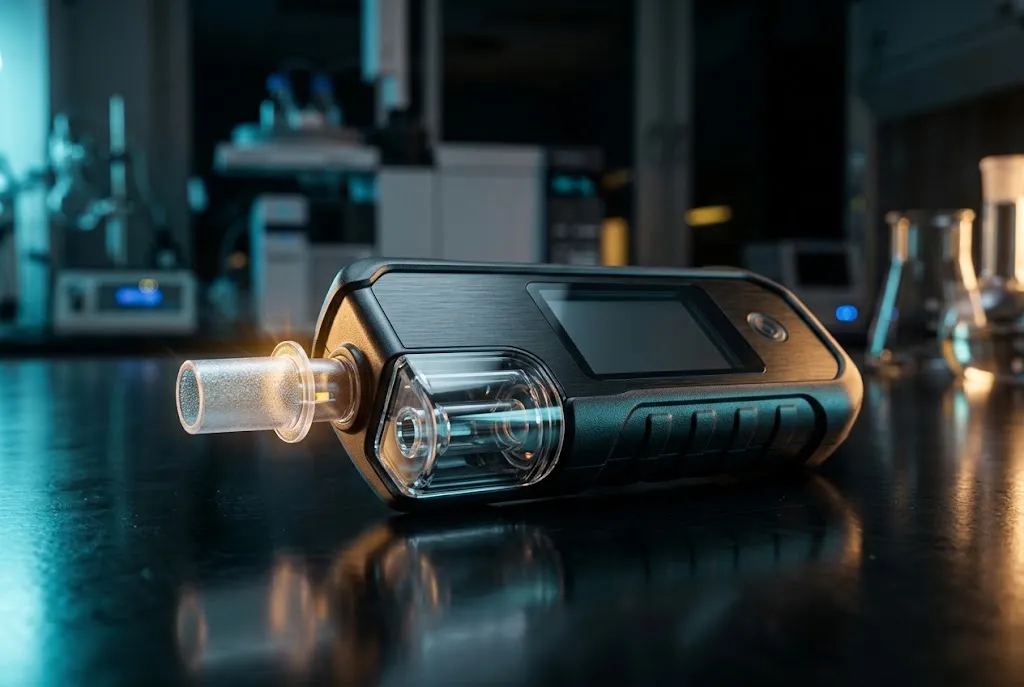
I watched an officer tear open a plastic wrapper, click a clear straw into a handheld black brick, and hold it out with total confidence. That little plastic nozzle was about to settle a legal argument in less than ten seconds.
Think about the sheer physical leap happening there. When someone drinks beer, wine, or whiskey, the liquid enters the stomach and intestines. It gets absorbed into the bloodstream. It does not go into the trachea, and it certainly does not pool in the bronchial tubes. Yet a traffic officer does not ask for a vial of blood or a syringe on the shoulder of a highway. They ask for an exhalation.
How does a puff of air carry a verifiable receipt for the chemistry running through your femoral artery?
It works because of a physical chemistry principle identified over two centuries ago. In 1803, English chemist William Henry formulated what we now call Henry's law (opens in a new tab). The rule is simple: at a constant temperature, the amount of a given gas dissolved in a given volume of liquid is directly proportional to the partial pressure of that gas in equilibrium across the liquid's surface.
Inside your chest, that equilibrium takes place across microscopic tissue. Your lungs contain roughly 300 to 500 million tiny air sacs called alveoli. The walls of these sacs are delicate, measuring less than a single micron across, and they are wrapped in an intricate lattice of pulmonary capillaries. When blood carrying volatile ethanol molecules circulates past those paper-thin membranes, the ethanol evaporates across the barrier into the alveolar air space.
At normal body temperature—roughly 34 degrees Celsius for exhaled breath—the partition ratio between blood and alveolar gas settles at roughly 2,100 to 1. That means 2,100 milliliters of deep alveolar air contain virtually the exact same mass of ethanol as 1 milliliter of circulating blood.
Much like the radar frequency compression we explored in how radar speed guns measure speed, this roadside system does not guess. It converts an invariant physical constant into an immediate numerical readout.
The Platinum Trap: How Fuel Cells Generate Current
Older breath test units from the 1950s—like the historic Borkenstein Breathalyzer—were messy chemical baths. A suspect blew into a glass vial filled with a mixture of potassium dichromate and sulfuric acid. If ethanol hit the solution, the red-orange liquid oxidized into green chromium sulfate, and a photocell compared the color shift against an unreacted control vial.
Nobody carries glass ampoules of sulfuric acid in a patrol car anymore.
Modern roadside devices are tiny electrical generators built around an electrochemical fuel cell (opens in a new tab).
Inside the core sensor chamber sits a sandwich: two porous discs of platinum foil flanking an acid-soaked electrolyte membrane. When an exhaled breath sample enters the chamber, ethanol molecules come into direct physical contact with the platinum surface of the catalytic anode.
Platinum acts as a relentless oxidizer. The metal strips electrons away from the ethanol, converting each ethanol molecule () into acetic acid (). That chemical breakdown liberates two protons () and two electrons ():
The freed electrons cannot cross the acidic electrolyte barrier. Instead, they flow through an external microcircuit toward the cathode, generating a tiny, measurable electric current. Meanwhile, the hydrogen protons migrate directly through the membrane, joining ambient oxygen and the arriving electrons on the opposite side to form plain water.
The sensor's microcontroller measures the electrical current. More ethanol molecules hitting the platinum means a greater surge of flowing electrons. By calculating the total electrical charge moved during the reaction, the unit computes the exact alcohol mass in that breath pocket.
This is why police officers make you blow steadily until the machine clicks, rather than taking a quick puff like blowing out a birthday candle.
A quick puff only captures shallow air from your mouth and trachea. That air hasn't sat in equilibrium with your pulmonary capillaries, so its alcohol reading is meaningless. The sensor needs the final, deepest volume of breath—the stale alveolar air right at the bottom of your lungs.
The Slope Detector: Catching the Mouth Alcohol Trap
There is a massive catch to all of this. What happens if someone rinsed with an alcohol-based mouthwash sixty seconds before being stopped, or took a single sip of beer without absorbing any of it into their bloodstream?
Mouth alcohol is dangerously concentrated. A drop of mouthwash can spike a breath reading to an apparent 0.40% blood alcohol concentration (BAC)—a lethal medical coma reading—even if the person has zero alcohol in their veins.
Engineers solved this with an algorithm called a slope detector.
When mouth alcohol is present, the sensor sees a sharp, instantaneous electrical spike that immediately decays as incoming breath flushes the oral cavity clean. Alveolar air from the lungs behaves in the exact opposite way. It rises gradually as breath leaves the mouth and trachea, and then flattens out into an unbroken, stable plateau as deep lung air reaches the chamber.
If the onboard processor detects a downward slope, a jagged drop, or a sudden spike that vanishes before the sample completes, it flags an error. The machine aborts the test entirely. (And honestly, the first time I saw the raw diagnostic curve for a slope error, it looked less like an interrogation tool and more like an oscilloscope hunting for clean audio).
The Heavy Artillery: Infrared Spectrophotometry at the Station
Roadside fuel cell units are screening tools. In most jurisdictions, their handheld readouts are not what prosecutors bring to trial as concrete forensic proof. For evidentiary certainty, suspects are transported to a processing room for testing on benchtop instruments like the Intoxilyzer or DataMaster.
These desktop machines do not use fuel cells. They do not burn ethanol. Instead, they use infrared spectroscopy (opens in a new tab).
Every molecule absorbs specific wavelengths of light based on its mechanical structure. Chemical bonds act like tiny springs: they stretch, bend, twist, and rock only when struck by photons whose frequency matches their natural vibrational resonant frequency. Ethanol has distinct carbon-hydrogen () and oxygen-hydrogen () bonds.
Inside the benchtop machine, a broadband infrared emitter beams light down a polished optical sample tube containing the captured breath. At the far end, optical bandpass filters isolate specific narrow wavelengths—chiefly 3.4 micrometers and 9.5 micrometers. Photodetectors measure how much infrared energy made it through without being absorbed.
Under the Beer-Lambert law, light absorption is mathematically proportional to the concentration of the gas in the optical path. More ethanol in the tube means less infrared light reaches the detector.
Dual-wavelength infrared testing also solves the keto diet dilemma. When a person is on an extreme low-carbohydrate ketogenic diet, or suffering from diabetic ketoacidosis, their liver produces endogenous acetone. Acetone can fool rudimentary sensors because its carbon-hydrogen bonds absorb light near the 3.4-micrometer band. But at 9.5 micrometers, acetone and ethanol absorb light in radically different ways. The machine measures both wavelengths simultaneously, comparing the ratios. If the math flags acetone rather than ethyl alcohol, the device refuses to count it toward intoxication, satisfying evidentiary guidelines overseen by the National Highway Traffic Safety Administration (opens in a new tab).
Unlike the subjective physiological reactions we explored in how lie detectors work—where nervousness can mimic guilt—infrared breath testing measures deterministic molecular physics.
Why Viral Cheats Fail Every Single Time
Over the decades, folklore has generated endless recipes for fooling the sensor. Sucking on copper pennies, chewing garlic, swallowing breath mints, hyperventilating, or holding an onion under your tongue.
None of them work.
Take the copper penny myth. Believers claim copper neutralizes alcohol vapors through an electric reaction in the mouth. In reality, pennies minted after 1982 are 97.5% zinc with a microscopic copper coating, and neither metal binds volatile airborne ethanol in the oral cavity. Even if you filled your cheeks with raw copper filings, the fuel cell doesn't test your saliva or your tongue. It measures the alveolar gas drawn straight from your lungs.
Breath mints and chewing gum are equally useless. They mask odors to human noses by filling the air with menthol and sugar aromatics, but fuel cell catalysts and infrared optical sensors do not smell things. They detect specific molecular bonds. In fact, using mouthwash or breath sprays containing alcohol worsens the situation: it trips the slope detector and forces an automatic delay.
Hyperventilating right before blowing does cause a momentary 10% to 15% drop in apparent BAC by cooling the airway and temporarily flushing volatile gas faster than capillaries replenish it. But that brief dip rarely moves an intoxicated driver below legal thresholds. Worse, deliberate hyperventilation triggers erratic breath flow profiles that cause modern pressure transducers to reject the sample for insufficient lung volume.
The Molecular Receipt
There is no trickery inside a breathalyzer. No hidden cameras, no psychological traps, and no guesswork.
What makes the device fascinating isn't police procedure—it is the seamless overlap of three distinct scientific centuries. You have an 1803 gas-liquid solubility law, a 19th-century platinum catalytic reaction, and mid-20th-century quantum vibrational spectroscopy, all packed into a housing that fits neatly inside a squad car glove compartment. When you blow through that straw, you aren't just exhaling air. You are delivering an unmistakable molecular balance sheet.




Conversation0
No comments yet. Be the first to share a thought — the best questions often become new stories.