


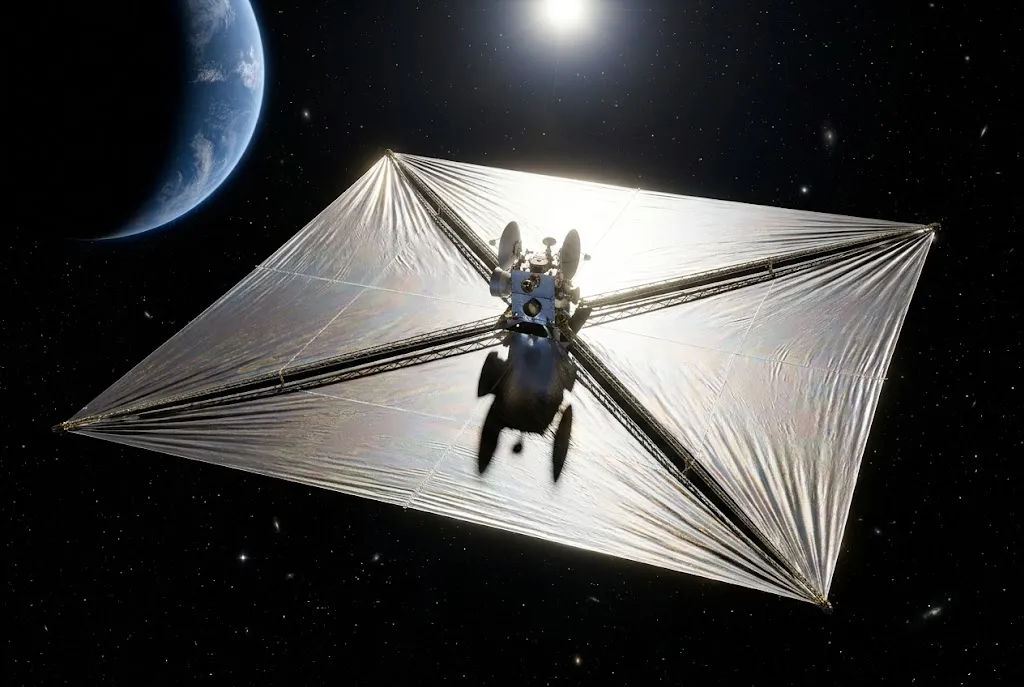
Sailing on a Beam of Weightless Light
I remember sitting through high school physics while my teacher wrote the classic momentum equation on the chalkboard: . Momentum equals mass multiplied by velocity.
Simple math. If an object has no mass, its momentum is zero. End of discussion.
Except that clean little formula breaks the moment you look up at the Sun. Photons—the elementary particles of light—carry zero rest mass. They are pure energy. Yet right now, spacecraft designed by NASA and international aerospace teams are coasting through the solar system with no chemical propellant, no gas thrusters, and no nuclear reactors onboard. They are propelled purely by sunlight bouncing off sheets of mirrored plastic.
It sounds impossible on paper. How can something with zero mass exert physical force on a heavy satellite?
Newton's neat equation was incomplete. When James Clerk Maxwell worked out classical electromagnetism and Albert Einstein later developed special relativity, they proved that light carries real, measurable momentum. The complete relativistic relationship between energy, momentum, and mass is . Because a photon has zero rest mass (), the equation collapses down to a direct link: , which means momentum is simply energy divided by the speed of light ().
Light has punch.
When a stream of photons strikes an object, it transfers that momentum directly to the surface. Physicists call this radiation pressure (opens in a new tab). On Earth, you never feel it. Step outside at high noon on a cloudless day, and the sunlight hitting your skin pushes against you with a force of roughly five micro-newtons per square meter. That is roughly the weight of a single housefly leg distributed over your chest. You brush it off without noticing because Earth's gravity and atmospheric drag overwhelm it by billions of times.
In the friction-free vacuum of orbit, conditions change completely.
This is why comets grow sweeping dust tails that always point directly away from the Sun regardless of which direction the comet is traveling—the Sun's relentless light pressure is physically blowing loose gas and dust away from the icy nucleus.
The Reflection Trick: Why Mirrors Double Your Speed
Building a solar sail requires a clever optical trick. If you build a giant sail out of a pitch-black, absorbent material, the photons crash into the sheet and get absorbed. Each absorbed photon transfers its momentum () to the craft, giving it a tiny push.
That works. But it leaves half the available thrust on the table.
Instead of absorbing the light, aerospace engineers polish the sail until it behaves like a pristine mirror. When an incoming photon strikes a reflective surface at a right angle, it does not stop. It bounces off and flies backward in the opposite direction.
Think about throwing a heavy medicine ball while standing on a sheet of slick ice. If someone tosses you the ball and you catch it against your chest, you slide backward across the ice. But if you catch that ball and immediately heave it back in the direction it came from, you slide backward twice as fast. Momentum is conserved in both directions.
For a reflecting photon, the initial momentum is , and the outgoing momentum is . The total change in momentum delivered to the sail is:
A perfectly reflective solar sail gets twice the push of an absorbing one.
At Earth's orbital distance from the Sun (one astronomical unit), sunlight delivers about 9.1 micro-newtons of thrust for every square meter of perfectly reflective sail area. That number is tiny. A typical dinner napkin made of reflective film would experience less than a microgram of force.
(And honestly, the first time I calculated that force for a desk-sized model, I re-checked my decimal points three times just to be certain.)
Here is the catch that changes space exploration: rocket engines produce tremendous thrust for about five minutes, run out of chemical propellant, and shut off forever. A solar sail never shuts off. That microscopic trickle of force pushes against the spacecraft 24 hours a day, seven days a week, 365 days a year. Over weeks and months, that steady, unyielding push accumulates into staggering orbital velocities.
Steering Without a Rudder: How to Tack in a Vacuum
The most common question people ask about solar sails is deceptively simple: "If sunlight pushes outward from the Sun, doesn't that mean you can only travel away from the solar system?"
Not quite.
You cannot sail directly into the teeth of the light beam, but you are never trapped moving in a straight line away from the star. The key lies in understanding that a spacecraft is never sitting still in space—it is always orbiting something.
When a solar sail unfurls in low Earth orbit or deep interplanetary space, it is already traveling sideways at dozens of kilometers per second relative to the Sun. Earth itself orbits the Sun at roughly 30 kilometers per second. Any spacecraft launched from Earth inherits that sideways velocity.
To move farther out into the solar system—toward Mars or Jupiter—you angle the sail so that the thrust vector points along the direction of your orbital travel. Adding speed raises your orbital energy. Your orbit widens into an outward spiral.
To travel inward toward Venus or Mercury, you do the exact opposite. You tilt the sail backward relative to your orbital flight path. The incoming sunlight pushes against your direction of travel. Light acts as a brake. By slowing your orbital speed, the Sun's gravity pulls your spacecraft downward into a lower, tighter orbit.
It works like maritime tacking, but with orbital mechanics instead of ocean currents.
This is why you cannot steer a solar sail like a boat on water; without a keel gripping the sea, steering is entirely about adjusting your orbital kinetic energy around the central star.
Gossamer Films and Unfolding Booms
Turning this physics into working flight hardware is an engineering nightmare. The entire system lives and dies by its area-to-mass ratio. If the sail is too heavy, the micro-newtons of thrust cannot overcome the vehicle's inertia.
A human hair measures roughly 70 micrometers across. A typical household plastic wrap is around 12 micrometers thick. The reflective films used on modern solar sails—usually aluminized polyimide film (opens in a new tab) or BoPET—measure between 2.5 and 4.5 micrometers thick.
They are gossamer sheets. Touch one with a dry finger, and static electricity will crumple it into an unusable ball.
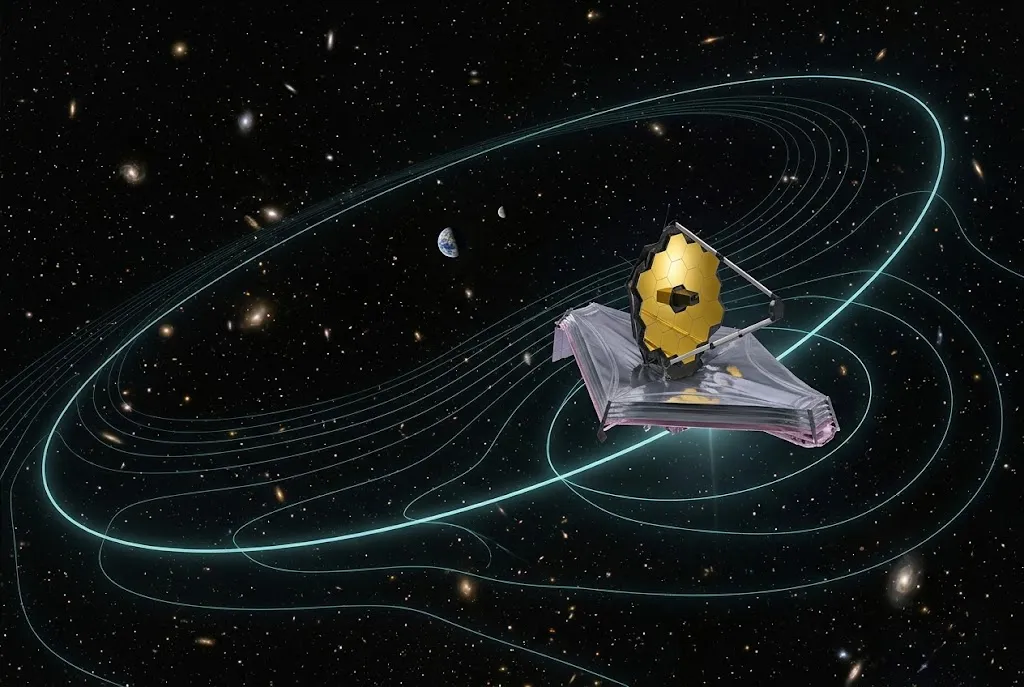
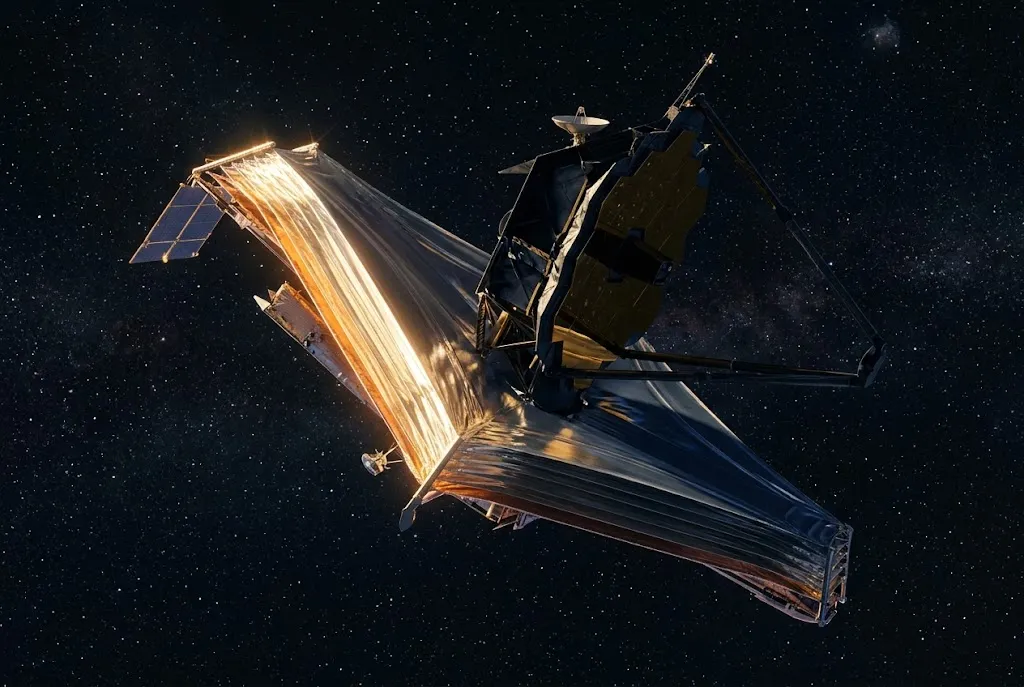
Engineers fold these massive membranes using origami patterns, tucking tens of square meters of film into a payload bay no larger than a shoebox. Unfurling them in space without tearing requires deployable structural booms. Similar membrane dynamics appear in the multilayer shielding designed for the James Webb telescope sunshield, where structural tension prevents delicate sheets from snagging during orbital deployment.
To deploy a sail, small electric motors unroll coiled strips of carbon fiber or hardened Elgiloy alloy. The strips snap into rigid tubular booms as they extend outward, dragging the four triangular corners of the folded sail behind them.
How do you keep the sail pointed at the right angle once it opens? You cannot use thruster gas without defeating the purpose of a propellant-free vehicle.
Engineers solve this using internal reaction wheels and magnetic torque rods that push against Earth's magnetic field in low orbit. Some advanced designs use Reflective Liquid Crystal displays placed on the outer tips of the sail. By electronically toggling these small panels between transparent and reflective states, operators change the reflectivity on one side of the craft, creating uneven radiation pressure that slowly pivots the entire sail.
Real Missions: From Science Fiction to Real Hardware
For decades, solar sailing existed solely in theoretical papers and science fiction stories by Arthur C. Clarke and Poul Anderson. That changed in May 2010 when the Japan Aerospace Exploration Agency (JAXA) launched IKAROS (opens in a new tab) (Interplanetary Kite-craft Accelerated by Radiation of the Sun).
IKAROS carried a 14-meter diagonal square membrane made of 7.5-micrometer polyimide film. Instead of relying on mechanical booms, the spacecraft spun at 25 revolutions per minute, using centrifugal force to fling the sail outward into shape. Over six months of cruising toward Venus, JAXA mission controllers measured an unmistakable acceleration caused by solar photons. They proved the concept worked.
Nine years later, The Planetary Society (opens in a new tab) demonstrated that small, crowd-funded CubeSats could harness the same physics. LightSail 2 launched into low Earth orbit in June 2019 aboard a SpaceX Falcon Heavy.
Its sail measured 32 square meters—about the size of a boxing ring—folded into a three-unit CubeSat chassis. Over three years of operation, LightSail 2 adjusted its orientation twice per orbit to catch sunlight on its prograde arc and turn edge-on to the Sun on the return pass. That synchronized dance raised the satellite's orbital apogee by several kilometers purely through radiation pressure.
More recently, NASA deployed the Advanced Composite Solar Sail System (opens in a new tab) (ACS3). The mission tests stiff, lightweight composite carbon-fiber booms that roll flat onto compact spools, demonstrating structural scalability for future sails spanning hundreds of square meters.
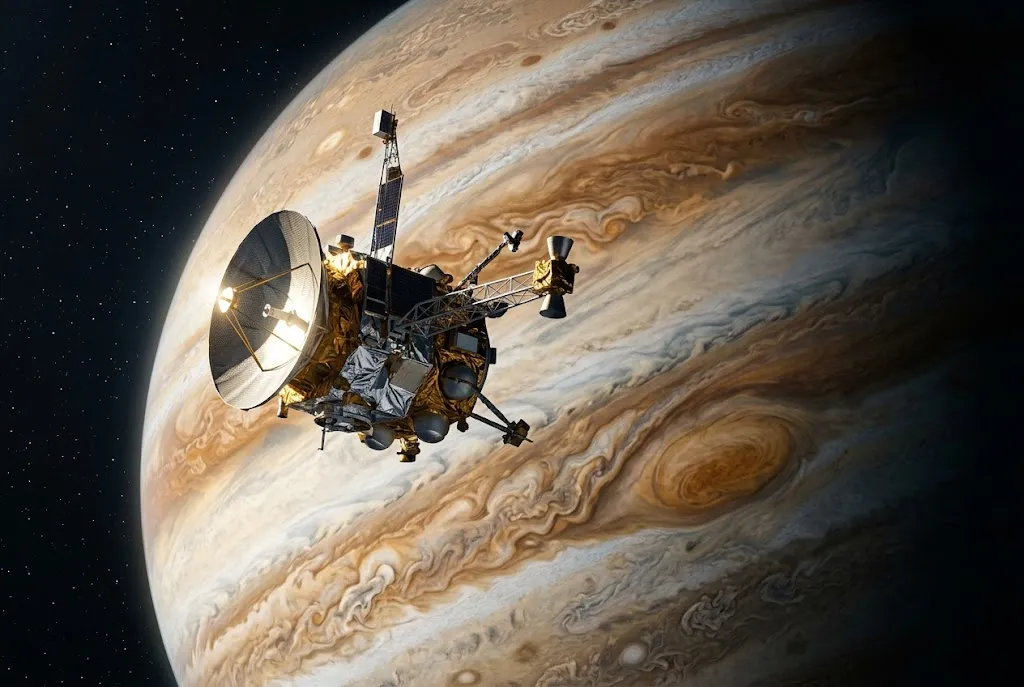
Solar sails complement other celestial navigation maneuvers; while deep-space missions often rely on planetary slingshots and gravity assists for sudden velocity boosts near large worlds, solar sails supply continuous, autonomous acceleration across the millions of kilometers between planetary encounters.
| Propulsion Type | Propellant Required | Thrust Level | Operating Duration | Theoretical Top Speed |
|---|---|---|---|---|
| Chemical Rocket | Hundreds of tons | Very High (kilonewtons) | Minutes | ~15–17 km/s |
| Ion Engine | Xenon / Krypton gas | Low (millinewtons) | Months to years | ~50–90 km/s |
| Solar Sail | Zero | Ultra-low (micronewtons) | Decades (indefinite) | Hundreds of km/s |
The Fundamental Limit: Where the Sun Fades Out
Solar sails possess one brutal limitation: the inverse-square law.
Radiation pressure scales inversely with the square of distance (). If you double your distance from the Sun, light pressure drops to one-quarter of its original strength. By the time a spacecraft reaches Jupiter at five astronomical units, the available thrust drops to 4% of its value at Earth. Past Saturn, the Sun shrinks to a bright point in the dark, and photon propulsion slows to a crawl.
To bypass this barrier, researchers are exploring beamed-light propulsion.
Projects like Breakthrough Starshot propose replacing natural sunlight with ground-based phased laser arrays firing gigawatts of focused coherent light. A tiny, gram-scale micro-probe attached to a four-meter sail could ride that laser beam for just a few minutes, accelerating at thousands of Gs until it reaches 20% the speed of light—fast enough to reach Alpha Centauri within two decades.
Conventional rocketry forces us to fight the tyrant rocket equation: every kilogram of fuel you add requires more fuel to lift it off the pad. Solar sails step around that trap. They treat stellar radiation not as background noise, but as an open ocean of energy waiting to be caught.
Conversation0
No comments yet. Be the first to share a thought — the best questions often become new stories.