


The Solid-Fuel Rocket in Your Steering Wheel
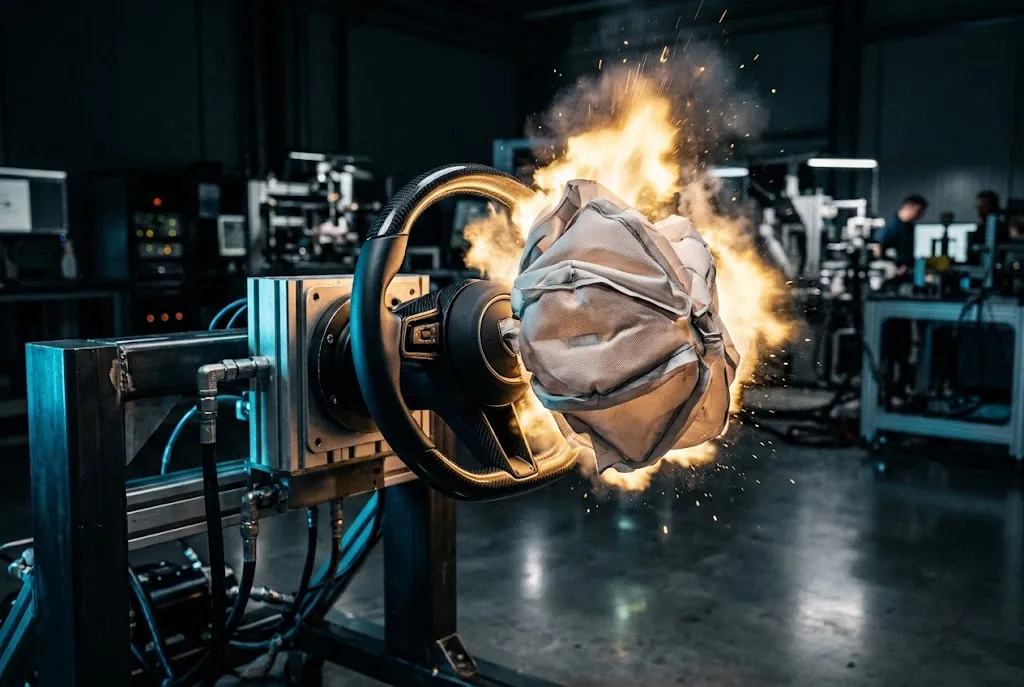
I was staring at the center of my steering wheel at a red light when a bizarre engineering reality struck me: just inches beneath the plastic horn emblem sits a miniature pyrotechnic charge. It is designed to detonate in your face, yet it is quite literally the only thing preventing your head from smashing through a windshield at highway speeds.
Most drivers assume an airbag (opens in a new tab) works like a beach ball hooked up to a compressed air tank. We imagine a valve clicking open and pressurized air whooshing in to cushion the blow. But compressed gas canisters have a fatal physical flaw: they are heavy, bulky, prone to pressure leaks over decades of temperature changes, and far too slow. Moving 70 liters of ambient air into a sealed bag through mechanical valves takes hundreds of milliseconds—time you simply do not have in a 40 mph collision.
To save a human life in a severe car crash, an airbag cannot merely inflate. It has to produce massive volumes of gas out of nothing in less time than it takes to blink. To pull that off, automotive engineers stole a trick directly from rocket propulsion: solid-state chemical combustion.
The Brutal Physics of a 30-Millisecond Window
When a car traveling at 45 mph strikes a rigid barrier, the vehicle stops in roughly 100 milliseconds as the crumple zones crush. The human inside, however, continues moving forward at 45 mph due to basic inertia.
Crash Timeline:
0 ms   — Vehicle hits barrier; deceleration sensors spike.
10 ms  — Airbag Control Unit (ACU) confirms severe crash; igniter fires.
20 ms  — Solid propellant combusts; nitrogen gas fills nylon cushion.
30 ms  — Cushion fully inflates at ~200 mph; occupant begins contact.
50 ms  — Occupant compresses bag; gas vents out rear exhaust ports.
Your seatbelt stretches and absorbs part of that forward momentum, but your head and torso whip forward violently. If the airbag cushion is not fully inflated and already beginning to soften by millisecond 30, your head will strike a rapidly expanding piece of canvas traveling at over 200 mph (320 km/h), causing severe blunt force trauma.
I find it fascinating that the entire life cycle of an airbag—from inert plastic cover to full deployment and deflation—is completely finished before your eyelids can close and reopen once.
How Your Car Knows You Are Crashing, Not Just Braking
Before any explosive reaction can take place, the car has to make an irreversible life-or-death calculation. If an airbag deploys over a severe pothole or a minor fender-bender, it can cause unnecessary injuries and total the dashboard.
Inside the vehicle's chassis and bumpers lie microscopic MEMS accelerometers (opens in a new tab)—tiny silicon cantilever beams that bend under deceleration forces. Much like how your phone senses motion, these silicon microscopic structures measure the rate of velocity drop in real time.
The central Airbag Control Unit (ACU) looks for deceleration curves exceeding negative 10g to 15g over a sustained pulse of several milliseconds. When the algorithm verifies that the vehicle is experiencing an actual structural collision, it sends an electrical firing current to an initiator known as a squib.
The squib is a microscopic bridge wire coated with a heat-sensitive ignition compound. When current surges through the wire, it glows red-hot within microseconds, igniting an internal booster charge that flashes straight into the main propellant chamber.
The Chemistry: Turning Solid Pellets into 70 Liters of Gas
Inside the inflator module sits a stack of solid propellant pellets. For decades, the standard chemical was sodium azide (opens in a new tab) (). When heated by the squib, sodium azide undergoes rapid thermal decomposition:
This reaction produces pure, benign nitrogen gas () in a massive burst. However, it also leaves behind metallic sodium (), which reacts violently with moisture. To neutralize this, chemists added potassium nitrate () and silicon dioxide (), which bind the free sodium into harmless silicate glass inside the inflator canister.
Much like consumer safety systems relying on contained hazardous materials, which we explored when analyzing whether smoke detectors use nuclear radiation, automotive engineers turned a violent chemical reaction into an intensely controlled consumer safeguard. Modern vehicles have largely phased out toxic sodium azide in favor of non-toxic guanidine nitrate propellants, but the physical mechanism remains identical: a solid chemical pellet deflagrates into expanding gas almost instantaneously.
| Propellant Era | Primary Chemical | Gas Produced | Secondary Byproduct |
|---|---|---|---|
| Classic (1970s–1990s) | Sodium Azide () | Nitrogen () | Metallic Sodium & Glass Slag |
| Modern Standard | Guanidine Nitrate | Nitrogen & Steam | Carbon Dioxide & Inert Ash |
| Side-Curtain Hybrids | Argon / Helium Mix + Pyrotechnic Booster | Compressed Inert Gas | Minimal Particulates |
This rapid chemical deflagration expands the solid volume into hot gas by a factor of roughly several hundred times in under 20 milliseconds.
Why the Airbag Must Deflate the Moment You Hit It
Here is the detail that catches almost everyone off guard: an airbag is not meant to stay inflated. If you hit a fully sealed, rigid nylon balloon filled with 70 liters of gas at 200 mph, your head would bounce off it with almost the same kinetic severity as hitting the steering wheel itself.
An airbag is designed to be a controlled deceleration brake, not a trampoline. The moment the nylon bag expands to its maximum volume, the occupant's head and chest slam into it. Built directly into the back and sides of the nylon bag are calibrated exhaust ports.
As your body crushes the cushion forward, the gas inside is forced out of these rear vent holes under high pressure. This controlled escape of gas decelerates your upper body gradually over a span of several inches, absorbing your forward kinetic energy () in the smoothest deceleration curve physics allows.
This is why an airbag smells like burnt metal and talcum powder after it goes off, and why your steering wheel feels hot to the touch.
That white cloud filling the cabin after a crash is not toxic smoke. It is a mix of inert nitrogen gas and cornstarch or talcum powder, which manufacturers pack inside the folded nylon fabric to prevent the material from sticking together during years of dormant storage.
The Razor's Edge of Pyrotechnic Engineering
Every time you turn your car's ignition, a silent electronic diagnostic check verifies that the tiny squib circuits inside your steering wheel, dash, and seat pillars are intact. You are driving with a network of precision chemical rockets pointed at your vital organs—engineered with such tolerances that they can sit untouched through blistering summers and sub-zero winters for twenty years, and still detonate with millisecond accuracy the single time you need them.




Conversation0
No comments yet. Be the first to share a thought — the best questions often become new stories.