


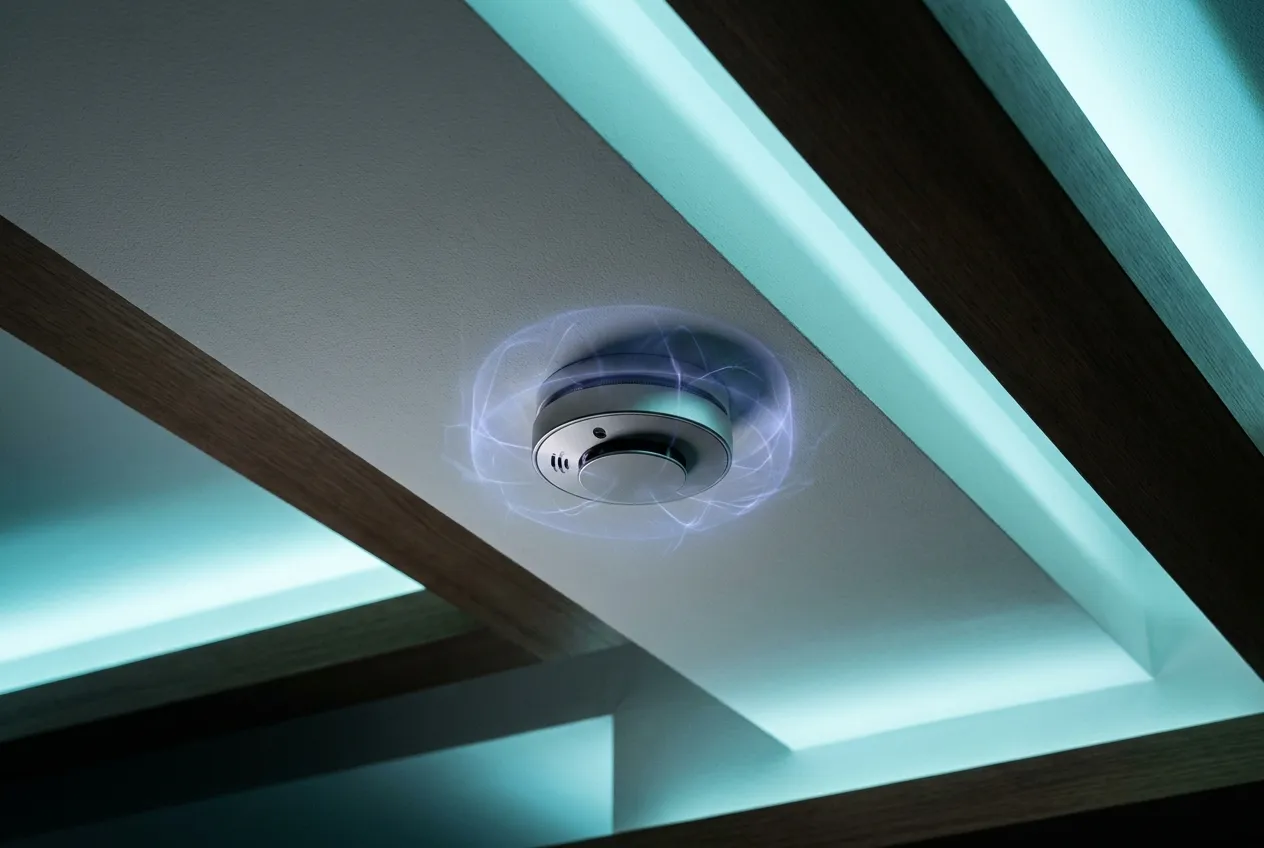
The Radioactive Secret on Your Ceiling
I was standing on a kitchen chair at 2:00 AM, waving a dishtowel at a plastic disc on my ceiling, when the question hit me: what is actually happening inside this shrieking little box?
Like most people, I assumed smoke alarms worked through some basic optical trick—maybe a tiny beam of light that trips when soot drifts through it. That is true for some of them. But when I cracked open an older unit, I noticed a stamped warning badge that looked like it belonged in a physics laboratory: Contains Radioactive Material: Americium-241.
It turns out millions of homes across the world have a genuine synthetic isotope quietly decaying directly above their beds. It is not an accident or a design flaw; it is one of the most brilliant, subatomic hacks in the history of everyday technology. To understand how it catches a fire before you can even smell smoke, you have to look at the invisible electrical circuit running through the air in your hallway.
Creating an Invisible Electric Current Out of Thin Air
Under normal conditions, air is an insulator. Nitrogen and oxygen molecules hold tightly to their electrons, meaning electricity cannot easily jump across an empty gap between two metal plates. If you wire up a 9-volt battery to two metal electrodes separated by half an inch of open air, precisely zero current flows.
This is where Americium-241 (opens in a new tab)—a man-made byproduct of nuclear reactors—comes into play. Inside an ionization smoke detector sits a microscopic speck of americium dioxide (usually less than a single microgram, or around 0.9 microcuries of activity).
[ (+) Metal Electrode ]
      ↑
  (e⁻) Moving Up    ← Air molecules ionized by Alpha Particles
  (⊕) Moving Down
      ↓
[ (-) Metal Electrode ] <--- Microscopic Americium-241 Source
Americium decays by shedding alpha particles—tight clusters of two protons and two neutrons. Because alpha particles are relatively heavy and carry a double-positive charge, they act like subatomic bowling balls. As they burst out of the americium source, they smash directly into ambient oxygen and nitrogen molecules, knocking off electrons.
This process, known as ionization, turns neutral air molecules into positively charged ions and free electrons. The detector maintains an electric voltage across the chamber, pulling the positive ions toward the negative plate and the electrons toward the positive plate. Just like the controlled nuclear reactions explained in how an atomic bomb works, the physics here relies on precise atomic decay—except instead of a runaway explosion, it produces a constant, microscopic trickle of electric current measuring just a few picoamps.
How Invisible Smoke Particles Break the Circuit
Once the detector establishes that steady baseline current, it monitors it relentlessly. And that baseline is fragile.
When materials begin to combust or smolder, they do not just release visible soot; they eject trillions of tiny, microscopic aerosol particles into the rising air currents. When these combustion particles drift into the ionization chamber, their physical presence changes everything:
- The incoming smoke particles are massive compared to single oxygen ions.
- As free ions and electrons drift toward the plates, they collide with and stick to the sticky surface of the smoke particles.
- Because these smoke particles are heavy and sluggish, they move far too slowly to reach the plates before recombining into neutral molecules.
- The steady picoamp current instantly drops below a calibrated threshold.
This is why your smoke alarm screams when you burn toast before you can even see a haze in the air. The fast-moving microscopic particles from aggressive, flaming heat enter the chamber and short-circuit the ion stream minutes before large, visible clouds of soot form.
Ionization vs. Photoelectric: Two Different Senses
Not every alarm uses nuclear physics. The second major category is the photoelectric smoke detector, which relies entirely on optical physics and the Tyndall effect (opens in a new tab).
Inside a photoelectric sensor, an infrared LED shoots a narrow light beam across an internal dark chamber. A light sensor (photodiode) sits at a 90-degree angle to the beam, completely hidden in the shadows. Under normal conditions, the light beam shoots straight across and hits a light-absorbing baffle, meaning the sensor remains in total darkness.
| Feature | Ionization Detectors | Photoelectric Detectors |
|---|---|---|
| Core Mechanism | Alpha radiation & ion current | Scattered infrared light beams |
| Best Detection | Fast-flaming, clean fires (paper, grease) | Slow, smoldering fires (mattresses, foam) |
| Particle Size | Tiny invisible aerosols (< 1 micron) | Larger visible soot particles (1–10 microns) |
| Power Source | Microgram Americium-241 speck | Infrared LED & photodiode |
| False Alarms | High (triggers on cooking vapors & humidity) | Low (resists steam, triggers on dense dust) |
When a slow, smoldering fire begins—like a cigarette burning through upholstery or an electrical wire melting inside a wall—it generates large, thick smoke particles. These fat particles scatter the infrared light beam in all directions, bouncing photons directly into the off-axis photodiode and sounding the alarm.
Are You Safe Sleeping Beneath an Isotope?
Whenever people discover there is radioactive material in their bedroom ceiling, their immediate reaction is concern. But the physics of alpha radiation makes it remarkably benign outside the body.
Alpha particles have enormous ionizing power, but they possess almost zero penetrating ability. A single sheet of paper—or even the thin layer of dead skin cells on your finger—is enough to stop an alpha particle dead in its tracks. In an ionization detector, the americium source is sealed inside a solid gold-foil casing within a secondary metal chamber.
According to data from the Environmental Protection Agency (EPA) (opens in a new tab), the radiation dose you absorb from standing ten feet away from a smoke alarm for an entire year is less than 0.01 millirem—a fraction of the background cosmic radiation you receive during a single hour on a commercial flight.
Why the Industry Is Moving Toward Optical Sensors
Despite their brilliance, traditional ionization detectors are gradually being phased out across many states and municipalities in favor of dual-sensor or dedicated photoelectric models. The primary reason is not radiation danger, but human behavior.
Because ionization units are so sensitive to tiny airborne molecules, they frequently trigger false alarms from cooking steam, aerosol hairsprays, or high humidity from a nearby bathroom. Frustrated homeowners often pull the batteries out, leaving their homes completely unprotected. Photoelectric sensors, coupled with intelligent microcontrollers that analyze particle density over time, have proven far more reliable at detecting real household emergencies while ignoring a hot shower.
The humble smoke detector remains a masterpiece of applied physics. Whether it uses optical light scattering or the subatomic decay of an element forged in a reactor, that unassuming white plastic disc stands guard by turning the invisible properties of our atmosphere into a life-saving warning system.



Conversation0
No comments yet. Be the first to share a thought — the best questions often become new stories.