


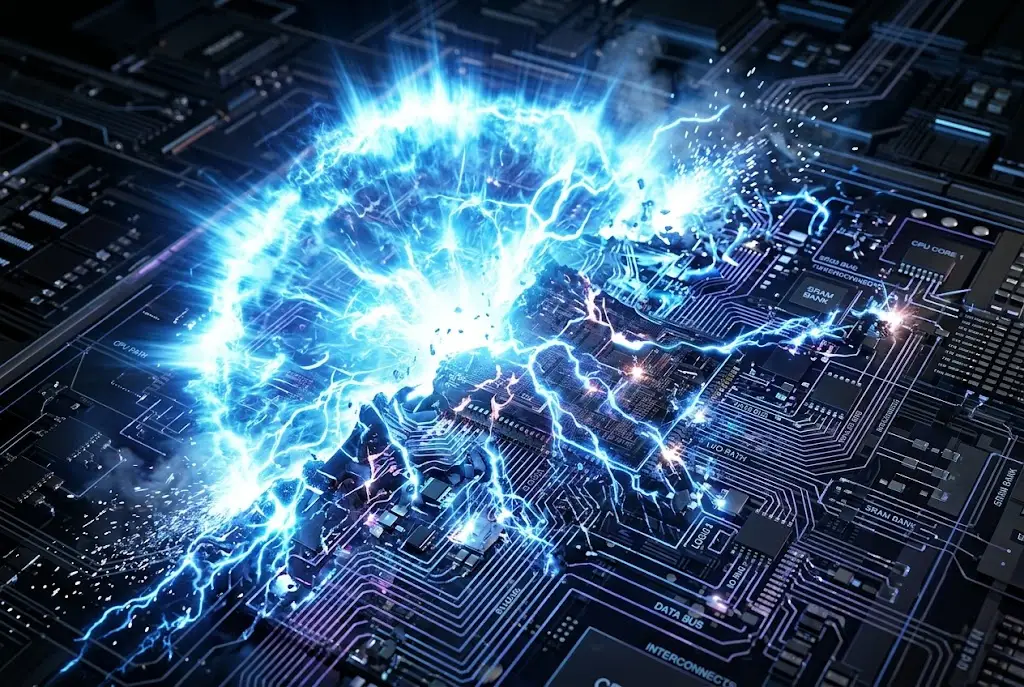
I was staring at a fried circuit board from a garage radio after a nearby lightning strike, and it hit me just how insanely fragile our digital world really is. In a fraction of a millisecond, an invisible burst of energy completely melted the delicate microprocessors without leaving a single scratch on the outer plastic shell.
That modest electrical surge was just a tiny preview of what a high-altitude Electromagnetic pulse (opens in a new tab) (EMP) weapon can unleash. Modern civilization runs entirely on microscopic silicon gates measuring mere nanometers across. While we enjoy lightning-fast smartphones, autonomous vehicles, and global communications, this extreme miniaturization has created a hidden vulnerability. An EMP weapon doesn't blow up buildings or emit heat; instead, it weaponizes physics to permanently brick microchips across thousands of square miles in the blink of an eye.
How can an invisible pulse turn cutting-edge supercomputers into worthless slabs of silicon? The secret lies in the underlying physics of electromagnetism and semiconductor design.
What Is an EMP Wave and How Is It Generated?
At its core, an electromagnetic pulse is a sudden, ultra-intense burst of electromagnetic energy that propagates through space. When high-altitude nuclear detonations or specialized non-nuclear high-power microwave devices burst in the upper atmosphere, they trigger a rapid cascade of physics.
In a high-altitude explosion, intense gamma radiation collides with atmospheric oxygen and nitrogen molecules. This collision knocks loose a torrent of high-energy electrons through a phenomenon known as Compton scattering (opens in a new tab). As these freed electrons accelerate downward and interact with Earth's magnetic field, they radiate a massive, widespread pulse of electromagnetic energy.
[Gamma Ray Burst] ──> [Atmospheric Ionization] ──> [Compton Electron Cascade]
                                                             │
                                                             ▼
[Widespread Circuit Destruction] <── [Induced High Voltage] <── [Earth's Magnetic Deflection]
This phenomenon operates on similar physical principles to the explosive energy discharge analyzed in our deep dive into how an atomic bomb works, but its primary destruction is focused purely on electronic infrastructure rather than thermal blast waves.
"An EMP attack would leave buildings standing and spare human lives directly, but it would instantly reduce modern military and civilian infrastructure to pre-industrial capabilities."
— Dr. William R. Graham, Chairman of the U.S. EMP Commission
The Three Phases of Destruction: E1, E2, and E3
An electromagnetic pulse is not a single uniform wave. Scientists categorize a High-Altitude EMP (HEMP) into three distinct temporal components, each targeting different scales of human technology.
To understand why your personal devices fail differently than city power grids during a burst, take a look at how these three components act:
| EMP Component | Timeframe | Peak Field Strength | Primary Physical Mechanism | Main Targets Impacted |
|---|---|---|---|---|
| E1 (Early-Time) | 1 to 100 Nanoseconds | Up to 50,000 Volts/meter | Fast Compton electron acceleration | Microchips, computers, phones, vehicle ECUs |
| E2 (Mid-Time) | 1 Microsecond to 1 Second | 10 to 100 Volts/meter | Scattered gamma radiation & neutron inelastic collisions | Power supplies, battery chargers, long phone lines |
| E3 (Late-Time) | Seconds to Minutes | Millivolts to Volts/kilometer | Geomagnetic fluctuations driven by solar-like field movement | High-voltage transformers, subsea cables, regional grids |
The E1 pulse is the true microchip killer. Because it ramps up to tens of thousands of volts per meter in less than five nanoseconds, standard surge protectors and circuit breakers cannot physically react in time to block it.
Microscopic Meltdown: Why Silicon Microchips Fry
Why does an E1 pulse destroy microchips while leaving copper wires relatively unharmed? The answer comes down to physical scale and semiconductor tolerance.
Modern microprocessors contain billions of microscopic transistors packed onto silicon wafers. These transistors rely on insanely thin gate oxides—sometimes only a few atoms thick—to switch electrical states. When an E1 pulse strikes an unshielded electronic device, every metal trace, circuit board line, and power cord acts as an unintentional antenna.
The antenna effect induces massive voltage spikes directly into the chip’s input/output pins. This extreme surge triggers several fatal phenomena within the silicon logic gate:
- Dielectric Breakdown: The extreme voltage gradient pierces directly through the ultra-thin insulating silicon dioxide layer, creating permanent short circuits inside the gate.
- Thermal Runaway: The sudden surge forces an enormous current density through microscopic PN-junctions. As temperature spikes rapidly inside the semiconductor, localized silicon melts, inducing permanent Thermal runaway (opens in a new tab).
- Parasitic Latch-Up: The pulse activates hidden parasitic bipolar transistors inherently present in CMOS logic circuits, locking the chip into a permanent short-circuit state until power is severed or the chip destroys itself.
This is why your smartphone or laptop turns into a useless brick during a high-energy surge. While older vacuum-tube technology from the mid-20th century could survive high-voltage spikes without burning out, modern sub-5nanometer chips are far too delicate to survive unattenuated transient pulses.
Real-World Vulnerability: Why Your Daily Tech Is at Risk
The danger of an EMP isn't restricted to military weapons. Similar low-frequency electromagnetic disturbances occur naturally during extreme solar flares. As we explored when analyzing whether solar storms could ignite digital chaos, space weather can drive powerful geomagnetically induced currents through surface infrastructure.
- Your Car's ECU: Modern vehicles rely on dozens of interconnected microcontrollers. An E1 surge entering through the wiring harness can permanently disrupt engine timing, electronic braking, and steering controls.
- Smart Grid Substations: High-voltage transformers rely on delicate digital relays. When E1 and E3 pulses strike simultaneously, high-voltage lines guide thousands of amps directly into grid substations, mirroring the vulnerabilities examined in our analysis of how tech prevents power grid blackouts.
- Consumer Electronics: Unplugging your computer or smart TV from the wall during a storm helps against basic lightning surges, but an airborne E1 pulse bypasses power outlets entirely by coupling directly into internal circuit traces.
How Engineers Shield Electronics from EMP Destruction
Can we protect sensitive microchips from invisible electromagnetic waves? Fortunately, electrical engineers have developed proven shielding techniques to mitigate transient radiation threats.
To shield microelectronics effectively, engineers rely on a layered defensive strategy:
- Faraday Cages: Enclosing sensitive hardware inside a continuous conductive shell made of copper or aluminum creates a Faraday cage (opens in a new tab). incoming electromagnetic waves induce currents on the outer conductive boundary, canceling the interior electric field.
- Transient Voltage Suppression (TVS) Diodes: Ultra-fast semiconductor diodes placed directly across circuit inputs clamp incoming high-voltage spikes to safe levels within picoseconds.
- Optical Isolation: Replacing metallic copper communication lines with non-conductive fiber-optic cables eliminates long antenna pathways where high-voltage spikes can collect.
The Verdict on Microchip Vulnerability
Electromagnetic pulse weapons don't destroy physical brick-and-mortar infrastructure, but they hit the modern world where it is most fragile: our microscopic digital brain. As semiconductor manufacturing pushes transistors down to sub-nanometer scales, our reliance on delicate microchips grows alongside our vulnerability to transient electrical surges. Understanding the physics of E1 spikes, semiconductor thermal breakdowns, and Faraday shielding remains our best defense in keeping our connected world safe from invisible disruptions.


Conversation0
No comments yet. Be the first to share a thought — the best questions often become new stories.