


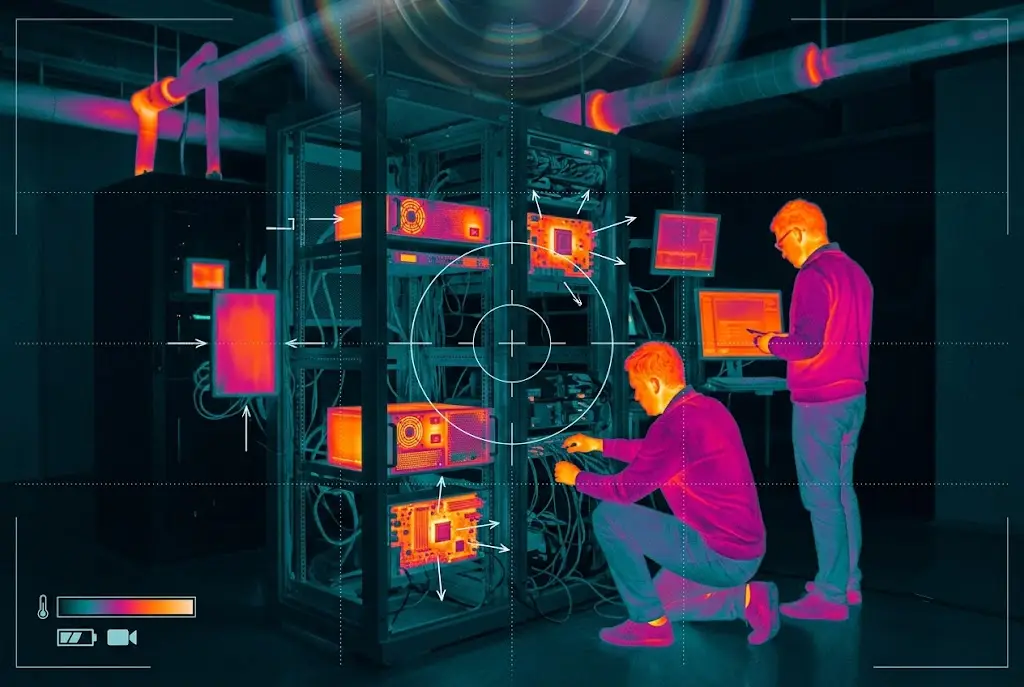
I was standing in a completely sealed, windowless basement with the lights killed when I first experienced thermal vision. It was pitch black—the kind of darkness where holding your hand an inch from your face is useless. Yet, when I switched on a handheld thermal imager, the entire room lit up on the display screen.
Even weirder? Where I had stepped seconds earlier, glowing glowing yellow footprints lingered on the concrete floor.
How can a camera create crisp, high-definition video when there isn't a single photon of visible light bouncing around?
The answer lies in a fundamental truth about our universe: every object emitting heat is constantly glowing in an invisible spectrum of light. Thermal cameras don't "see" light the way our eyes or smartphone sensors do; they detect microscopic thermal vibrations and translate kinetic heat energy into an image.
1. The Electromagnetic Spectrum: Heat is just invisible light
To understand how thermal imaging works, we first have to realize that visible light is only a tiny sliver of the electromagnetic spectrum.
Standard phone cameras capture wavelengths between 0.4 and 0.7 micrometers—the narrow band of light reflected off objects into the lens (as unpacked in our deep dive on how phone cameras process digital vision). When night falls and ambient light sources disappear, regular optical sensors become completely blind.
Thermal sensors operate in the Long-Wave Infrared (LWIR) band, spanning 8 to 14 micrometers.
According to Planck’s Law of Radiation, any physical object with a temperature above absolute zero (-273.15°C or 0 Kelvin) constantly emits infrared photons. The hotter an object gets, the faster its atoms vibrate, and the more infrared radiation it shoots out into space.
Wien's Displacement Law defines the exact peak wavelength () of this emission:
Where is Wien's displacement constant () and is absolute temperature. For human skin at 37°C (310 K), the peak thermal emission lands right around 9.3 micrometers—dead center in the long-wave infrared band.
2. Microbolometers: The tiny bridges that measure heat
Older military thermal systems required heavy containers of liquid nitrogen to cool their sensors down to -196°C so internal heat wouldn't ruin the image. Modern handheld cameras and drone thermal pods use a clever solid-state technology called a microbolometer sensor (opens in a new tab).
Instead of detecting light photons directly, an uncooled microbolometer contains an array of hundreds of thousands of tiny, microscopic bridges made from Vanadium Oxide (VOx) or Amorphous Silicon (-Si) suspended over a silicon circuit board.
Incoming Infrared Photon
          │
          ▼
┌─────────────────────────┐
│ Absorber Layer (VOx)    │ ──► Heats up microbridge
└────────────┬────────────┘
             │
             ▼
┌─────────────────────────┐
│ Thermal Isolation Legs  │ ──► Prevents heat leakage to substrate
└────────────┬────────────┘
             │
             ▼
┌─────────────────────────┐
│ ROIC Circuit Board      │ ──► Reads electrical resistance change (ΔR)
└─────────────────────────┘
When invisible infrared radiation hits the absorbing layer:
- The microscopic bridge absorbs the heat energy, raising its temperature by a micro-fraction of a degree.
- As its temperature changes, the material's electrical resistance drops drastically.
- The Readout Integrated Circuit (ROIC) sends a tiny current through the grid, measures the resistance shift (), and converts that voltage change into a precise numerical temperature value.
Because these microbridges are vacuum-sealed and held above the silicon substrate by thin isolation legs, they can react to temperature fluctuations as small as 0.01°C in real time according to thermal imaging research from Teledyne FLIR (opens in a new tab).
3. Germanium Lenses: Why thermal cameras use metal, not glass
Here is an anomaly that catches most people off guard: you cannot build a thermal camera using normal glass lenses.
Standard glass—the material inside your eyeglasses, DSLR lenses, and smartphone cameras—is completely opaque to long-wave infrared light. If you point a thermal camera at a clear glass window, it won't see through the window; it will merely reflect the heat signature of the person holding the camera!
To allow infrared radiation to reach the sensor array, thermal lens elements are manufactured from Germanium—a rare, lustrous metalloid element.
"Germanium acts like a paradox in optics: to human eyes, it looks like a polished metallic mirror, but to an infrared thermal sensor, it is as crystal-clear as polished optical quartz." — Optics & Photonics Engineering Journal
Because raw Germanium metal is rare and extremely difficult to refine, a high-end thermal camera lens often accounts for up to 50% of the camera's overall cost.
4. Real-World Value: Why this tech matters in everyday life
Thermal vision isn't just a military tool—it is deeply integrated into modern consumer safety, energy management, and automotive engineering:
- Automotive Autonomous Emergency Braking (AEB): Standard optical cameras on self-driving cars struggle with headlight glare or total pitch darkness. Thermal imaging sensors let autonomous cars detect pedestrians or animals on dark highway roads up to 300 feet away, drastically reducing night accidents.
- Lithium-Ion Battery Health: Overheating cells in high-power systems—like those found in electric vehicle battery packs—display clear thermal anomalies on thermography scans long before short-circuits trigger thermal runaway.
- Firefighting Through Smoke: Water vapor and carbon smoke particles completely scatter visible light photons. Long-wave infrared waves pass right through thick smoke columns, allowing firefighters to instantly locate trapped victims inside burning buildings.
- Home Energy Audits: Thermographers use infrared thermography (opens in a new tab) to locate hidden insulation gaps and HVAC duct leaks behind drywall, cutting home energy waste by up to 25%.
Comparing Imaging Technologies in Total Darkness
| Technology | Light Source Required | Detects Through Smoke/Fog? | Sees Through Glass Windows? | Primary Use Case |
|---|---|---|---|---|
| Standard RGB Camera | High (Sunlight / LED) | No | Yes | General photography & video |
| Active Near-IR Night Vision | Low (IR Illuminator LEDs) | No | Yes | Home security cameras & baby monitors |
| Thermal Infrared (LWIR) | Zero (Pitch Black) | Yes | No | Search & rescue, vehicle safety, thermography |
The False-Color Transformation
Once the microbolometer chip reads temperature values across its pixel array (such as 320×240 or 640×510 grid points), internal processors map those temperatures to color palettes:
# Conceptual False-Color Signal Mapping
def map_temperature_to_pixel(temp_celsius):
    if temp_celsius >= 37.0:
        return (255, 255, 255)  # White Hot (Extreme Heat)
    elif 30.0 <= temp_celsius < 37.0:
        return (255, 128, 0)    # Warm Orange (Human Skin)
    elif 20.0 <= temp_celsius < 30.0:
        return (128, 0, 128)    # Ambient Purple (Room Temp)
    else:
        return (0, 0, 64)       # Deep Blue / Black (Cold Objects)
Whether mapped to Ironbow (black-to-orange-to-yellow), Rainbow, or Black Hot / White Hot, these false colors allow our human eyes to intuitively digest thousands of precise temperature measurements simultaneously.
Seeing the Unseen World
Thermal cameras reveal that our world is never truly in dark silence. Every wall, creature, engine block, and electrical circuit continuously radiates a vibrant kinetic story written in heat.
By combining quantum solid-state physics, rare metal optics, and high-speed signal transformation, thermography transforms invisible atomic vibrations into an absolute superpower: total clarity in pitch-black darkness.


Conversation0
No comments yet. Be the first to share a thought — the best questions often become new stories.