


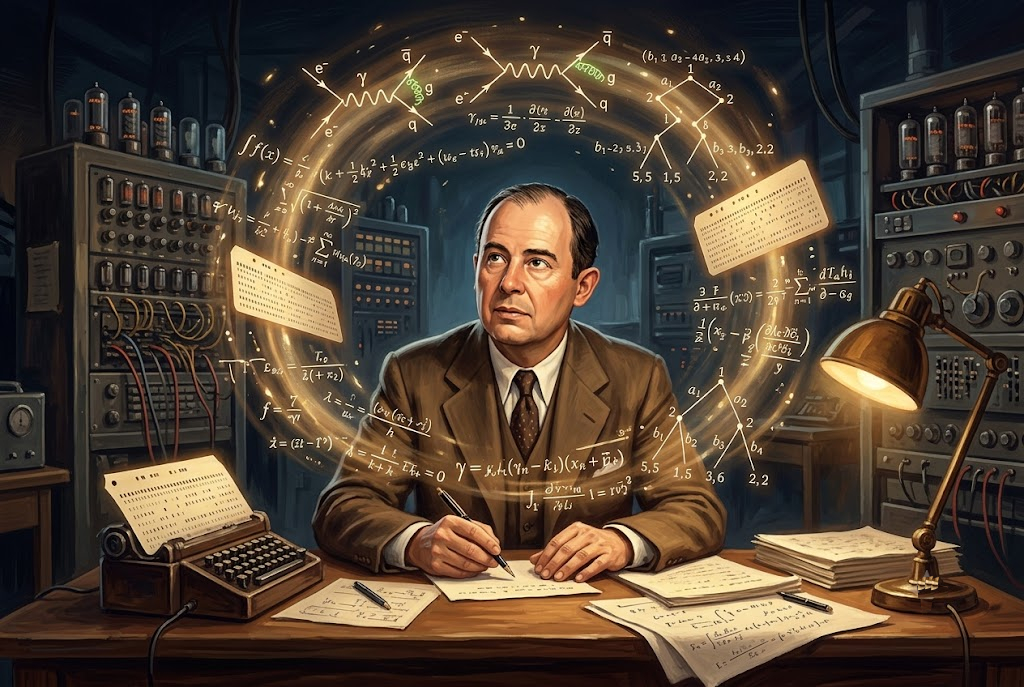
Introduction: The Universal Genius Who Shaped Our Modern World
When I first started diving into the origins of modern technology, I kept stumbling across one name that seemed to appear everywhere: John von Neumann (opens in a new tab). Whether I was reading about quantum mechanics, nuclear physics, computer design, economics, or artificial intelligence, von Neumann’s genius was right at the center of it. Nobel laureates and legendary physicists often described him as a human supercomputer, a man whose mind operated on an entirely different plane from the rest of humanity.
Before we dive in, please note that this is going to be a very long and detailed biography blog detailing the complete life, mind, and historic contributions of John von Neumann. If you have ever wondered who actually laid the blueprint for the smartphone in your hand, the modern computer processor, or the geopolitical strategy of the nuclear age, you are about to discover the human mind behind it all.
"I have known many intelligent people in my life. I knew Planck, von Laue, and Heisenberg. Paul Dirac was clever and Erwin Schrödinger was brilliant. But von Neumann was in a species by himself." — Eugene Wigner, Nobel Laureate in Physics
Von Neumann did not just contribute to one field; he reshaped nearly every branch of knowledge he touched. From proving fundamental theorems in pure mathematics to designing the architecture that runs every modern laptop, his legacy quietly powers our everyday lives.
Early Years in Budapest: The Child Prodigy Who Memorized Phonebooks
John von Neumann was born as Neumann János Lajos in Budapest, Hungary, on December 28, 1903. He grew up in a wealthy, non-practicing Jewish family. His father, Max Neumann, was a successful banker who bought a title of nobility, which added the "von" to the family name. From a very young age, János—nicknamed "Jancsi"—showed extraordinary mental capabilities that stunned his family and teachers.
By age six, von Neumann could mentally divide two eight-digit numbers and converse in Ancient Greek. If his mother left a telephone directory nearby, young Jancsi would memorize entire pages for fun, reciting names, addresses, and phone numbers upon request. He possessed a photographic memory combined with lightning-fast processing speed.
His home in Budapest was a hub for intellectual discussion. His parents encouraged reading, foreign languages, and high-level debate, ensuring that Jancsi and his brothers were immersed in literature, history, and science from childhood.
The Mathematical Foundations: Rátz, Fejér, and Young János
By the time von Neumann entered the prestigious Lutheran Fasori Evangélikus Gimnázium in Budapest, his math teachers quickly realized that he had already surpassed their knowledge. The famous mathematics teacher László Rátz recognized Jancsi's extraordinary talent and arranged for university professors to tutor him privately.
Among these mentors was Lipót Fejér, one of Hungary's top mathematicians. Legend has it that when Fejér first read one of von Neumann's early mathematical proofs, the professor had tears in his eyes because of its sheer elegance. Von Neumann published his first mathematical paper at the age of 17 alongside Gábor Szegő, focusing on the zeros of certain polynomials.
Even at this young age, von Neumann displayed an unusual trait: he was not a solitary, eccentric scholar living in isolation. He loved social gatherings, jokes, good food, and fine clothes—a personality that would make him uniquely popular throughout his life.
Life Across Two Campuses: ETH Zürich and the University of Budapest
Despite his obvious mathematical genius, von Neumann’s father wanted him to pursue a career with practical financial security. Max Neumann believed that pure mathematics was not a reliable income source, so a compromise was made: John would study chemical engineering.
Between 1921 and 1926, von Neumann pulled off a astonishing dual academic career:
- He enrolled at ETH Zürich (opens in a new tab) in Switzerland to study Chemical Engineering.
- Simultaneously, he remained enrolled at the University of Budapest for a Ph.D. in Mathematics.
He rarely attended lectures in Budapest, appearing only to take and easily ace the end-of-semester exams. In 1926, at just 22 years old, he graduated with a diploma in Chemical Engineering from ETH Zürich and a Ph.D. in Mathematics from Budapest, submitting a revolutionary dissertation on axiomatic set theory.
The Weimar Years: Revolutionizing Mathematics in Berlin and Göttingen
After earning his doctorate, von Neumann moved to Germany, the global epicenter of theoretical physics and mathematics during the 1920s. He became a Privatdozent (unpaid lecturer) at the University of Berlin—the youngest in the university’s history.
During this period, von Neumann collaborated with David Hilbert at the University of Göttingen, working on Hilbert's program to put all of mathematics on a rigorous logical foundation. Von Neumann’s work on set theory helped clarify the fundamental axioms of mathematics, securing his reputation across Europe.
During these Weimar years, von Neumann published mathematical papers at an astounding rate—averaging one major paper every month. His ability to instantly digest complex mathematical logic left senior professors in awe.
Taming Quantum Mechanics: Creating the Mathematical Language of Physics
In the late 1920s, the world of physics was in total chaos. Quantum mechanics was rapidly developing, but it suffered from two competing, mathematically awkward theories: Werner Heisenberg’s matrix mechanics and Erwin Schrödinger’s wave mechanics. While both models yielded correct predictions, nobody understood why two completely different mathematical tools worked for the same physical reality.
Von Neumann solved this crisis. Between 1927 and 1932, he proved that both formulations were mathematically equivalent within the framework of infinite-dimensional Hilbert spaces (opens in a new tab). Similar to how we explored in our deep dive into Niels Bohr and quantum mechanics, quantum theory needed a unified framework, and von Neumann provided it.
He published his findings in his landmark 1932 book, Mathematical Foundations of Quantum Mechanics. He introduced the mathematical concept of quantum measurement, density matrices, and state vectors, giving physicists the exact tools still used today in modern quantum computing research.
Crossing the Atlantic: Joining the Institute for Advanced Study at Princeton
As the political situation in Germany deteriorated with the rise of the Nazi regime in the early 1930s, von Neumann recognized the growing danger. Being of Jewish descent, he accepted an invitation to become a visiting professor at Princeton University in New Jersey in 1930.
In 1933, the Institute for Advanced Study (IAS) was established in Princeton, designed as a paradise for pure research with no teaching obligations. Von Neumann was invited to be one of its founding professors alongside Albert Einstein and Kurt Gödel.
At Princeton, von Neumann became a legend. While Einstein worked quietly on unified field theory, von Neumann was hyperactive, consulting for government military research, hosting legendary cocktail parties, and driving his Cadillac down Princeton streets while reading mathematical papers—often resulting in minor traffic accidents!
The Birth of Game Theory: Mathematical Strategy and Economics
In 1944, von Neumann co-authored a monumental book with economist Oskar Morgenstern titled Theory of Games and Economic Behavior. This single publication created the field of game theory (opens in a new tab).
Before von Neumann, economics lacked a rigorous way to model decisions made by competing individuals or businesses. Von Neumann realized that human interactions—whether in poker, business competition, or military warfare—could be analyzed mathematically as "games" of strategy.
Key concepts introduced by von Neumann include:
- Zero-Sum Games: Situations where one participant's gain is exactly equal to another participant's loss.
- The Minimax Theorem: Proving that in zero-sum games with perfect information, there is always a rational strategy that minimizes maximum potential loss.
This framework revolutionized modern economics, corporate negotiation strategy, evolutionary biology, and political science.
The Manhattan Project: Designing the Implosion Lens for the Atomic Bomb
When World War II escalated, von Neumann lent his immense calculation power to the Allied war effort. In 1943, he joined the top-secret Manhattan Project (opens in a new tab) at Los Alamos, New Mexico.
While theoretical physicists were wrestling with how to detonate a plutonium bomb, von Neumann provided the mathematical solution: the implosion lens mechanism. A spherical shell of conventional high explosives surrounding plutonium needed to detonate with perfect microsecond precision, compressing the subcritical core into a supercritical mass.
Von Neumann performed the extremely complex hydrodynamics calculations by hand and using early mechanical calculators, proving that implosion was physically possible. His work was essential to the success of the "Fat Man" atomic bomb dropped on Nagasaki. As we detailed in our analysis of how atomic bombs work, mastering blast wave focus was the critical hurdle of nuclear weapons design.
The ENIAC and EDVAC Breakthrough: Rethinking How Machines Compute
While working on shockwave equations for Los Alamos, von Neumann realized that human computers and mechanical desk calculators were far too slow. In 1944, he visited the Moore School of Electrical Engineering at the University of Pennsylvania, where engineers J. Presper Eckert and John Mauchly were constructing the ENIAC—the world's first large-scale electronic computer.
The ENIAC was fast, but it had a massive flaw: to change its program, technicians had to physically rewire hundreds of cables and flip thousands of switches over several days.
Von Neumann saw a far better way. In 1945, he wrote a famous paper titled First Draft of a Report on the EDVAC. In this report, he conceptualized the "stored-program computer"—a machine that stored both program instructions and data in the same electronic memory.
Unpacking the Von Neumann Architecture: How Memory and CPU Coexist
The structural blueprint outlined in that 1945 report became known worldwide as the Von Neumann Architecture. Prior to this design, computers were single-purpose calculating machines. Von Neumann’s design transformed the computer into a flexible, general-purpose platform.
+---------------------------------------------------+
| CENTRAL PROCESSING UNIT |
| +--------------------+ +--------------------+ |
| | Control Unit (CU) | | Arithmetic Logic | |
| | - Instruction Reg | | Unit (ALU) | |
| | - Program Counter | | - Accumulator | |
| +---------+----------+ +---------+----------+ |
+------------|------------------------|-------------+
| |
+------------+-----------+
|
v
+---------------------------------------------------+
| MEMORY UNIT |
| - Stores Instructions (Program Code) |
| - Stores Data (Variables, Inputs, Outputs) |
+---------------------------------------------------+
^
|
+-------------------------+-------------------------+
| |
v v
+--------------+ +---------------+
| Input Device | | Output Device |
+--------------+ +---------------+
The architecture consists of four primary functional components:
- Central Processing Unit (CPU): Contains the Arithmetic Logic Unit (ALU) for processing calculations and control registers.
- Control Unit (CU): Fetches instructions from memory, decodes them, and coordinates operations.
- Memory Unit: Stored RAM holding both executable instructions and working data.
- Input/Output (I/O) Mechanisms: Interfaces for human interaction and data retrieval.
Why the Von Neumann Architecture Powers Your Smartphone and Laptop Today
This design is the reason why your smartphone can run a web browser, play a 3D game, stream music, and execute AI algorithms without needing hardware physical rewiring. The hardware stays the same; only the software instructions loaded into memory change.
However, this design also introduced a famous performance bottleneck known as the Von Neumann Bottleneck. Because data and instructions must share the same physical bus or communication channel, the CPU frequently sits idle waiting for memory transfer. Modern computer engineers bypass this limit using multi-level cache memory (L1, L2, L3 caches), pipelining, and parallel GPU processing.
Just as Alan Turing gave us the theoretical model of computation with the Universal Turing Machine, John von Neumann gave us the physical engineering reality.
Self-Replicating Automata: The Pioneer of Cellular Automata and AI
Long before modern computer viruses, biological engineering, or artificial intelligence, von Neumann posed a radical question: Can a machine construct an exact copy of itself?
In the late 1940s, he introduced the concept of Cellular Automata and the Universal Constructor. He proved mathematically that an automaton could contain its own instruction manual, build a duplicate machine from raw components, and copy its instruction manual into the offspring.
This work laid the foundation for:
- Cellular Automata: Grid-based simulation systems (later popularized by John Conway's Game of Life).
- Computer Viruses: Software self-replication logic.
- Nanotechnology: Self-assembling microscopic robotic systems.
- DNA Biology: Von Neumann predicted the dual role of genetic material (acting as both structural code and instructions) years before Crick and Watson solved the DNA structure!
Cold War Strategy: Deterrence, ICBMs, and the Atomic Energy Commission
After World War II, von Neumann became a prominent policy advisor to the US government. In 1954, President Dwight D. Eisenhower appointed him to the Atomic Energy Commission (AEC).
During the Cold War, von Neumann used game theory to formulate the strategy of Mutually Assured Destruction (MAD). He argued that nuclear weapons were so destructive that if both superpowers maintained guaranteed retaliation capabilities, neither side would ever launch a first strike.
He also led the ICBM (Intercontinental Ballistic Missile) committee, pushing for miniaturized hydrogen bomb warheads mounted on long-range rockets. His strategic insights dominated American military policy throughout the 1950s.
The Mind That Outcalculated Supercomputers: Anecdotes of Infinite Intelligence
Stories of von Neumann's astonishing brain speed are famous among scientists. His colleagues often felt that while normal geniuses were simply faster than average people, von Neumann was an entirely different species.
Here are three famous historical anecdotes:
- The Fly and the Trains Problem: A classic puzzle asks: Two trains 100 miles apart travel toward each other at 50 mph. A fly flies back and forth between them at 75 mph until squished. How far did the fly travel? Most people use simple distance-time math (the trains collide in 1 hour, so 75 miles), but mathematicians usually get caught setting up infinite series. When posed this problem, von Neumann gave the answer in two seconds. The poser remarked, "Ah, you saw the trick!" Von Neumann replied in surprise: "What trick? I just summed the infinite series in my head."
- Out-calculating ENIAC: When the ENIAC computer was brought online, researchers spent hours setting up a complex hydrogen fusion calculation. Von Neumann did the calculation in his head on a notepad to verify whether the machine was functioning properly.
- Instant Translation: Von Neumann could read a book in original Latin or Ancient Greek and fluently translate it aloud into English on sight at full speaking speed without pausing.
Comparison of 20th Century Visionaries: Von Neumann vs Turing vs Einstein
To understand where von Neumann stands in scientific history, let's compare his domain contributions with two other legendary figures of his time: Albert Einstein and Alan Turing.
Feature / Domain John von Neumann Alan Turing Albert Einstein
Primary Fields
Pure/Applied Math, Quantum Mechanics, Computing, Economics, Defense
Mathematical Logic, Cryptanalysis, Theoretical Computer Science, AI
Theoretical Physics, Cosmology, Quantum Mechanics, Thermodynamics
Key Legacy Invention
Von Neumann Architecture, Game Theory, Implosion Lens
Turing Machine, Codebreaking (Enigma), Turing Test
General & Special Relativity, , Photoelectric Effect
Working Style
Hyper-polymath, practical engineer, government consultant, socialite
Reclusive, deeply focused theoretical solver, codebreaker
Intuitive visual thought experiments, isolated theoretical focus
Impact on Computing
Physical architecture of digital computers, memory layout
Fundamental theory of what is computable
Physical foundations of semiconductors (quantum physics)
Impact on Modern Society
Everyday digital processors, modern economic strategy, nuclear policy
Software design, AI ethics, cryptography
Space exploration, GPS, solar energy, nuclear physics
The Final Battle: Cancer, Hospital Bed Breakthroughs, and Last Days
In 1955, von Neumann was diagnosed with bone cancer or pancreatic cancer—likely caused by his exposure to nuclear radiation during tests at Los Alamos and Bikini Atoll.
Even as his health rapidly deteriorated, his mind refused to slow down. From his bed at Walter Reed Army Hospital in Washington, D.C., he continued to advise the U.S. military and write complex mathematical manuscripts. He began working on a book comparing human brain neurological processing with electronic computers.
As cancer invaded his brain, the man who had relied on unyielding mental speed experienced terrifying moments of memory decline. Military guards were placed outside his hospital room to ensure he did not accidentally blurt out top-secret military secrets in his sleep during high-fever delirium.
John von Neumann passed away on February 8, 1957, at the age of 53. His unfinished final hospital manuscript was published posthumously as The Computer and the Brain, serving as a foundational text for cognitive science and modern neural network AI architectures.
Conclusion: The Invisible Architect of the Digital Universe
Was John von Neumann the smartest human in history? While intelligence is difficult to measure across eras, few human beings have ever altered so many distinct domains of human civilization simultaneously.
Every time you unlock your smartphone, run a computer program, analyze market investments, or rely on strategic global stability, you are living inside a digital world engineered by John von Neumann. He did not merely predict the future; he calculated it, wrote the code for it, and built the architecture that made it possible.
What part of John von Neumann's incredible contributions surprises you the most? Share your thoughts in the comments below, and don't forget to share this article with fellow science and tech enthusiasts!

Conversation0
No comments yet. Be the first to share a thought — the best questions often become new stories.