


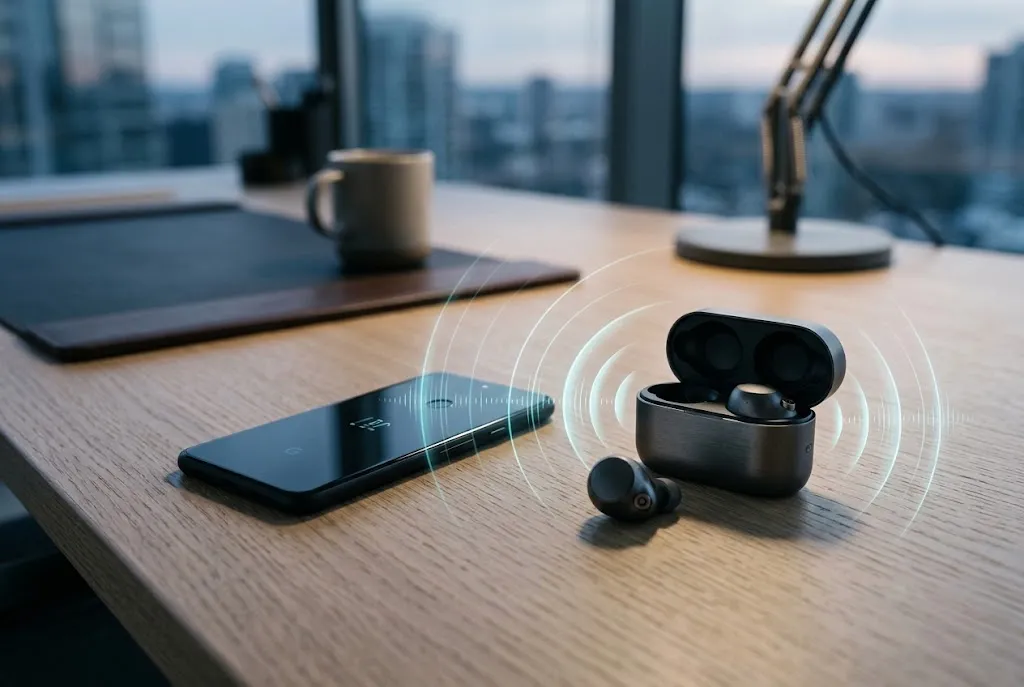
The invisible connection in your pocket
I can pair a pair of Bluetooth earbuds in a few seconds and then forget the radio link is even there. No cable. No visible beam. Just music arriving in my ears while the phone stays in my pocket.
How does Bluetooth work? The trick is not that your phone somehow “finds” your earbuds through magic. Bluetooth devices use short-range radio, a careful discovery process, and rapidly changing communication channels to exchange small bursts of data while using very little power.
I find the first part especially interesting because Bluetooth was designed around a very ordinary problem: replacing short cables with a wireless link. The name comes from a 10th-century Danish king, Harald “Bluetooth” Gormsson, who was associated with uniting Denmark and Norway; the modern technology borrowed the name because its founders wanted a symbol for bringing separate devices together. The Bluetooth Special Interest Group (opens in a new tab) now maintains the technical specifications used by Bluetooth products.
And the radio itself is surprisingly modest. Classic Bluetooth and Bluetooth Low Energy operate in the unlicensed 2.4 GHz band, the same broad neighborhood used by Wi-Fi and several other everyday wireless systems.
That crowded neighborhood is why Bluetooth cannot simply shout louder and hope for the best.
Your phone is really talking in radio packets
When I turn on Bluetooth, the phone does not continuously broadcast everything it knows. Instead, Bluetooth has procedures for discovering nearby devices and establishing a connection.
A simplified version looks like this:
discover → identify → connect → exchange data → manage the link
During discovery, a device can make itself available for other devices to detect. The exact behavior depends on the Bluetooth mode and roles involved, but the important idea is that nearby devices exchange short radio messages rather than opening a permanent radio channel.
Once I choose my headphones from the list, the two devices negotiate how they will communicate. They also handle security steps so that an unwanted nearby device cannot simply impersonate the connection.
This is one reason pairing can feel like a tiny ritual. Behind that single tap, the devices are agreeing on identities, capabilities, security information, and connection parameters.
Bluetooth then chops information into packets. A song, for example, is not sent as one enormous wireless file. The data moves through a stream of smaller pieces that the receiver can check and process.
The Bluetooth Core Specification (opens in a new tab) defines the rules for this exchange, from the radio layer upward. I like thinking of it as a very strict conversation: each device has to speak the same protocol, listen at the expected moments, and understand the same packet format.
Why Bluetooth survives in the same room as Wi-Fi
Here is where the engineering gets clever.
Bluetooth uses a technique called frequency hopping in its classic radio system. Instead of staying on one frequency all the time, the connection changes among many channels according to a shared sequence.
That matters because the 2.4 GHz band can get messy. Your Wi-Fi router may be transmitting. Another Bluetooth device may be active. A wireless keyboard could be nearby. None of them gets a perfectly quiet slice of spectrum.
Frequency hopping does not make interference disappear. It gives the Bluetooth link more ways to avoid spending the entire connection on one noisy spot.
This is also why the relationship between Bluetooth and Wi-Fi is interesting. They can operate in the same 2.4 GHz band, but they use different radio strategies and network protocols; the Wi-Fi system behind your internet connection is doing a much larger job than a typical Bluetooth link.
Bluetooth Low Energy, or BLE, takes a somewhat different path. It is designed around short bursts of communication and low power consumption, which is useful for devices such as sensors, fitness accessories, and small controllers.
For many BLE gadgets, there is simply no reason to keep a high-power radio conversation going every second. The device can wake, transmit the needed information, and return to a low-power state.
That tiny design choice has a huge practical consequence.
Why your earbuds can last for hours
I used to think battery life in wireless gadgets mostly came down to battery size. Radio design matters just as much.
A Bluetooth device has to spend energy transmitting and receiving, but it can also save energy by deciding when not to communicate. BLE is particularly good at this because its architecture supports short communication events rather than requiring a continuously active high-throughput link.
Audio is a special case. Bluetooth audio needs a more sustained stream than a temperature sensor sending one reading every few seconds. Headphones therefore use profiles and codecs designed for audio transport, with the exact behavior depending on the Bluetooth version, device capabilities, and software.
A codec compresses audio into a form that can be delivered efficiently over the wireless link. The headphones then decode that information and turn it back into an electrical signal for the speaker drivers.
So when I press play, the path is roughly:
phone audio data → Bluetooth processing → radio packets → headphone radio → audio decoding → amplifier → speaker driver
That sounds complicated because it is. But each step happens quickly enough that I usually experience it as one thing: sound.
This is why Bluetooth earbuds can lose a little battery while sitting quietly in a pocket even when no music is playing. The radios and supporting electronics still have to perform periodic communication and connection-management work.
Pairing is more than “finding a device”
The word “pairing” makes the process sound simpler than it is.
A Bluetooth connection has to answer several questions. Who is the other device? Should these two devices trust each other? Which services are available? How should data be protected? What communication settings should they use?
Modern Bluetooth security can use authentication and encryption, with the exact method depending on the pairing model and the devices involved. That means the little code confirmation or pairing prompt you sometimes see is part of a larger trust process.
There is a useful distinction here between pairing and simply being connected.
Pairing generally establishes or stores the information needed for two devices to recognize and trust each other again. A connection is the active communication session happening now.
That is why a keyboard can remain paired to a laptop even when the keyboard is turned off. The relationship has been remembered; the radio link itself is not continuously active.
What actually happens when you walk away?
Range is not a single number carved into stone.
Bluetooth performance depends on the radio power, antenna design, physical obstacles, interference, and the specific Bluetooth mode and data rate in use. Two devices in an open room can behave very differently from the same devices separated by walls and furniture.
As I walk away from my phone, the signal arriving at the headphones gets weaker. Radio waves spread through space, and buildings, people, and objects can absorb or reflect some of that energy.
Eventually, the connection may begin to suffer packet errors or missed communication events.
Bluetooth systems can react in several ways depending on the link. They may retry data, adjust behavior, or ultimately lose the connection if communication can no longer be maintained.
That is the familiar moment when music freezes.
Then the phone shows “disconnected,” and the invisible conversation is over.
Bluetooth is not one single thing
One reason Bluetooth specifications can seem confusing is that Bluetooth Classic and Bluetooth Low Energy are not identical systems.
Bluetooth Classic is widely associated with continuous connections such as traditional wireless audio and some older accessory use cases. BLE was designed around low-power communication and has become common in sensors, beacons, medical accessories, smart-home devices, and many battery-powered gadgets.
There is overlap, too. Modern phones often support both.
That means two products carrying the Bluetooth logo can behave very differently because they may be using different Bluetooth technologies, profiles, power modes, and application designs.
The radio is only one piece of the puzzle.
The strange beauty of a Bluetooth connection
What amazes me is how little of this process I notice.
I tap a button. Somewhere inside the phone, software prepares data. A tiny radio turns electrical signals into electromagnetic waves. An antenna launches those waves into the room. Another antenna catches a small fraction of that energy, the receiver reconstructs the packets, and software decides what those bits mean.
Then I hear a guitar riff.
No visible connection. No dedicated cable. Just physics, timing, protocols, and a very small amount of radio energy working together.
That is the real Bluetooth trick. It does not defeat distance or interference. It works within those limits by controlling the conversation carefully.
What to remember
Bluetooth works because devices agree on how to discover each other, establish trust, exchange packets, manage interference, and conserve power.
The next time your earbuds connect before you have even looked at the phone, there is a whole radio conversation happening in the background.
Quietly.
Very quickly.
And entirely by design.


Conversation0
No comments yet. Be the first to share a thought — the best questions often become new stories.