


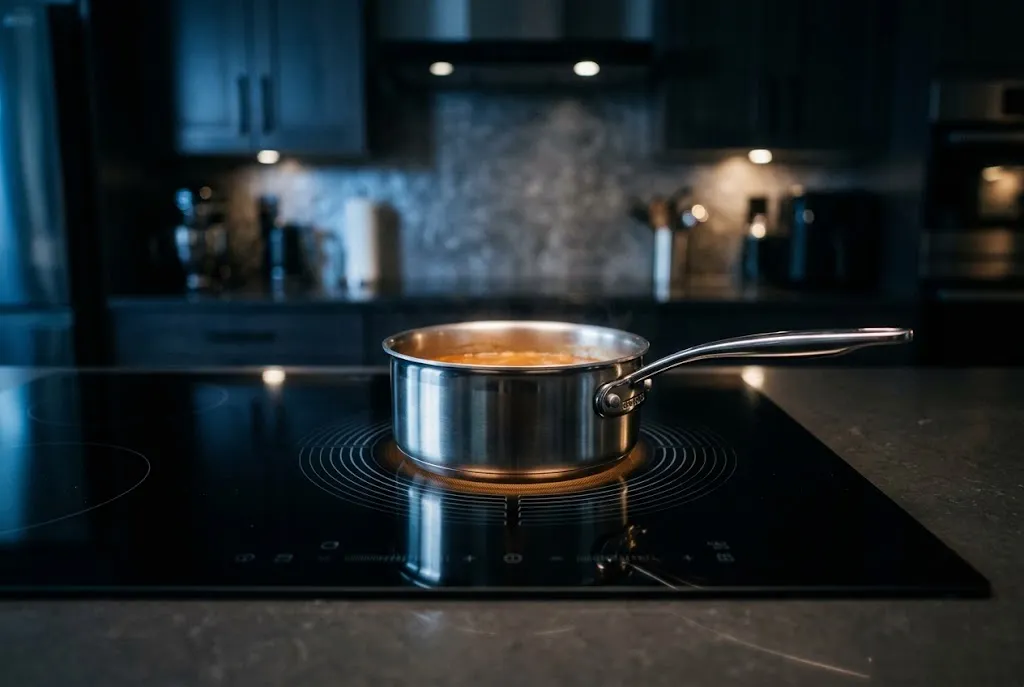
I Put a Pan on Glass. It Got Hot.
The first time I really thought about an induction cooker, I found the whole thing slightly absurd. The cooktop looked almost cold and ordinary, yet a pan sitting on it could get hot enough to fry an egg in minutes.
Induction cooking sounds almost like a trick. It is not.
The heat comes from electricity, a changing magnetic field, and tiny electrical currents that form inside the metal pan. The glass surface is mostly along for the ride.
That is the part I find most interesting: the cooker does not simply heat the surface and wait for heat to move into the pan. It creates the conditions for the pan to heat itself.
An induction cooker works through electromagnetic induction, the same physical idea behind transformers and many wireless-power systems. You can read a compact technical overview of the cooking method in the induction cooking (opens in a new tab) entry on Wikipedia.
So what is actually happening underneath that black glass?
The Coil Hiding Under the Glass
I would see almost nothing if I lifted the top of a typical induction cooktop while it was switched off. The important component sits underneath: a flat coil of conductive wire.
When the cooker is operating, electronics send alternating electric current through that coil. Because the current is constantly changing direction, the coil produces a changing magnetic field above it.
The field passes through the glass and reaches the bottom of a suitable pan.
Nothing dramatic appears to happen. There is no flame. The glass does not become a glowing heating element. The invisible field is doing the work.
The basic idea is closely related to the physics behind transformers. A changing magnetic field can induce electrical currents in another conductor, which is why induction also turns up in electrical engineering beyond kitchens. The U.S. Department of Energy (opens in a new tab) provides background on electrical heating and related energy concepts.
But there is a catch: the pan has to interact with that magnetic field in the right way.
A random piece of metal will not necessarily behave like an induction pan.
Why the Cookware Matters
Most induction cookers work best with cookware containing ferromagnetic material, such as iron or certain magnetic stainless steels. A quick magnet test is often enough to tell you whether a pan is likely to work.
Aluminum and copper are good electrical conductors, but ordinary cookware made only from those metals generally does not couple to the magnetic field in the same useful way.
Some pans solve this by using a magnetic layer on the bottom.
And that thin layer matters a lot.
The Pan Makes Tiny Electric Currents
Once the changing magnetic field reaches the conductive base of the pan, it induces circulating electrical currents inside the metal. These are commonly called eddy currents.
I like to picture them as little loops of current moving within the pan rather than electricity simply flowing from one edge to another.
The metal has electrical resistance. So when current moves through it, electrical energy is converted into heat.
That is the key step.
The heat is generated inside the pan material itself, rather than mainly being produced by a burner and then conducted upward.
The exact distribution depends on the cookware, its magnetic properties, its thickness, the coil design, and the operating frequency. The currents tend to be concentrated toward certain regions of the cookware, an effect associated with the skin effect in alternating-current systems.
So when I put a compatible pan on an induction zone, I am effectively bringing a second electrical system into the field created by the cooker coil.
No flame required.
And because the pan is where much of the heating occurs, the glass surface can remain far cooler than a conventional radiant electric burner while cooking is underway. It can still get hot, though, because the hot pan transfers heat back into the glass.
This is why an induction cooktop can feel strangely different from a traditional electric stove: the pan is the main heating element.
Why It Can Heat So Quickly
Speed is where the physics becomes practical.
Imagine a conventional electric resistance cooktop. The electrical element heats up first. That element then transfers heat to the cookware, and the cookware transfers it to the food.
An induction system cuts out much of that intermediate path.
The changing magnetic field is coupled directly to the pan, so energy can be deposited in the cookware without first making a separate burner red-hot.
That does not mean every watt becomes useful heat in the food. There are still losses in the electronics, the coil, the cookware, and the surrounding environment. But the cooking system can transfer energy efficiently because the heat is created directly in the vessel.
The practical result is familiar: water can begin heating rapidly, and a pan can respond quickly when I raise or lower the power setting.
This is also why the shape and material of the pan matter. Two pans sitting on the same induction zone can behave differently because their magnetic and electrical properties are different.
For a useful real-life connection, this is why a cheap incompatible aluminum pan can sit almost uselessly on an induction cooker while a magnetic steel pan heats normally on the exact same surface.
The Electronics Are Doing More Than Switching It On
There is another part of the story hiding underneath the countertop: the power electronics.
Household electricity arrives as alternating current at a relatively low frequency compared with the operating frequency used by the induction system. The cooker's electronics convert and control that electrical power so the coil can generate the rapidly changing magnetic field it needs.
A simplified chain looks like this:
| Stage | What happens |
|---|---|
| Household supply | Electrical power enters the cooker |
| Power electronics | The incoming power is converted and controlled |
| Induction coil | Alternating current creates a changing magnetic field |
| Pan base | Eddy currents are induced in the metal |
| Pan resistance | Electrical energy becomes heat |
| Food | Heat moves from the cookware into the food |
The controls also let the cooker change the effective power delivered to the pan. Depending on the model, that can involve changing operating conditions, duty cycles, or other control parameters rather than simply behaving like a basic on-off switch.
And modern cooktops add another layer: sensing.
They can detect whether suitable cookware is present, manage temperature or power limits, and shut down a cooking zone under certain conditions.
The experience feels simple because the complicated part is hidden.
Why the Glass Does Not Need to Glow
I think this is the visual detail that makes induction cooking seem mysterious.
With a gas flame, I can literally see the energy source. With a traditional electric coil, I can often see the element glowing. Induction gives me almost nothing to look at.
The magnetic field is invisible, and the heating is happening in the cookware.
That makes the cooktop look passive even while a large amount of energy is moving through the system.
The glass is mainly there to provide a smooth cooking surface and to let the magnetic field pass through with relatively little interference. It can become hot later because the pan sitting on top is hot.
So the familiar warning that an induction surface can remain hot after cooking is still real. It just is not hot for the same reason a conventional electric element gets hot.
Why an Induction Cooker Sometimes Makes Noise
Then there is the odd buzzing.
I have heard induction cookers make a faint hum, buzz, or clicking sound, especially with certain pans and power settings. That noise does not automatically mean something is wrong.
The coil and power electronics can produce audible vibrations, while the cookware itself may vibrate slightly as alternating electromagnetic forces act within the system. Pan construction matters too.
A lightweight or poorly matched pan can sound different from a heavy one.
At lower power levels, some cookers also regulate energy in ways that create noticeable cycling or pulsing sounds.
It is a good example of something that looks purely electronic but still has a mechanical side.
The Surprising Link to Wireless Power
There is a useful connection here to something you may already use every day.
Induction cooking and wireless charging share the same broad physical idea: transferring energy through a changing magnetic field.
The engineering goals are different, and so are the frequencies, coil geometries, power levels, control systems, and coupling distances. A cooktop is designed to move substantial power into cookware, while a wireless phone charger is optimized for a much smaller device over a short gap.
Still, the underlying concept is related.
That is why the same basic induction principle appears in discussions of wireless charging (opens in a new tab). It is also the reason electromagnetic induction is such a familiar idea in electrical engineering.
I can bring the connection even closer to home: the same broad physics helps explain why your phone can receive power without a cable touching its charging coil.
What Happens When the Pan Leaves the Surface?
Here is one of the nicest safety features.
If I remove the compatible pan, the magnetic coupling changes dramatically because the intended load is gone. Modern induction cookers can detect that change and stop or reduce power to the cooking zone.
This does not make every induction surface harmless immediately. A recently used pan can leave residual heat behind, and the glass can remain hot from contact with cookware.
But the cooker is not normally dumping full cooking power into an empty spot with nothing to absorb it.
That difference is one reason people often appreciate induction for kitchen safety and control.
So, Is Induction Cooking Really Just Magnetism?
Not quite.
Magnetism starts the chain, but several pieces have to work together: controlled alternating current, a coil, the magnetic response of the cookware, induced currents, electrical resistance, and heat transfer into the food.
Remove one major piece and the whole process changes.
That is what makes induction cooking such a satisfying everyday example of physics. I can stand in front of an ordinary kitchen counter and watch an invisible electromagnetic system turn electrical energy into heat inside a metal pan.
The strange part is also the useful part.
The burner is not really the thing getting hot. The pan is.
The Takeaway
Once I see what is underneath the glass, an induction cooker stops looking mysterious. It is a carefully controlled electromagnetic system that creates heat directly in compatible cookware.
And that little black circle on the countertop is doing far more than it appears to.
Why Some Pans Work and Others Do Not
The simplest test remains almost comically low-tech: use a small magnet.
If the magnet sticks firmly to the bottom of the pan, the cookware is generally a good candidate for an induction hob. That test is only a practical clue, not a full engineering specification, because performance also depends on the pan's construction and the cooker itself.
Some manufacturers build magnetic material into a composite base so the visible cooking surface can still be made from another metal.
This is why the phrase "stainless steel" alone does not tell me enough. Stainless steels have different magnetic properties depending on their composition and structure.
A pan can look almost identical to another pan and behave very differently on an induction zone.
Why Size and Position Change the Result
The cookware also needs to sit in a useful position relative to the coil.
If I place a small magnetic pan far off-center on a large cooking zone, the coupling can be weaker or the cooker may refuse to operate depending on its sensing system. Some modern hobs use multiple sensing strategies and flexible coil arrangements, but the basic requirement remains the same: the electromagnetic field needs a suitable load to interact with.
That is another everyday clue that the cooker is not simply heating the glass.
Move the pan, and the electrical behavior changes.
Why Induction Is So Efficient at the Point of Cooking
The biggest practical advantage is not magic efficiency. It is where the useful heating occurs.
Because the electromagnetic field induces current directly in the cookware, there is less need to heat a separate burner first. The pan can respond quickly, and the system can be controlled electronically.
That is especially noticeable when changing power during cooking. A traditional electric element can remain visibly hot after the control is turned down, while an induction cooker can reduce the energy transfer to the pan much more quickly.
The difference is not absolute; cookware retains heat, and food certainly does not cool instantly. But the source of new heating can be reduced rapidly.
This is why induction feels unusually responsive when I am trying to keep a sauce from suddenly boiling over.
One Invisible Field, One Very Ordinary Dinner
The funny thing about induction is that nothing about the dinner itself looks futuristic.
There is still a pan. Still oil. Still steam rising from food. Still the moment when I realize I turned the heat up too far.
Underneath, though, an alternating electrical current is creating a changing magnetic field, that field is inducing electrical currents in the pan, and resistance inside the cookware is turning those currents into thermal energy.
That invisible chain is the whole trick.
And it is a good reminder that some of the most useful technology does not need a dramatic appearance. Sometimes the cleverest machine is the one that leaves almost nothing to see.
The Simple Physics Behind the Heat
At its core, the idea can be expressed without turning the kitchen into a physics lecture.
A changing magnetic field induces an electromotive force in a conductor. In a conductive pan, that induced effect drives currents. Because the material has resistance, those currents dissipate electrical energy as heat.
The cooker's engineering challenge is to make that process controlled, efficient, and safe at useful cooking power.
That requires the coil, switching electronics, magnetic materials, sensing system, cooling, and cookware to cooperate as one system.
I find that more interesting than the usual phrase "magnetic heating," because the phrase makes it sound like the magnet itself is hot. It is not.
The field is providing the mechanism for electrical current to be induced in the cookware.
Once that clicks, the whole cooker makes sense.
The Takeaway: The Glass Is Almost the Decoy
An induction cooker looks like a glass heating surface, but that is the wrong mental model.
The real action is underneath and inside the pan. Electronics drive a coil, the coil creates a changing magnetic field, the field induces currents in compatible cookware, and the pan converts that electrical energy into heat.
So the next time I see a perfectly calm black cooktop heating a pot of water, I know what I am really watching.
The stove is barely the hot part.
The pan is where the physics cashes the check.


Conversation0
No comments yet. Be the first to share a thought — the best questions often become new stories.