


Antikythera Mechanism: How Did It Predict Eclipses?
I first came across the Antikythera Mechanism through a question that sounded almost backwards: how could an ancient Greek device predict an eclipse with gears? A calculator made from bronze, recovered from a shipwreck, should not feel this mechanically sophisticated. Yet that is exactly what makes the artifact so strange in the best possible way.
The Antikythera mechanism (opens in a new tab) was built around the late second or early first century BCE and was designed to represent astronomical cycles. It was not a clock in the modern sense. It was a hand-powered mathematical model of the sky, packed into a box that was small enough to carry.
And the eclipse trick is even better than the headline suggests. The machine did not stare at the Moon and somehow detect a coming eclipse. It used known cycles of celestial motion, translated into carefully chosen gear ratios, to calculate when certain lunar events should occur.
That is the part I find hardest to get over. The intelligence was not in electronics. It was in the design of the mechanism itself.
What Was the Antikythera Mechanism?
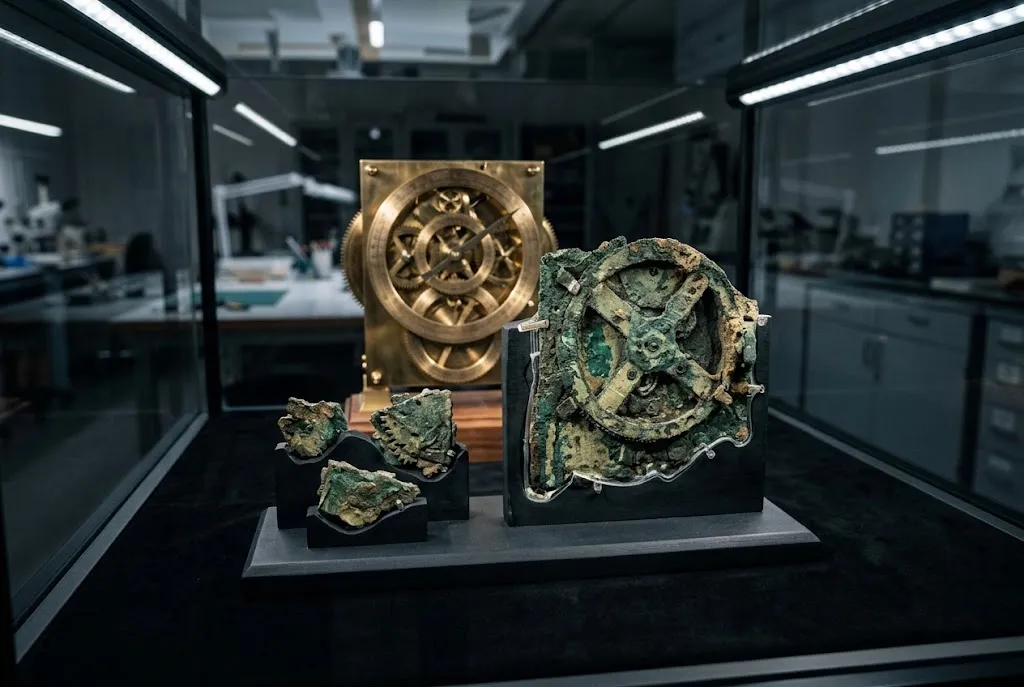
The object was recovered in 1901 from the Antikythera shipwreck, between Crete and the Greek mainland. Archaeologists initially saw a pile of corroded bronze fragments, but later examinations revealed something much more interesting: toothed gears, inscriptions and circular plates that belonged to a single astronomical instrument.
The surviving pieces are badly damaged, so nobody can simply open the original and watch it work. Researchers instead combine the fragments, the visible gear teeth and the surviving inscriptions with astronomical mathematics to reconstruct how the machine operated. The most detailed modern studies show a surprisingly compact system of interconnected gears representing several calendars and astronomical cycles.
The mechanism appears to have had a front display showing the Sun and Moon against a zodiac scale, while rear dials tracked longer cycles. One of those rear displays was closely associated with eclipse prediction.
This is why the artifact matters so much. It is not merely an old collection of gears. It is evidence that ancient Greek craftsmen could turn abstract astronomical relationships into physical mechanical computation.
The Big Idea: Turn Time Into Ratios
I think the easiest way to understand the machine is to forget the word “computer” for a minute and think about ratios.
Suppose one wheel completes 12 turns while another completes 5. If you connect those wheels correctly, you have created a mechanical relationship between two repeating motions. Change the tooth counts, and the relationship changes.
That is the basic language of the Antikythera Mechanism.
A gear with 40 teeth driving a gear with 20 teeth makes the second wheel rotate twice as fast as the first. Reverse the arrangement and the second wheel turns more slowly. With enough gears, you can build a physical representation of complicated cycles without writing an equation on paper.
The actual mechanism was far more intricate than that simple example. Multiple gear trains worked together to represent different periods associated with the Sun, Moon and calendar systems. The surviving inscriptions are especially valuable because they function like partial instructions, helping researchers interpret what the dials were meant to show.
A detailed modern analysis of the artifact, including work published in Nature (opens in a new tab), helped establish how its gear trains could reproduce known astronomical periods.
The clever part is that the machine does not need to reproduce every detail of the real sky. It only needs to reproduce the cycles relevant to the calculations it is designed to make.
That same principle appears in modern mechanical calculators. Build the right relationship into the machine, and the machine carries out the arithmetic for you.
How the Gears Became an Astronomical Calculator
Here is where the mechanism starts to feel almost modern.
Imagine turning a crank attached to one shaft. That motion can be passed through a sequence of gears, and every gear changes the speed or direction of rotation. A pointer attached farther down the chain can therefore move according to a completely different cycle from the original handle.
The Antikythera Mechanism exploited exactly that idea. Its designers selected tooth counts so the output movements corresponded to astronomical periods. The result was a mechanical model in which one physical turn could stand in for a carefully calculated slice of celestial time.
The Moon created a special challenge because its apparent motion across the sky is not perfectly uniform. The mechanism seems to have included a pin-and-slot arrangement that produced a variable-speed motion for the lunar display rather than treating the Moon as if it moved at a constant rate.
That detail is astonishing because it shows that the designers were not satisfied with a crude circular dial. They were attempting to represent a real irregularity in the Moon's apparent movement.
This is why your everyday mechanical watch can do something surprisingly similar in spirit: a train of gears converts one steady input into several hands moving at different rates. The difference is that the Antikythera Mechanism uses that logic to represent astronomical mathematics instead of hours and minutes.
So How Could It Predict an Eclipse?
An eclipse is not random. It happens when the geometry of the Sun, Moon and Earth lines up in a particular way, and those opportunities recur according to recognizable cycles.
One of the most important cycles represented by the Antikythera Mechanism is the Saros cycle, roughly 18 years, 11 days and 8 hours. After one Saros cycle, eclipse circumstances occur again in a closely related pattern because the relative geometry of the Sun and Moon repeats in a useful way.
The machine's rear dial incorporated a calendar designed to represent the Saros cycle. Markings on that dial include symbols that researchers associate with eclipse events, with additional indications for the expected type or timing of the event.
In other words, the mechanism could take a starting date and move its indicator through a sequence showing when eclipse events should recur. It was not predicting an eclipse by measuring the sky in real time. It was predicting one by encoding periodic astronomical relationships into gears.
That distinction matters.
Think about a mechanical calendar that knows the date without having a sensor pointed at Earth. It works because the designer has built the relevant cycle into the mechanism. The Antikythera Mechanism takes the same principle much further, using several astronomical cycles at once.
And there is another complication. The approximately eight-hour offset in the Saros period means that successive eclipses in a family are visible from different parts of Earth. The mechanism therefore represented a cycle, not a promise that the same place on Earth would see the next eclipse.
That is a much more precise idea than the popular image of an ancient dial simply “telling the future.”
The Other Dials Were Doing More Work
The eclipse dial gets most of the attention, but it was only one part of the story.
The mechanism also represented longer calendar relationships, including the Metonic cycle, a period of 19 solar years that is close to 235 synodic lunar months. That relationship was useful because ancient calendar systems had to deal with the awkward fact that lunar months and solar years do not fit together neatly.
A mechanical device could make that mismatch visible. Instead of asking a person to remember a complicated sequence, the dial could show where a given month sat within the larger cycle.
The front display also tracked the Sun and Moon against the zodiac. Researchers have reconstructed a lunar display that could show the Moon's changing phase, while the surrounding scales provided a framework for reading its position.
There is a subtle lesson here: the mechanism was not trying to make the universe look simple. It was trying to make complicated repeating relationships usable.
That is exactly what good scientific instruments do.
Who Built It?
This is where our certainty drops.
The machine has no surviving label saying “built by” followed by a name. Some historical interpretations have connected it with the scientific tradition of ancient Rhodes, where astronomers such as Hipparchus and Posidonius worked, but the exact workshop and designer remain uncertain.
The ship that carried it appears to have been transporting valuable goods, and the mechanism was probably an expensive specialist instrument rather than an everyday household object. Its inscriptions were written in Greek, and the level of workmanship suggests a skilled manufacturing tradition rather than an isolated experiment.
That uncertainty is worth preserving. We know a great deal about what the mechanism did, while knowing much less about the individual who physically made it.
And that makes the surviving object more valuable, not less. It gives us direct evidence where written historical accounts are incomplete.
What the Antikythera Mechanism Really Changed
I would not call it the first computer without qualification, because the word “computer” covers several very different technologies. But it is reasonable to call the Antikythera Mechanism an ancient analog computational device: a machine that represents numerical and astronomical relationships through continuous mechanical motion.
That places it in a remarkable lineage. Long before silicon chips, engineers were already asking a familiar question: can I make a machine carry the calculation instead of making a person perform every step?
The same instinct appears elsewhere in ancient Greek engineering. You can see the broader tradition in accounts of ancient mechanical devices and Greek automatons, where moving parts were used to turn abstract ideas into physical action.
The Antikythera Mechanism goes one step further. It turns astronomical prediction into something you can hold, turn and read.
Why Did We Forget Machines Like This?
Part of the answer is survival.
Bronze survives better than many organic materials, but a complex machine still has a terrible chance of making it through two thousand years intact. Wooden cases decay. Small components corrode. Instruments are lost in wars, shipwrecks and ordinary neglect. Even when a device survives, the knowledge needed to understand it can disappear.
The Antikythera wreck gives us a particularly dramatic example. A sophisticated instrument survived only as fragments on the seabed, and much of its meaning had to be reconstructed centuries later.
That means the artifact should not be treated as proof that ancient technology was somehow identical to modern technology. It was not. The engineering culture, manufacturing methods and scientific assumptions were very different.
But the underlying idea feels familiar.
We build models. We encode relationships. We make machines do arithmetic.
The Strange Beauty of a Mechanical Prediction
What I love about the Antikythera Mechanism is that its “magic” disappears the moment you understand the gears—and then somehow becomes more impressive.
An eclipse still follows physics. The Moon still obeys orbital motion. Nothing supernatural is happening inside the bronze case.
The wonder is that somebody looked at repeating motions in the sky and decided that those relationships could be translated into metal.
Turn the handle.
The gears move.
The pointers advance.
And a machine built more than two thousand years ago gives you a physical answer to a question about the heavens.
That is not an ancient computer because it looks futuristic. It is remarkable because the basic engineering idea is timeless: understand a pattern well enough, and you can build the pattern into a machine.
A Machine That Made the Sky Readable
The Antikythera Mechanism did not predict eclipses because ancient engineers possessed a hidden technology. It did it because they understood recurring astronomical cycles and had the mechanical skill to represent those cycles with gears.
Once I see it that way, the artifact stops looking like an impossible object and starts looking like something even more interesting: a physical piece of mathematical reasoning.
The bronze has corroded. The ship has been under the sea for centuries. Most of the original machine is gone.
But the idea survived.
And somehow, that idea is still turning.





Conversation0
No comments yet. Be the first to share a thought — the best questions often become new stories.