


The $200 Knife That Lied to You
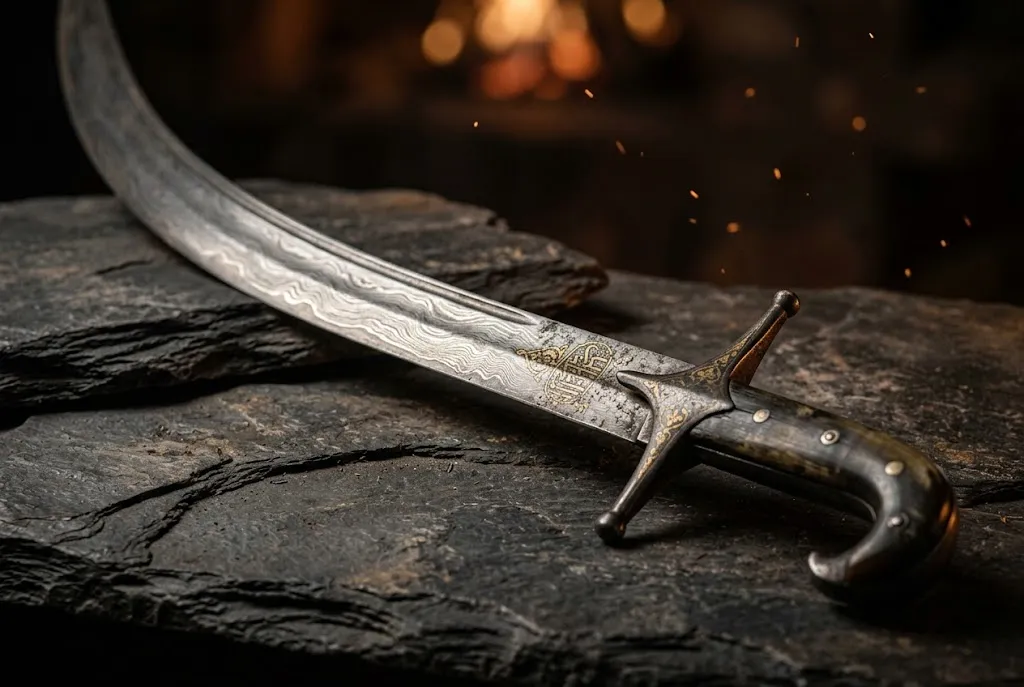
I bought my first "Damascus steel" chef's knife about six years ago. It had gorgeous, swirling gray ripples etched across the flank of the blade, looking like dark topographical lines running down to a razor-sharp edge.
I thought I owned a piece of ancient wizardry. I was wrong.
Almost every modern blade marketed as Damascus steel is an illusion. What you buy online or in kitchen specialty shops is pattern-welded steel: smiths take alternating bars of high-carbon steel and high-nickel steel, forge-weld them into a block, fold that block a dozen times, and bathe the finished blade in ferric chloride. The acid eats the high-carbon layers faster than the nickel layers, leaving behind dark and light stripes.
It looks dramatic. But it has almost nothing to do with how authentic Damascus steel (opens in a new tab) was made.
Historical Damascus blades didn't rely on folding contrasting billets together. Their rippling patterns were not layered sandwiches hammered flat by European blacksmiths. The true pattern was crystalline. It grew from inside the metal itself as liquid iron cooled in sealed clay vessels on the southern coast of India.
When Crusaders returned from the Levant, they brought back terrifying accounts of Islamic sabers that could supposedly sever a falling silk veil in midair and flex ninety degrees without snapping. Western smiths spent five centuries trying to copy them. They failed every single time.
The Secret Traveled from India in Clay Eggs
To understand real Damascus steel, you have to leave Syria entirely. The city of Damascus was a bustling trade hub, not the metallurgical birthplace of the metal.
The raw material came from southern India and Sri Lanka, where artisans produced small, hemispherical cakes of crucible metal known as wootz steel (opens in a new tab).
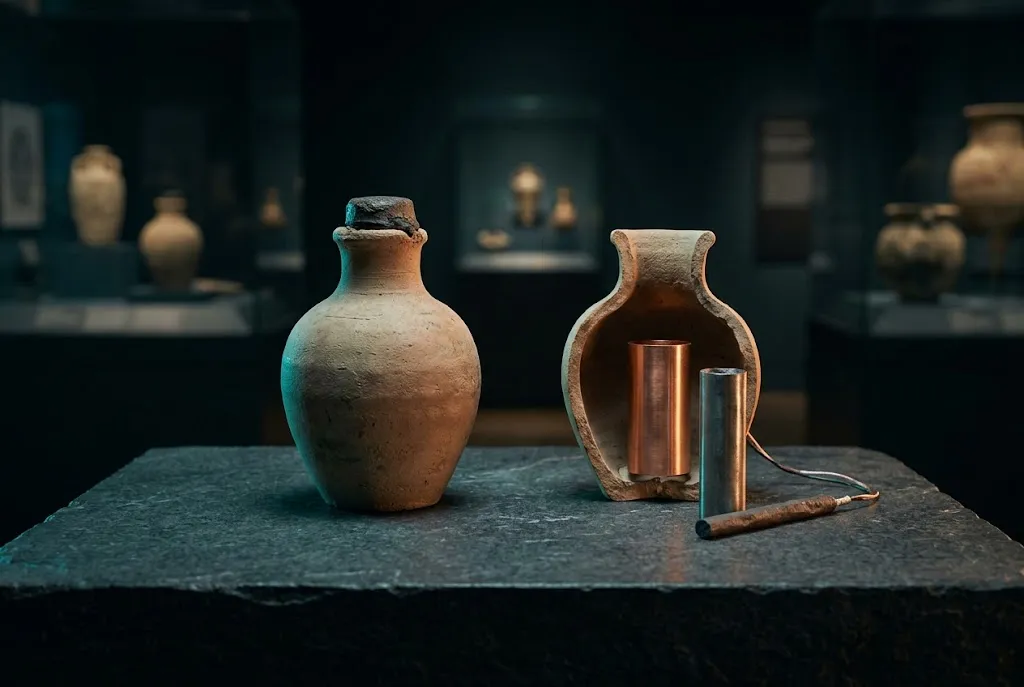
Around 300 BC, Indian smelters developed an ingenious technique. They placed high-purity iron bloom into small refractory clay crucibles alongside crushed charcoal, dry wood chips from the Cassia auriculata shrub, and specific plant leaves. They sealed the lids airtight with clay and piled the crucibles into charcoal furnaces blown by bellow-pumped air.
For days, temperatures hovered between 1,200 and 1,400 degrees Celsius.
Inside those sealed clay chambers, the iron began soaking up carbon from the vaporizing wood chips. This changed the fundamental chemistry of the metal. Pure iron melts at a blistering 1,538 degrees Celsius, well beyond the reach of an ancient furnace. But as carbon diffuses into iron, it lowers the metal's melting point.
Once the carbon content hit roughly 1.5 percent—a dangerously high level known as hypereutectoid steel—the iron melted into a liquid button. The artisans let the furnace extinguish slowly over several days. That agonizingly slow cooling was critical. It allowed thick clusters of iron carbide, called cementite, to grow into microscopic crystalline colonies inside the solidified ingot.
When cracked open, each crucible yielded a dense, porous puck of raw wootz metal roughly the size of a hockey puck. Arab traders bought these ingots by the thousands, carried them along caravan trails to the Levant, and handed them to local bladesmiths.
The Impossible Balance: Hard Enough to Cut, Tough Enough to Bend
Every swordmaker in the ancient world faced a brutal physical tradeoff. You could have a hard sword, or you could have a tough sword. You could never have both.
Add carbon to iron, and the steel becomes hard. It holds a savage edge, but it turns brittle as glass. Strike a bronze shield with a brittle blade, and it shatters into jagged shards. Keep the carbon low, and the steel becomes tough and flexible—it absorbs blows without breaking, but the cutting edge rolls over like cheap tin.
Damascus steel solved this paradox by structuring the metal into microscopic alternating phases.
When a Syrian smith hammered a wootz ingot into a saber, they weren't forging uniform metal. They were working with a natural metal-matrix composite. Bands of rock-hard cementite particles were suspended inside a softer, shock-absorbing iron matrix called pearlite.
Think of it like reinforced concrete. The cementite crystals were the hard gravel and rebar that held the edge, while the surrounding ferrite iron acted as the pliable cement that stopped cracks from running.
This is why modern kitchen knives stamped with acid-etched swirls dull so quickly: they are just folded steel without the micro-carbide saw teeth that gave genuine wootz its bite.
When you sharpened a real Damascus blade, the softer iron ground away slightly faster than the ultra-hard cementite clusters. This left behind microscopic serrations along the edge. The blade was essentially an invisible micro-saw that ripped through fibrous targets even after hundreds of cuts.
The Vanadium Mystery That Stumped Modern Science
By 1850, the craft vanished. No one in the Middle East could make Damascus blades anymore. The technique had died.
For over a century, modern metallurgists assumed the old legends were exaggerated romanticism. Then, in the late 1990s, a materials scientist named John Verhoeven (opens in a new tab) from Iowa State University teamed up with master bladesmith Alfred Pendray to solve the puzzle.
They tried melting pure iron and carbon together. They cooled it slowly. They hammered it out.
Nothing. No flowing watery patterns, no super-strength. Just ordinary, brittle high-carbon steel.
After hundreds of failed melts, Verhoeven ran chemical spectrographic analyses on authentic 17th-century museum swords. He noticed an oddity: every genuine blade contained minute traces of impurity elements—specifically vanadium, chromium, and molybdenum. We're talking tiny amounts, sometimes as little as 0.003 percent vanadium by weight.
That minuscule impurity changed everything.
During the slow cooling cycle in the crucible, vanadium atoms don't distribute evenly. They concentrate into microscopic parallel sheets along the grain boundaries. When the bladesmith repeatedly heated the ingot between 650 and 850 degrees Celsius to shape the blade, those vanadium bands acted as chemical magnets. Cementite dissolved and reprecipitated exclusively along those vanadium-rich tracks.
Just as Roman builders accidentally stumbled upon self-healing chemistry in how Roman concrete works, Indian crucible smiths had unknowingly exploited trace geology.
If the smith got careless and heated the steel above 900 degrees Celsius, the vanadium atoms diffused outward into a uniform mush. The banding vanished permanently. The blade became useless.
Ancient Nanotechnology Inside a Museum Sword
If the vanadium story wasn't weird enough, what happened in 2006 blew the metallurgical community wide open.
A team of researchers at the Technical University of Dresden, led by crystallographer Peter Paufler, acquired a fragment of an authentic 17th-century Damascus saber made by legendary smith Assad Ullah. They submerged the sample in hydrochloric acid, dissolving the bulk iron, and placed the residue under a high-resolution transmission electron microscope.
They found multi-walled carbon nanotubes.
Not modern synthetic tubes made in cleanrooms with arc-discharge vapor deposition. Four-hundred-year-old carbon nanotubes, perfectly formed, measuring barely four nanometers in diameter. Even more shocking: inside the hollow cores of those nanotubes, the microscope revealed encapsulated nanowires of cementite.
How could seventeenth-century blacksmiths produce carbon nanotubes?
They had no idea what a nanometer was. But the recipe they followed happened to create the exact thermal and chemical conditions modern labs use to synthesize nanotubes. The wood chips and leaves sealed inside the airtight clay crucibles cracked into hydrocarbon gases at high temperatures. Trace metals in the ore acted as catalysts, seeding the growth of tubular carbon lattices.
Those resilient nanotubes coated the cementite particles, shielding the brittle carbides from breaking during the hammering process and conferring unexpected tensile strength.
(And honestly, the first time I read Paufler's Nature study (opens in a new tab), I had to put my coffee down and stare out the window for twenty minutes. We spent billions developing nanotech in the 1990s that ancient smelters were cooking in charcoal pits).
Why the Secret Disappeared
So why did we lose it?
For decades, historians claimed that invading armies slaughtered the master smiths of Damascus, taking the oral traditions to the grave. But metallurgy doesn't die that easily.
The real culprit was resource depletion. By the late eighteenth century, the specific iron ore mines in Kodumanal and the surrounding regions of southern India had run dry. New mines were opened nearby, but their ore came from different geological strata.
The new ore was cleaner. It lacked that tiny, miraculous 0.003 percent trace of vanadium.
Bladesmiths ordered their crucible cakes as usual. They hammered them at the customary temperatures. But without the vanadium impurities to organize the carbide sheets, the wavy patterns never appeared. The blades snapped under stress or dulled within minutes.
Much like the mysterious loss of the heat-resistant material Starlite, Damascus steel vanished because its creators didn't know the true scientific linchpin of their own formula. When their geological luck ran out, their empirical recipe collapsed.
Today, modern materials labs can replicate authentic wootz steel whenever they want using controlled amounts of vanadium and precise computer-monitored furnaces. But the next time someone tries to sell you a "Damascus" knife with wavy acid-etched swirls, look closer. You're holding folded kitchen cutlery—not the lost carbon-nanotube marvel of the ancient world.



Conversation0
No comments yet. Be the first to share a thought — the best questions often become new stories.