


What Is Greek Fire and Why Was It So Terrifying?
I used to assume Greek fire (opens in a new tab) was little more than medieval folklore—a dramatic legend puffed up by terrified naval captains who encountered basic pitch and flaming arrows. Most cinematic depictions treat it like magic. A wizard mutters an incantation, flings an earthenware jug, and the entire ocean combusts in emerald flames.
Real history is far more chilling.
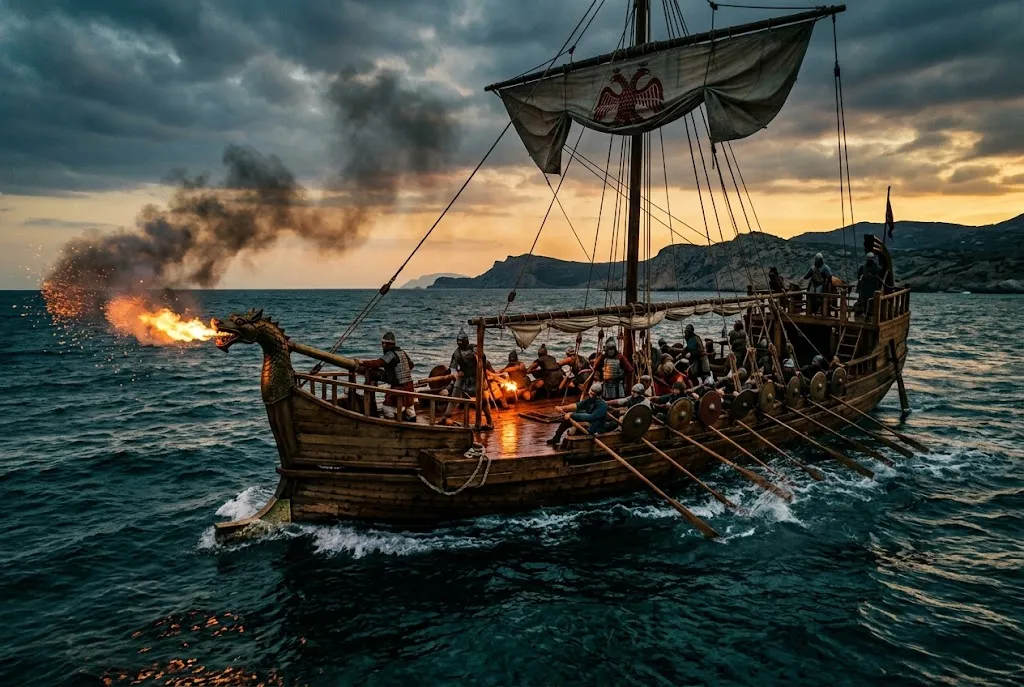
In the late spring of 674 CE, a massive Umayyad Arab fleet sailed up the Sea of Marmara to besiege Constantinople. The Byzantine Empire stood on the brink of total collapse. If the capital fell, imperial Roman continuity vanished with it. But when the opposing fleets met along the Golden Horn, the Roman flagship didn't launch ordinary catapult rocks. A bronze dragon head mounted on the bow hissed violently, spat a continuous jet of roaring, pressurized liquid across the waves, and engulfed enemy ships in self-igniting fire.
The water didn't stop the flames—it carried them.
Wooden hulls ignited down to the waterline. Sailors jumped overboard to douse the burning fluid clinging to their clothing, only to find the surface of the sea coated in burning fuel. Arab chroniclers wrote of an unnatural, shrieking roar that accompanied the blast, followed by black plumes of greasy, blinding smoke. Pure terror broke their formations. The siege dragged on for years, but Constantinople survived, largely because the Byzantine navy possessed a chemical superweapon no rival state could match.
The Words for This Fire in Greek: Pyr Thalassion
If you wanted to describe this terrifying fire in Greek during the early Middle Ages, you never actually said "Greek fire." That name was coined centuries later by Western European Crusaders who were baffled and horrified by it during the Crusades.
The citizens of Constantinople considered themselves Roman to the core. To them, the weapon was pyr thalassion ("sea fire") or hugron pyr ("liquid fire"). Sometimes military treatises simply called it "manufactured fire" (pyr skeuaston). According to the ninth-century chronicler Theophanes the Confessor (opens in a new tab), the original formula was invented around 673 CE by Kallinikos of Heliopolis, a Syrian architect and engineer who fled Arab conquests to seek asylum in Constantinople.
Kallinikos didn't just invent a flammable paste. He handed the Byzantine military an integrated incendiary delivery system that combined distillation chemistry, metallurgy, and pneumatic engineering.
How Was Greek Fire Made and Pressurized Into a Weapon?
Understanding how was Greek fire made requires looking past the liquid itself and examining the mechanical apparatus. A bucket of flammable goo is useless at sea; toss it against the wind and you incinerate your own deck crew. The real technological leap lay in the bronze projector.
Byzantine naval architects fitted war galleys known as a dromon (opens in a new tab) with specialized bow compartments lined with protective lead plating. Inside this firing bay sat a sealed bronze cauldron suspended directly above an insulated charcoal furnace. Crew members carefully heated the volatile liquid inside the vessel, building internal vapor pressure before battle even began.
Attached to the cauldron was a double-acting bronze force pump, an engineering concept borrowed from Hellenistic mechanics. When the gunners worked the pump levers, they forced the heated liquid through an airtight swivel pipe ending in a flexible nozzle. At the tip of the tube, operators hung a small, burning brazier or oil lamp wrapped in linen.
When the release valve snapped open, physics did the rest. The pressurized liquid shot forward through the nozzle, passed across the pilot flame, atomized into an aerosol mist, and ignited instantly in mid-air.
It was a naval flamethrower operating nearly thirteen hundred years before the First World War.
In 2002, British historian John Haldon (opens in a new tab) worked with mechanical engineer Maurice Byrne to construct a full-scale replica of the Byzantine siphon mechanism based on medieval tactical texts. Using authentic alloys, hand-fitted bronze valves, and a crude-oil mix, their rig sprayed a steady, coherent jet of burning fuel twelve to fifteen meters.
More importantly, the test confirmed why seawater proved utterly useless against it. The fuel floated.
This is why throwing water onto a burning kitchen grease fire erupts into a violent fireball: the water sinks beneath the lighter fuel, immediately flashes into high-pressure steam, and blasts atomized droplets of oil into the air where they ignite simultaneously. When enemy sailors hurled buckets of seawater over Greek fire, they achieved the exact same catastrophic outcome. They simply spread the hydrocarbon slick across their decks.
What Was Greek Fire Made Of? Breaking Down the Ingredients
For centuries, armchair historians argued over what was Greek fire made of, proposing everything from saltpeter and gunpowder to quicklime. Most of those old theories fall apart under modern thermodynamic analysis.
Take quicklime (calcium oxide). A popular myth claimed Greek fire ignited spontaneously upon hitting the water because quicklime reacts exothermically with moisture. But while that reaction gets hot, it generates nowhere near enough instantaneous heat to ignite heavy oil slicks on an open, wave-tossed sea. Furthermore, mixing quicklime with volatile hydrocarbons inside a pressurized bronze boiler would have blown the Byzantine crew to pieces before they ever left port.
Saltpeter is equally improbable. Byzantine chemists had no steady source of refined potassium nitrate in the seventh century. True gunpowder mixtures produce violent deflagration or detonation, not the sustained, sticky, clingy burn described by contemporary witnesses.
Modern chemical consensus points toward a refined hydrocarbon cocktail:
| Ingredient | Probable Source | Functional Role in Combustion |
|---|---|---|
| Light Crude Petroleum (Naphtha) | Black Sea oil seeps (Taman Peninsula, Kerch) | Primary volatile liquid fuel; creates low-density floating flame |
| Pine Resin (Rosin) | Mediterranean pine forests | Thickener; makes the jet sticky and prolongs burn time |
| Sulfur | Volcanic deposits (Milos, Sicily) | Lowers ignition temperature; generates suffocating toxic sulfur dioxide smoke |
| Bitumen / Pitch | Natural asphalt deposits | Increases viscosity; prevents fuel from dispersing too thinly in air |
The raw base was almost certainly light petroleum collected from natural surface seepages around the Black Sea and Crimea. In its unrefined state, crude oil contains too many heavy waxes and tars to spray smoothly through narrow bronze pipes. Byzantine distillers had to separate the light, volatile fractions—what ancient texts called white naphtha—to achieve a liquid that vaporized cleanly under pressure while retaining enough heavy bitumen to cling to timber.
Resin was the secret binder. Without it, the fuel sprayed as a fragile mist that burned up before reaching the target. Dissolved pine resin turned the petroleum into a viscous, sticky gel—the exact operational principle behind modern napalm.
Why the Secret Died With the Byzantine Empire
If Greek fire was so devastating, why didn't every Mediterranean kingdom copy it? Why did the recipe completely vanish from the historical record?
The answer lies in imperial paranoia and compartmentalized engineering.
Emperor Constantine VII Porphyrogennetos wrote a confidential foreign-policy manual for his son in the mid-tenth century called De Administrando Imperio. In it, he laid down strict instructions: if foreign ambassadors demand the secret of liquid fire, the emperor must tell them it was delivered directly by an angel to Constantine the Great, and that anyone who reveals the formula will be struck down by God and cursed forever. (And honestly, reading Constantine VII’s frantic warnings about guarding the state secret makes the imperial paranoia feel eerily modern).
It wasn't just religious propaganda. The Byzantines instituted ruthless operational security.
No single individual understood the whole weapon system. The chemical distillers in Constantinople knew how to refine the oil but never operated the fleet. The metallurgists who cast the airtight bronze siphons had no access to the chemical stores. The naval gunners—specialized elite soldiers known as siphonatoi—received pre-sealed canisters and never saw the refining stills.
If an enemy captured a Byzantine dromon, they captured useless pieces of bronze and jars of foul-smelling grease. Without the preheating parameters, the exact pressure thresholds, the correct nozzle diameters, and the trained pump crews, trying to fire the weapon usually ended in self-immolation. Arabic chronicles mention several attempts to use captured Byzantine siphon equipment; most ended with the machines exploding on their own docks.
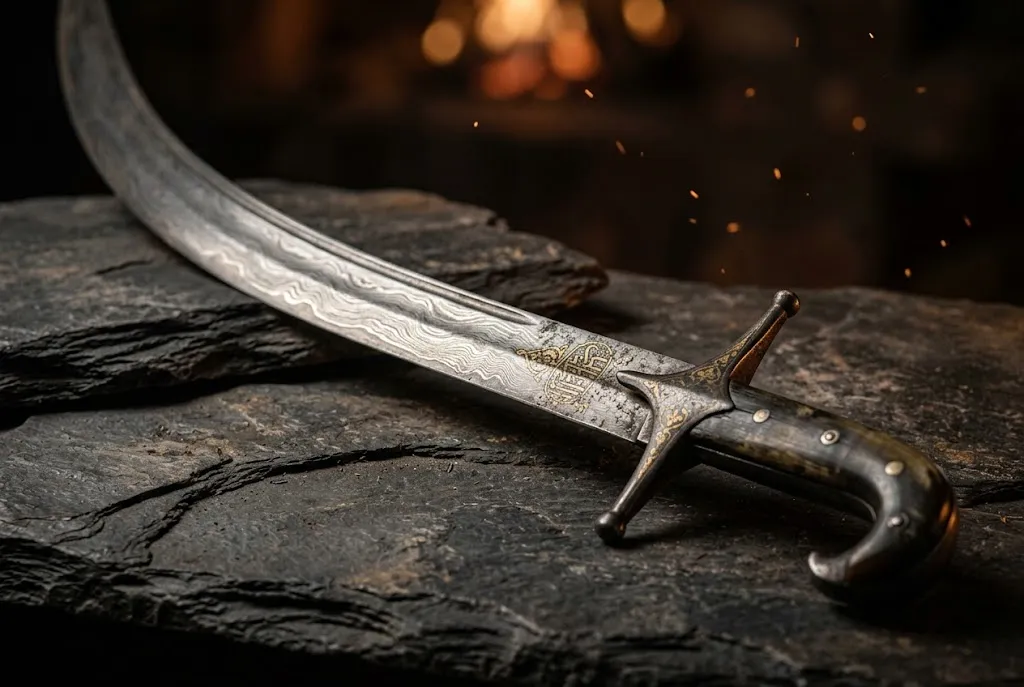
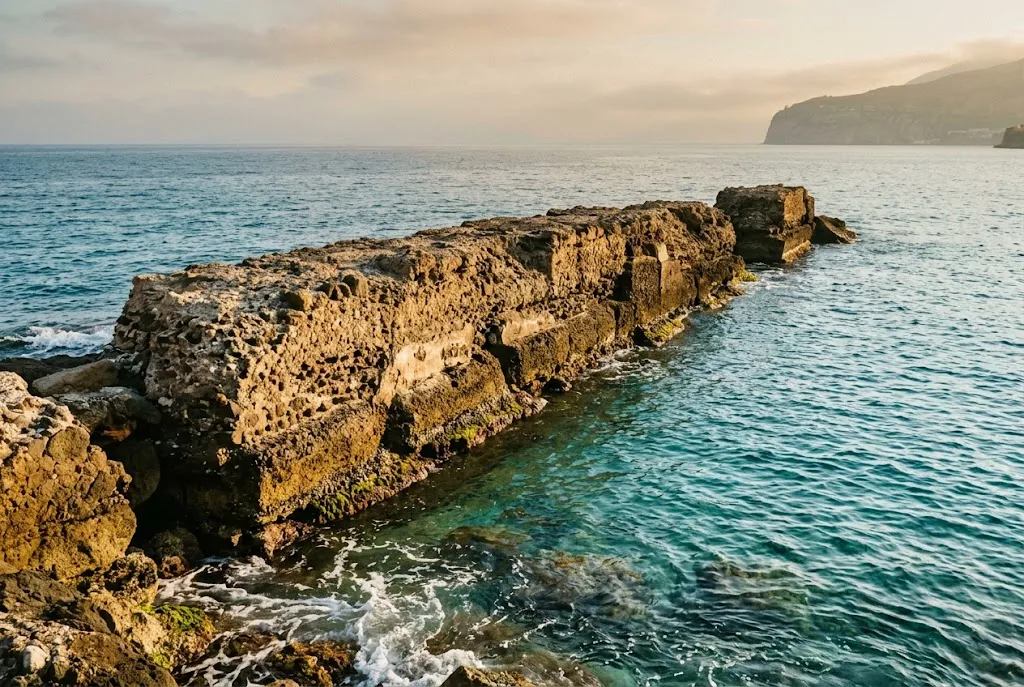
Much like the lost metallurgy behind how Damascus steel was made, the Byzantine incendiary mixture relied on specialized precursor materials that eventually disappeared. Just as Roman builders utilized volcanic reactions in how Roman concrete works, the Byzantines relied on specific Black Sea oil seeps under their geopolitical control. When the empire gradually lost control of the Crimean ports and eastern trade routes after the eleventh century, access to that distinct, light Crimean crude dried up.
Once the specific petroleum sources were cut off and gunpowder artillery emerged in the late Middle Ages, the complex bronze siphons became obsolete relics. The remaining guild masters died without passing down the oral instructions. The secret broke apart, piece by piece.
The True Legacy of Byzantium's Lost Fire
Greek fire was never magic. It was the peak of early medieval chemical and mechanical engineering, executed by an empire fighting for its survival with its back against the sea.
By treating petroleum refinement, pneumatic pumping, and thermal weaponization as an integrated technology rather than isolated curiosities, Byzantine engineers protected the gates of Europe for half a millennium. When we look at modern flame projection systems, aerosol sprays, and chemical weapon defense, we aren't seeing entirely new inventions. We are looking at the distant, refined descendants of a roaring bronze dragon mounted on the bow of a wooden galley, spitting liquid fire into the cold night of the Bosporus.

Conversation0
No comments yet. Be the first to share a thought — the best questions often become new stories.