


I Keep Coming Back to One Strange Clay Jar
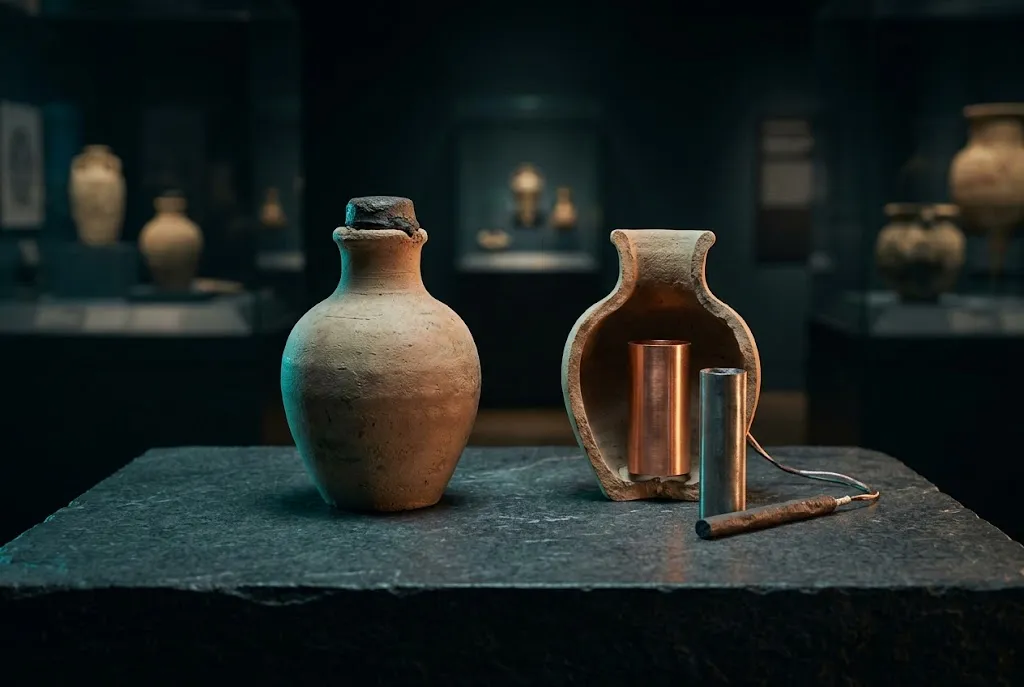
I have always liked ancient objects that become more mysterious the closer you look at them. The Baghdad Battery is a perfect example because, at first glance, it looks almost painfully ordinary: a small clay vessel, a metal cylinder, and a rod. Nothing about it screams breakthrough technology.
Then comes the obvious question. Could this ancient object really have made electricity?
The artifact was discovered in the early twentieth century near Baghdad and is generally dated to the Parthian or early Sasanian period, roughly around the first centuries BCE to CE. Archaeologist Wilhelm König proposed that it may have functioned as a simple galvanic cell, which would make it one of the most famous possible examples of ancient electrical technology.
But there is a problem.
We do not have proof that anyone used it as a battery.
That distinction matters. The object is real. Its unusual construction is real. Experiments have also shown that a similar arrangement can produce a small voltage when an acidic liquid is placed inside. What remains uncertain is whether the original object was actually intended to do that.
I think that makes the story more interesting, not less.
What Exactly Is the Baghdad Battery?
The artifact consists of a small terracotta jar containing a copper cylinder and an iron rod. The rod sits inside the cylinder, while the arrangement is held within the jar by a bitumen-like insulating material.
That combination caught attention because it resembles, at least in broad terms, the structure of a simple electrochemical cell. In a modern battery, two different electrodes interact through an electrolyte, allowing chemical reactions to produce an electrical potential.
Here, the copper and iron provide two different metals. The jar could hold an acidic liquid such as vinegar or another naturally acidic solution. That is enough to make the basic electrical experiment plausible.
The key word is plausible.
A reconstruction does not automatically reveal the purpose of the original artifact. People can accidentally invent useful effects long before they understand why those effects happen. An unusual container might have produced a voltage without its maker ever thinking of it as an electrical device.
The Baghdad Battery (opens in a new tab) remains controversial largely for this reason: archaeologists have the object, but not an ancient instruction manual explaining what it was meant to do.
And archaeology is full of that problem.
We often know what an object is made from long before we know why somebody made it.
The Chemistry Is the Part That Makes the Idea Possible
I find the battery hypothesis much easier to understand once I stop imagining a mysterious ancient power source and think about ordinary electrochemistry.
Put two different metals into an electrically conductive liquid and chemical reactions can separate charge between them. The metals do not need to be connected to a power station. The chemistry itself creates the electrical potential.
A simple galvanic cell depends on a difference in how the electrode materials participate in chemical reactions. In a copper-and-iron arrangement, the iron is more chemically reactive than copper, making it possible for oxidation at one electrode to be coupled to reduction at the other.
The electrolyte matters too. Pure water would not necessarily provide a very effective setup, but an acidic liquid contains ions that can support the movement of charge through the solution.
So the proposed mechanism is not exotic.
It is ordinary electrochemistry inside an extraordinary historical question.
That is why researchers and experimenters have been able to reproduce measurable voltage from reconstructed versions of the object. The underlying chemistry is real, even if the ancient purpose remains uncertain.
This is also why a reconstruction can produce only a small electrical output. A cell like this is not comparable to a modern alkaline battery in practical capacity. Its voltage depends on the electrode materials and electrolyte, while the available current depends strongly on the internal resistance and the amount of reactive material involved.
This is why a reconstructed Baghdad Battery can register voltage on a meter without being remotely powerful enough to run a modern lamp.
How Much Electricity Could It Actually Produce?
This is where modern expectations can distort the story.
When people hear the word battery, they may picture AA cells, phone batteries, or a car battery. Those devices are engineered to deliver useful electrical energy for predictable periods. The Baghdad Battery hypothesis concerns something much smaller.
A reconstructed cell of this type can generate a modest potential difference, depending on its exact construction and electrolyte. Experiments with replicas have demonstrated that the arrangement can behave like a galvanic cell, but the output is generally tiny by modern standards.
And one cell is only one cell.
If several cells were connected together, their voltages could in principle be combined. Connecting cells in series increases voltage, while other arrangements can affect current capability. But there is no archaeological evidence showing that ancient makers actually assembled large banks of these objects for electrical work.
That missing evidence is one of the biggest obstacles to the battery interpretation.
If somebody had built dozens of identical jars and used them together, the case would become much stronger. Instead, we have a small number of intriguing artifacts and a very attractive chemical explanation.
That is not the same thing.
Researchers have also questioned whether the materials were selected specifically for electrical behavior. Copper and iron were already useful metals for many ordinary purposes. Bitumen was used historically as a sealant and waterproofing material, so its presence does not automatically imply an insulating role designed by someone thinking about circuits.
The object therefore sits in an awkward middle ground: its geometry permits an electrical interpretation, but its archaeological context does not prove one.
What Could It Have Been Used For?
Several possibilities have been proposed over the years, and some are more historically grounded than others.
One famous suggestion is electroplating: using a small electrical current to deposit a thin metal coating onto another object. The chemistry would at least make the basic principle conceivable.
But again, conceivable is doing a lot of work here.
There is no clear archaeological trail showing that the Baghdad Battery was used for electroplating. Ancient metalworking already had several chemical and mechanical techniques for producing decorative surfaces, so electrical plating is not automatically the simplest explanation.
Other interpretations treat the vessel as a storage container or a ritual object rather than an electrical device. The exact combination of the jar, metal cylinder, rod, and sealing material may make sense for purposes unrelated to electricity.
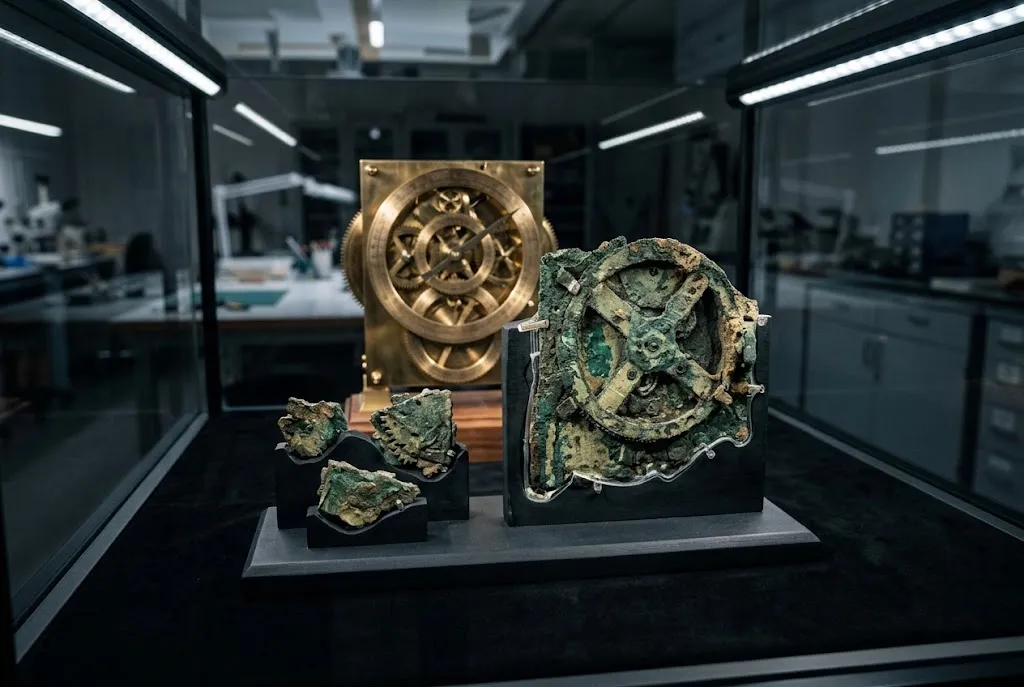
This uncertainty is easier to appreciate when compared with another famous ancient technological artifact, the Antikythera Mechanism (opens in a new tab). In that case, the mechanism's gears provide direct evidence of deliberate mechanical calculations, and later research has helped reconstruct what those gear systems represented. The Baghdad Battery gives us much less certainty about function.
That contrast is useful.
Sometimes an ancient machine tells you what it does because its mechanism leaves a very clear signature. Sometimes the mechanism is simple enough to support several different stories.
The Baghdad Battery belongs to the second group.
Could Ancient People Have Discovered Electricity by Accident?
Absolutely in the broad sense that people can encounter electrical effects without having a modern theory of electricity. Static electricity, sparks, shocks from certain animals, and electrochemical phenomena all predate modern electrical science by centuries.
But the existence of ancient electrical observations does not establish that this particular artifact was designed as a battery.
That distinction is easy to lose because the modern experiment is so satisfying. Fill a reconstructed jar with an acidic liquid, insert the metals, measure a voltage, and suddenly the whole story appears to snap into place.
Except it doesn't quite.
A successful experiment proves that the arrangement can work electrically. It does not prove that this is why an ancient craftsperson built it.
That is a broader lesson in experimental history. A device can have an effect that its creators never intended, understood, or noticed. The ability to reproduce an effect today is evidence about physical possibility, not automatically evidence about historical purpose.
And that is exactly where the Baghdad Battery becomes such a good science story.
The Evidence Problem Is the Real Mystery
I think the most compelling question is no longer "Did the Baghdad Battery work?" A reconstruction suggests that a version of it can produce electricity.
The harder question is "Did its makers know that it did?"
To answer that, archaeologists would want more than a working replica. They would want contextual evidence: similar artifacts in meaningful numbers, wear patterns associated with repeated electrical use, residues consistent with electrolytes, manufacturing choices that are difficult to explain in other ways, or historical records connecting the objects to electrical processes.
Without those clues, the battery interpretation remains a hypothesis.
This is a surprisingly important line between science demonstration and historical explanation. Physics can tell us what an arrangement is capable of doing. Archaeology has to determine what people actually did with it.
Those are different questions.
The first can often be tested in a laboratory. The second requires evidence from the past.
So, Was It Really an Ancient Battery?
My answer would be careful: maybe, but we cannot responsibly say that it definitely was.
The Baghdad Battery is a genuine archaeological artifact with a configuration that can be used to make a small electrochemical cell. Modern reconstructions show that the proposed mechanism is physically possible.
What remains missing is decisive evidence of intended electrical use.
That means the strongest version of the story is not "ancient people had batteries." The stronger, more accurate version is this: an unusual ancient object can be interpreted as a battery because its materials and internal arrangement are compatible with electrochemical generation, yet its original purpose remains disputed.
And honestly, I prefer that answer.
A mystery with boundaries is much more interesting than a solved story built from wishful thinking.
The Takeaway
The Baghdad Battery does not need to have powered ancient machines to be fascinating. Its real value is the question it forces us to ask: when does a physical possibility become evidence of human technology?
We can reproduce the chemistry. We can measure the voltage. We can explain the mechanism.
What we cannot do yet is travel back and ask the person who built the jar what they intended.
That missing sentence is the part history still owes us.





Conversation0
No comments yet. Be the first to share a thought — the best questions often become new stories.