


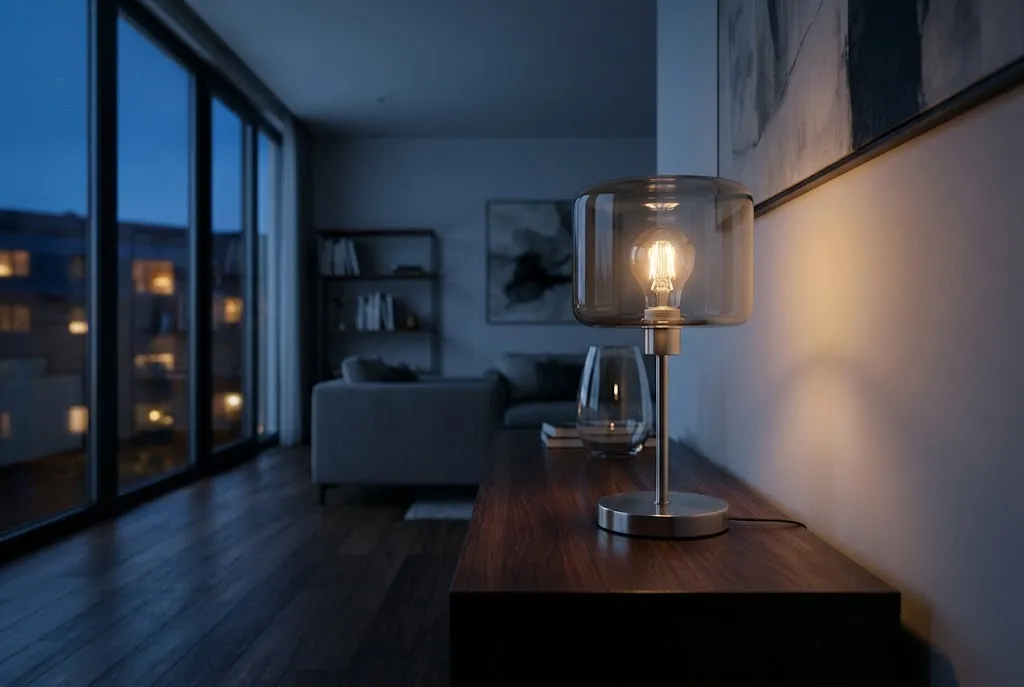
Why LED Bulbs Feel Almost Magical
How do LED bulbs work? I can switch on an LED bulb, leave it running for hours, and barely think about what just happened. There is no glowing wire like the old incandescent bulb had. There is no hot filament slowly turning electricity into light.
Instead, a small semiconductor is doing the interesting part.
So how do LED bulbs work? The short answer is that an LED turns electrical energy into light inside a tiny semiconductor junction, where electrons and “holes” meet and release energy as photons. That sounds tidy. The real trick is getting those electrons to release the right amount of energy in a useful way.
This is why an LED bulb can stay relatively cool while an old incandescent bulb becomes hot enough to burn your fingers.
I’m going to follow that process from the wall socket to the photons leaving the bulb, because each stage answers a different everyday mystery.
The Tiny Part That Actually Makes the Light
The word LED stands for light-emitting diode. A diode is an electronic component that mainly lets current move in one preferred direction, and an LED adds a semiconductor structure that can emit light as current passes through it.
Inside the LED is a junction between two differently prepared semiconductor regions. One side is called the p-type region, where the material has an excess of positively behaving “holes.” The other side is the n-type region, where electrons are more abundant.
Put those regions together and something interesting happens near the boundary.
Electrons and holes can recombine there. When an electron falls into a lower-energy state, the lost energy can emerge as a photon. The energy difference determines the photon's wavelength, which is what we experience as its color.
That gives us a surprisingly direct connection between solid-state physics and a lamp on a desk.
Why the Semiconductor's Material Matters
Not every semiconductor is equally good at making light. Materials such as gallium nitride and related compounds can efficiently produce photons in parts of the visible spectrum, which is one reason modern LEDs are so useful.
The band gap is the key number here. In simple terms, it describes an energy separation inside the semiconductor that helps determine the energy of the emitted photon.
Higher photon energy corresponds to shorter wavelength light. Lower photon energy corresponds to longer wavelength light.
So the material is not just a mechanical holder for electricity. Its internal energy structure helps decide what kind of light comes out.
What Happens When I Flip the Switch
An LED chip does not simply connect straight to household mains electricity. The bulb contains electronics that convert and control the incoming electrical power so the LED receives a suitable current.
This driver circuit is easy to overlook because it is hidden inside the bulb's base. But without it, the tiny LED junction would not operate as intended.
Once the driver supplies the correct current, charge carriers move through the semiconductor junction. Electrons and holes meet. Some of their energy becomes photons. Those photons leave the semiconductor and contribute to the visible light from the bulb.
The process is remarkably small-scale.
No piece of metal has to glow red-hot.
That difference explains a familiar experience: an LED bulb can produce the same broad job of lighting a room while wasting much less of its input power as heat than an incandescent lamp. It still gets warm, because real electronics are never perfectly efficient, but the light-producing mechanism is fundamentally different.
This is why LED bulbs usually feel much cooler than old filament bulbs at comparable brightness. The LED is not relying on a filament becoming a miniature furnace and hoping enough visible light escapes.
The Real Route From the Socket to Your Eyes
I like to picture the bulb as a chain of conversions:
| Stage | What happens |
|---|---|
| Wall power | Alternating electrical power enters the bulb |
| Driver | Voltage and current are converted and controlled |
| LED junction | Electrons and holes recombine |
| Photon emission | Energy is released as light |
| Optics | The bulb spreads and directs that light |
The chip is tiny, but the final bulb is not just a chip in a plastic shell. The package also has to manage heat and shape the light so a small light source can illuminate a room rather than create a harsh point of glare.
That engineering is part of the story too.
Why a White LED Is Often Blue First
Here is the part that confused me the first time I looked closely at LED lighting: many common white LED bulbs begin with a blue LED.
A blue LED produces relatively high-energy blue light. The bulb then uses a phosphor material that absorbs some of that light and re-emits energy across a broader range of wavelengths. Our eyes receive the combination as white light.
This approach became a major milestone in practical lighting. The Nobel Prize in Physics (opens in a new tab) recognized the development of efficient blue LEDs in 2014, highlighting how blue light enabled bright white light sources.
The word “phosphor” can sound exotic, but the job is straightforward: it changes part of the emitted spectrum.
Why Warm and Cool LEDs Look Different
Two bulbs can both be labeled “white” while looking completely different in a room. One may have a warm, yellowish appearance. Another may look much bluer and cooler.
That comes down to the spectrum of light the bulb produces.
Manufacturers tune the materials and phosphor mixture so the emitted light has a desired color appearance, commonly described by correlated color temperature. A warm-looking bulb often sits around the lower end of the usual household range, while cool white bulbs sit higher.
This is also why the number printed on a bulb matters more than people sometimes expect. A bulb can be electrically efficient yet feel wrong in a bedroom simply because its light spectrum and color temperature are not what you wanted.
And there is another layer: color rendering.
A good bulb should not merely make objects visible. It should let colors look reasonably natural under the lamp's spectrum. That is why two LEDs with similar brightness can make the same painted wall look noticeably different.
Heat Is Still a Problem
LEDs are efficient, not heat-free.
The semiconductor junction operates best within a suitable temperature range, and excess heat can reduce performance and shorten the useful life of the light source. The heat has to travel away from the chip and into the surrounding structure.
That is why a quality LED bulb may contain a metal heat sink or another thermal path hidden under its outer housing.
This seems almost backwards. If the point of the LED is to make light efficiently, why spend so much effort dealing with heat?
Because the light-producing chip is sensitive to temperature, and because the driver electronics have their own losses.
The bulb is really two systems living together: an optical system that creates and distributes light, and an electrical system that supplies the LED with controlled power.
The U.S. Department of Energy's LED lighting guidance (opens in a new tab) describes LED lighting as a solid-state technology and explains why its efficiency and long operating life differ from traditional lighting.
Why a Cheap Bulb Can Behave Differently
This helps explain something I have noticed with inexpensive bulbs: one can last for years while another begins flickering or failing much sooner.
The LED chip itself is only part of the equation. Driver quality, thermal design, electrical stress, component choice and operating temperature all affect how the finished bulb behaves.
A bulb that looks identical from the outside can have a completely different internal design.
That is why “LED” is not, by itself, a guarantee of identical performance.
The Flicker You May Not Notice
Some LED bulbs can produce visible or nearly invisible fluctuations in light output.
The reason starts with the electrical supply and the way the driver converts that power. If the driver does not smooth the current sufficiently, the LED output can vary with the electrical waveform.
Your eyes and brain do not always perceive that fluctuation as an obvious blink. But under certain conditions, such as moving objects or cameras, the variation can become easier to notice.
A phone camera may reveal banding or flicker that I cannot easily see with my eyes.
This is one place where the hidden electronics matter as much as the LED itself.
Modern drivers can use different circuit designs to regulate the current and reduce ripple. Better designs also help maintain stable light output across changes in the input supply.
Why LEDs Last So Long
An incandescent bulb has a simple weakness: its filament runs extremely hot. Over time, that tiny wire evaporates and becomes thinner until it fails.
An LED has no glowing filament to burn through.
That does not mean the semiconductor and driver can never fail. They can. But the failure mechanisms are different, and LEDs can achieve very long operating lives when their electrical and thermal conditions are controlled.
This is why an LED can remain useful for many more hours than an old incandescent design in typical applications.
The exact lifetime printed on a package is not a magical countdown, though. It depends on temperature, current, driver quality and the manufacturer's testing assumptions.
LEDs Connect to the Same Physics as Solar Cells
Here is a connection I love: an LED and a solar cell can look like completely different technologies while sharing important semiconductor physics.
A solar cell absorbs photons and uses their energy to help create electrical current. An LED does almost the reverse: electrical energy drives a semiconductor process that produces photons.
The devices are optimized differently, but the underlying language of electrons, energy levels and semiconductor junctions overlaps.
That is why understanding how solar panels turn sunlight into electricity gives you a useful mental model for LEDs too.
One device takes incoming light and turns it into electrical energy. The other takes electrical energy and creates light.
What You're Really Buying When You Buy an LED
I used to think an LED bulb was basically a brighter, more efficient replacement for an incandescent bulb.
It is more interesting than that.
You're buying a small power-conversion system, a semiconductor light source, a thermal design and a set of optical materials that have to cooperate inside one inexpensive object.
The visible light is the final step. Most of the cleverness is hidden.
That is the satisfying part: there is no tiny flame inside the bulb, no miniature filament waiting to glow. There is a carefully engineered semiconductor junction where charge carriers change energy states, and the released energy becomes photons that eventually reach your eyes.
Flip the switch, and solid-state physics becomes light.
And once you know what is happening inside that little bulb, the ordinary act of turning on a room lamp feels a lot less ordinary.



Conversation0
No comments yet. Be the first to share a thought — the best questions often become new stories.