


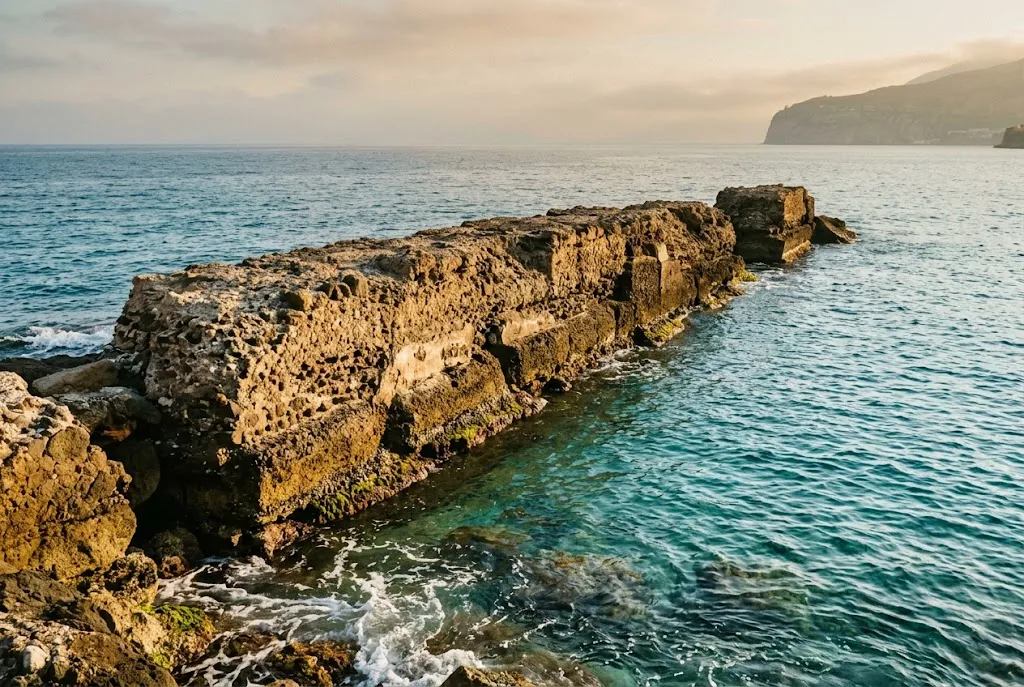
The 2,000-Year-Old Harbor That Refuses to Dissolve
I spent years assuming modern civil engineering had mastered stone. We build thousand-foot skyscrapers, bore highway tunnels through granite mountains, and cast suspension bridges that span ocean straits. Yet whenever I walk past a coastal highway overpass built in the 1980s, I see peeling concrete, rust streaks, and crumbling edges.
Modern concrete fails fast around saltwater. Give it forty or fifty years, and the steel inside expands, cracking the shell from within.
Then you look at Rome.
In the ancient port of Cosa on the Italian coast, Roman harbor piers have sat directly inside crashing saltwater since the first century BC. They are not crumbling. They are not eroding into gravel. In fact, after two thousand years of salt spray, chemical attacks, and pounding waves, that artificial stone is actually harder than the day the masons poured it.
For generations, historians assumed this was an accident of luck or simple over-engineering. Some speculative theories even tried to link classical monuments to lost high-tech machining, similar to the myths debunked around ancient stonework tools. But Roman concrete was neither magic nor an alien artifact. It was empirical chemistry performed by builders who paid close attention to what happened when volcanic rock met fire and brine.
Consider Rome's Pantheon (opens in a new tab). Its massive unreinforced dome stretches 142 feet across, cast from Roman concrete in 125 AD. It remains the largest unreinforced concrete dome on Earth. No rebar. No structural steel skeleton. Just ancient mortar, volcanic rock, and two millennia of defiance against gravity.
How did builders working with bronze chisels and horse carts brew an artificial rock that outlasts our best industrial formulas? The answer begins with what modern engineers spent a century dismissing as sloppy craftsmanship.
Modern Concrete vs. Opus Caementicium: A Tale of Two Rocks
To see why Roman walls survive, you have to look at what modern concrete actually is.
Modern builders rely on Portland cement. We bake limestone and clay in massive kilns at roughly 1,450°C (2,640°F). That super-heated baking process forms clinker, which we pulverize into a pale grey powder. When you mix that powder with sand, gravel, and water, you trigger hydration reactions. Calcium-silicate-hydrate gel binds everything into a rock-hard mass within hours.
Portland cement is brilliant at one specific job: delivering immense compressive strength very quickly. It lets contractors pour the tenth floor of an apartment tower while the fifth floor is still curing.
But it is rigid. And brittle.
When water seeps into microscopic fissures in modern concrete, winter freeze-thaw cycles pry those cracks open. If that concrete contains steel rebar, moisture rusts the metal. Rust takes up more volume than raw iron, exerting thousands of pounds of internal pressure until chunks of concrete blow outward. Engineers call this spalling.
Roman concrete—known as opus caementicium—played by completely different rules.
The Romans did not grind fine uniform powders. They mixed slaked lime, coarse volcanic ash known as pozzolana, and fist-sized chunks of volcanic tuff or brick aggregate (caementa). They rammed this stiff paste into wooden forms by hand. It took months to harden, not days.
For decades, modern geologists examining Roman samples kept noticing tiny, bright white flecks scattered through the grey matrix. These white specks, roughly the size of rice grains, are called lime clasts.
Early twentieth-century researchers wrote them off. The consensus was straightforward: the Romans must have had poor quality control. The workers simply didn't mix their mortar thoroughly, leaving unblended lumps of raw lime behind.
Turns out, that assumption was dead wrong.
The Mistake That Wasn't: The Secret of Hot Mixing
In 2023, a research team led by MIT material scientists published a landmark study in Science Advances (opens in a new tab) that completely overturned the "sloppy mixing" theory.
The researchers asked a simple question: if the Romans were notoriously obsessive about infrastructure specs—as recorded by Vitruvius in his architectural treatises—why would every single concrete structure across the Mediterranean carry the exact same mixing mistake?
They analyzed the lime clasts under high-resolution multiscale imaging and chemical mapping. What they discovered was astonishing.
Historians had long assumed Roman masons followed a standard recipe: taking limestone, burning it to create quicklime (calcium oxide, CaO), and then "slaking" it by drowning it in water to produce a smooth calcium hydroxide putty () before blending it with pozzolana.
Instead, the Romans were practicing hot mixing.
They introduced unslaked quicklime directly into the volcanic ash and aggregate, adding only a controlled splash of water. When dry quicklime meets water, the reaction is violently exothermic. The temperature inside the mortar batch spikes past 200°C (392°F).
This extreme flash of heat did two critical things. First, it allowed chemical reactions that cannot happen at room temperature, forming high-temperature calcium compounds. Second, it prevented the lime from fully dissolving, leaving behind millions of tiny, highly porous, brittle white lime clasts distributed throughout the wall.
Those clasts were not manufacturing defects. They were chemical battery packs waiting for an injury.
How Roman Concrete Heals Its Own Fractures
The moment a crack forms in Roman concrete, the building turns into a self-repairing chemical reactor.
Concrete will crack. No engineer can stop it. Thermal expansion, shifting earth, and ground settling always generate hairline fissures over decades. In modern structures, that crack marks the beginning of the end. Water rushes in, spreads, and destroys.
In a Roman wall, the crack behaves differently:
- The crack seeks the clast: Because the white lime clasts have high surface area and brittle boundaries, traveling micro-cracks naturally route directly through the clasts rather than cutting around them.
- Water enters the fracture: Rainwater or morning dew filters into the new void, soaking the exposed lime clast.
- Dissolution and saturation: The water immediately dissolves the clast's reactive calcium reservoir, transforming the moisture inside the crack into a super-saturated calcium-rich solution.
- Recrystallization: As this calcium-dense water reacts with carbon dioxide dissolved in the liquid or air, it triggers carbonation. It precipitates solid calcium carbonate ()—the primary constituent of limestone.
Within days or weeks, crystalline calcite fills the crack, physically gluing the gap shut. Once the crack seals, moisture can no longer penetrate. The fracture heals before it can grow wide enough to threaten the structure.
This is why modern highway overpasses sprout rusted rebar and hairline fractures after just forty years, while Roman aqueducts still carry mountain water across European valleys.
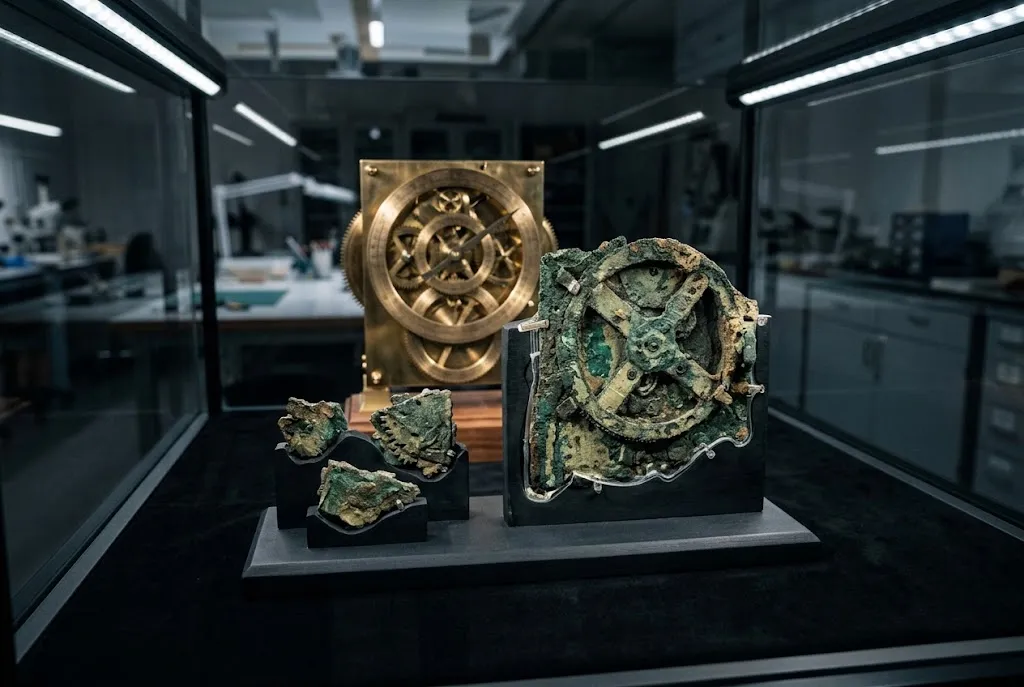
The wall does not merely resist damage. It responds to it. Much like the ingenious mechanical design seen in the Antikythera Mechanism, classical craftsmen developed an extraordinarily advanced physical system purely through empirical observation long before anyone had words for atoms or molecules.
The Seawater Superpower: Growing Minerals in the Ocean
Self-healing lime clasts explain why Roman buildings on dry land survived earthquakes and rain. But what about the ocean piers?
If you drop standard calcium carbonate into salt water with crashing waves, the mechanical force alone will eventually strip the material away. Calcium carbonate can wash out. Yet Roman marine structures did something even more radical: they used the ocean as an active building ingredient.
To build in the sea, Roman crews blended quicklime with a specific reddish-brown volcanic ash mined near the Bay of Naples, around the town of Pozzuoli. This ash is rich in silica and alumina. When mixed with lime, it drives what geologists call the pozzolanic reaction (opens in a new tab).
When Roman breakwaters were submerged in seawater, the water did not dissolve the structure. Instead, alkaline seawater slowly permeated through the porous volcanic mortar over decades, reacting with the volcanic glass.
This gentle, long-term chemical bath dissolved microscopic components of the ash and catalyzed the growth of an exceptionally rare interlocking mineral: aluminous tobermorite (opens in a new tab) ().
Tobermorite is a layered silicate mineral that is remarkably difficult to synthesize in modern laboratories because it typically demands high temperatures and pressures. Yet inside Roman harbor walls, tobermorite grew at ambient sea temperatures over centuries.
As the tobermorite spread, it sprouted microscopic, plate-like crystals that knit themselves directly into the pore spaces between aggregate stones. Later, another mineral called phillipsite joined the network.
Instead of weakening the concrete, seawater triggered a continuous crystal-growth mechanism that interlocked the entire breakwater into a monolithic, ductile composite stone. The waves weren't destroying the harbor; they were finishing the recipe.
Why Did We Stop Using It?
If Roman concrete was effectively eternal, self-healing, and carbon-friendly compared to modern kilns, why on earth did humanity stop making it?
It wasn't because builders forgot how to mix lime. It happened because the supply chain broke down.
Roman concrete was not a single standalone recipe; it was an imperial industrial network. It depended on shipping thousands of tons of high-grade volcanic pozzolana from the slopes of Vesuvius across the Mediterranean to ports in Spain, North Africa, and Greece. When the Western Roman Empire collapsed in the fifth century, the merchant fleets, centralized quarries, and distribution networks vanished with it.
Builders in medieval Britain or central France had to use whatever local stone and sand they could dig up. Without the specific reactive aluminosilicates found in Italian volcanic ash, you cannot trigger the tobermorite reaction.
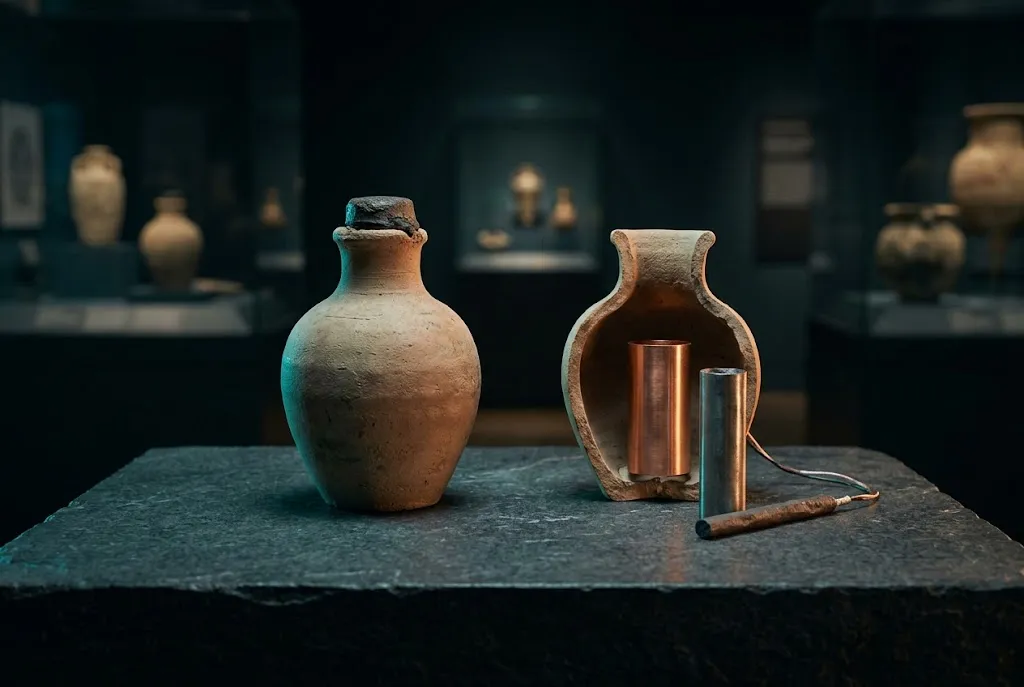
Specialized technical recipes often vanish when global logistics collapse, a pattern that also explains the disappearance of early chemical curiosities like the Baghdad Battery.
There was an economic reason, too: speed.
When Joseph Aspdin patented Portland cement in England in 1824, the world was entering the industrial revolution. Factories, railways, and canal locks could not wait three months for pozzolanic concrete to cure. Portland cement achieved massive structural capacity in days, and for a world building rapidly on short-term capital, fast-drying concrete was king—even if it meant rebuilding the bridge fifty years later.
The Modern Renaissance of Ancient Slag
That trade-off is finally catching up with us. Modern concrete production is responsible for roughly 8% of global carbon dioxide emissions, driven largely by the blistering 1,450°C temperatures required to roast limestone for Portland cement.
Today, materials scientists are actively reviving the Roman playbook.
Laboratories at MIT and across Europe are experimenting with hot-mixed formulations and deliberately seeded lime clasts to create commercial self-healing concrete for highway barriers and marine seawalls. If a bridge deck can seal its own winter cracks using moisture from the morning fog, the lifespan of that infrastructure doubles or triples without human maintenance.
We spent two centuries looking at ancient ruins through a lens of technological arrogance, treating ancient builders like primitive masons who got lucky.
Turns out, they were just playing a longer game than we were. They weren't building for the next quarterly report or the next political term. They engineered stone that could listen to the environment, react to damage, and pull strength directly from the sea.



Conversation0
No comments yet. Be the first to share a thought — the best questions often become new stories.