


The Sound of Invisible Danger
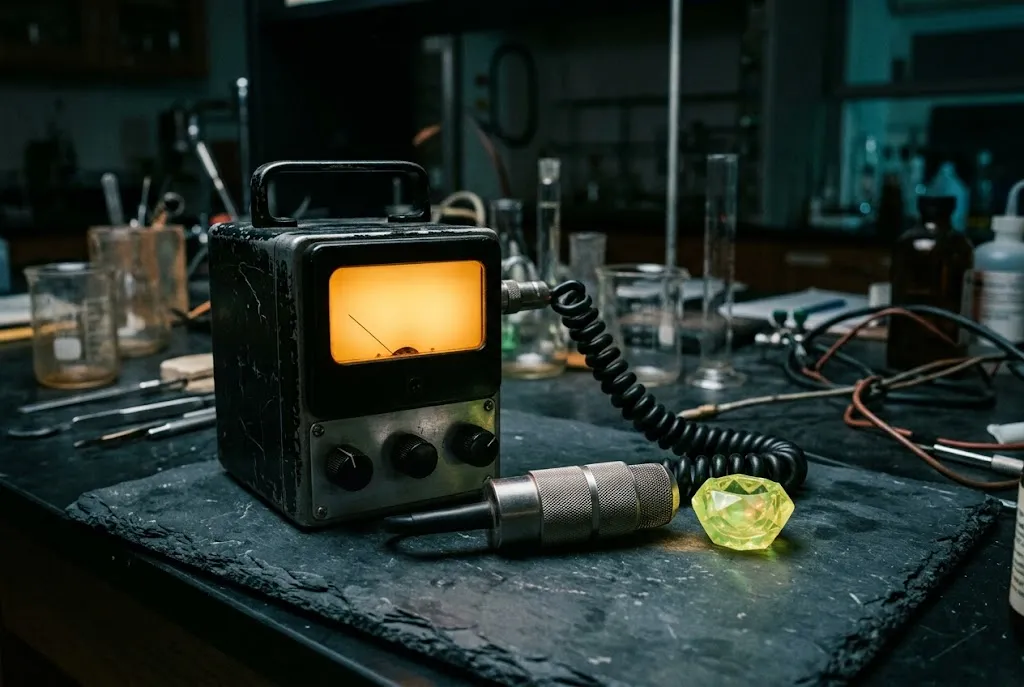
I still remember the first time I held a live radiation detector near an antique, lime-green depression glass saucer.
Nothing moved. Nothing glowed. The room was dead silent.
Then, I flipped the toggle switch. The speaker immediately began spitting out erratic, metallic clicks: tick... tick-tick... tick-tick-tick-tick. It sounded like cold water hitting a pan of boiling oil.
It was unsettling.
Ionizing radiation has no mass you can feel, no scent, and no color. It passes straight through your corneas and muscle tissue without triggering a single sensory nerve ending in your body. Yet this small handheld wand of metal and gas was translating unseen atomic decay into a frantic auditory alert.
Most people assume a Geiger counter works like a microphone listening to atomic collisions.
Not quite.
A Geiger counter does not listen to radiation. It does something far more violent: it sets an electrical trap, lets a passing particle spring it, and converts that tiny trigger into an avalanche of ten billion cascading electrons.
[Incoming Particle]
       │
       ▼
[Gas Atom Ionized] ──► [Free Electron Rushes to Anode Wire]
                              │
                              ▼
                     [Townsend Avalanche]
                              │
                              ▼
            [10,000,000,000 Electrons Surge]
                              │
                              ▼
                    [Voltage Drop = CLICK]
Inside the Chamber: High Voltage Meets Low Pressure
Strip away the yellow plastic casing and the microchips of a modern survey meter, and you find a deceptively simple device invented nearly a century ago: the Geiger–Müller tube (opens in a new tab).
Hans Geiger and Walther Müller perfected the core design back in 1928, and the underlying geometry has barely changed since.
The sensor consists of a hollow metal cylinder that acts as a negative electrode (the cathode). Down the dead center of that cylinder runs a hair-thin wire, usually made of tungsten, serving as the positive electrode (the anode). The tube is sealed airtight and pumped down to a partial vacuum—typically between 0.05 and 0.1 atmospheres of pressure—filled with a noble gas like argon or neon, mixed with a tiny trace of halogen vapor.
Now, here is the trick.
An external battery pack pumps anywhere from 400 to 900 volts of direct current across that tiny gap between the cylinder wall and the central wire. Under normal rules of electricity, you would expect a continuous spark to jump between them.
It doesn't.
Because the noble gas atoms inside have tight, complete electron shells, they act as electrical insulators. The gas holds back the current. The circuit sits charged, primed, and completely silent, waiting on an atomic catalyst.
The Townsend Avalanche: Turning One Electron into Ten Billion
The instant a ray of ionizing radiation (opens in a new tab)—whether a stray gamma photon from deep space or a fast beta electron from a rock—punches into the tube, the peace shatters.
The incoming particle collides with an argon atom and violently knocks an orbital electron loose. This creates an "ion pair": a free negative electron and a positively charged argon ion.
In an ordinary electric field, that single free electron would simply drift slowly to the positive wire. A lone electron carries a charge of roughly coulombs. That is infinitely too tiny for standard electronics to detect without massive background noise.
Physics solves this with geometry.
Because the center wire is razor-thin, the electric field is not uniform. The field strength spikes exponentially the closer you get to that wire—a relationship that scales inversely with radius (). Far out by the tube wall, the pull is gentle. But within millimeters of the wire, the field becomes ferociously intense.
The liberated electron accelerates toward the central wire at staggering velocity. It picks up so much kinetic energy that when it smacks into a second argon atom, it knocks that atom's electrons loose too. Those new electrons accelerate, hit more atoms, and knock even more electrons free.
This runaway chain reaction is called a Townsend avalanche (opens in a new tab).
It happens in less than a microsecond.
To make matters wilder, the accelerated electrons also bump argon atoms into excited states without ionizing them. When those atoms settle back down, they spit out ultraviolet photons. Those photons streak across the chamber at the speed of light, striking gas atoms near other sections of the wire and kicking off secondary avalanches all along the cylinder.
That one stray particle has just unleashed a surging cloud of 10,000,000,000 electrons.
This massive burst of electrical charge slams into the positive wire all at once, creating a sudden, measurable drop in voltage across an external resistor. That sharp electrical pulse is routed through a tiny amplifier and sent straight to a loudspeaker coil.
The speaker diaphragm violently flexes once.
Click.
This is why cheap hobbyist radiation monitors give wildly misleading readings near old uranium glassware or ionization smoke detectors—they register every single low-energy beta particle as an identical explosive electrical hit, completely blind to the actual biological energy reaching your skin.
In fact, the underlying mechanism of gas ionization is the exact same foundational physics that lets smoke detectors spot microscopic soot particles using americium-241, long before flames appear.
The Halogen Quench Trick: Why the Tube Doesn't Catch Fire
There is a massive engineering flaw hiding inside this avalanche.
Electrons are featherweights. They race to the center anode wire in nanoseconds. But those heavy positive argon ions? They lumber sluggishly toward the outer cylinder wall like bowling balls through molasses.
When a positive argon ion finally slams into the metal cathode wall, it aggressively rips an electron from the metal to neutralize itself.
Here lies the danger.
Neutralizing an argon ion releases roughly 15.7 electron-volts of energy. The metal wall only needs about 4 or 5 electron-volts to kick an electron loose (the work function of the metal). The leftover energy gets transferred into the metal, accidentally launching a brand-new electron out into the chamber.
Guess where that new electron flies? Straight back toward the central wire. It triggers an avalanche all over again.
Without an engineered fix, a single ionizing particle would spark a continuous, runaway electrical storm. The tube would screech endlessly, destroying its own circuitry.
Engineers solved this by adding a "quench gas"—usually a 5% to 10% vapor of diatomic bromine () or chlorine ().
Bromine molecules have a much lower ionization energy (around 10.5 eV) than argon. As the positive argon ions crawl toward the wall, they repeatedly bump into bromine molecules. In every collision, the argon ion forcibly steals an electron from the bromine:
By the time the ion cloud reaches the tube wall, virtually every charge has been handed off to bromine.
When a bromine ion hits the cathode, something clever happens. Instead of ejecting a secondary electron from the metal, the excess collision energy harmlessly snaps the chemical bond holding the two bromine atoms together. The molecule absorbs the shock by breaking in two.
Moments later, the isolated bromine atoms drift back into the gas and naturally recombine back into .
The tube resets itself. It is ready for another strike.
Dead Time and the Terrifying Flaw of Saturation
While the bromine molecules are busy quenching that electrical fire, the detector has a blind spot.
The cloud of heavy positive ions forms a cylindrical sheath around the central wire. Because like charges repel, this positive cloud temporarily shields the anode, collapsing the intense electric field down below the threshold needed to trigger an avalanche.
Until those ions reach the outer wall and clear out, the counter is completely deaf.
This dead interval is called the tube's dead time. It usually lasts between 50 and 100 microseconds. Under normal background radiation—the 30 to 50 clicks per minute caused by natural soil minerals and cosmic rays—a 100-microsecond pause is completely unnoticeable.
But in an extreme radiological disaster, dead time becomes deadly.
If millions of radioactive particles flood the chamber every second, the ion cloud never clears. The electric field never recovers. The voltage never rises back up to register a new click.
The needle drops to zero. The speaker goes dead silent.
This horrifying failure mode is called detector saturation. (And honestly, the first time I saw an uncompensated tube freeze near an active calibration source, my stomach dropped before my brain caught up).
During the initial minutes of the Chernobyl disaster, plant workers carried portable civil defense dosimeters that maxed out or flatlined under extreme flux. They assumed the ambient radiation was moderate, completely unaware that the radiation field was so intense it had choked the sensor into silence—an operational blind spot that engineers must account for when monitoring how nuclear reactors operate under extreme stress.
| Detector Component | Material Used | Core Function |
|---|---|---|
| Cathode | Stainless steel / Copper | Outer negative electrode wall |
| Anode | Thin Tungsten wire | Focuses extreme electric field () |
| Primary Gas | Argon / Neon (~90%) | Easily ionized by passing radiation |
| Quench Gas | Bromine / Chlorine (~10%) | Absorbs cathode energy to stop endless sparking |
| End Window | Cleaved Natural Mica | Lets delicate alpha particles enter |
Mica Windows: Catching the Bulkiest Particles
Not all radiation behaves the same way.
Gamma rays are high-energy photons; they shoot right through the steel casing of a Geiger tube, occasionally kicking an electron out of the metal wall into the gas. Beta particles are high-speed electrons that can punch through thin aluminum.
Alpha particles are entirely different beasts.
An alpha particle is a bulky cluster of two protons and two neutrons—a helium-4 nucleus. It is enormous on an atomic scale. A standard sheet of notebook paper or the dead outer layer of human skin will stop an alpha particle cold.
If you point a standard steel-walled Geiger tube at a powerful alpha emitter like polonium, the counter won't make a sound. The particles crash into the metal cylinder wall and die before they ever touch the gas inside.
To catch them, instrument makers build "pancake" probes equipped with an ultra-thin end window made of cleaved natural mica.
Mica can be split into sheets so absurdly thin they measure just 1.5 to 2.0 milligrams per square centimeter. That is thinner than plastic food wrap. It is fragile enough that pressing it with a fingernail will puncture the vacuum seal, yet sturdy enough to keep the internal gas trapped.
Bulky alpha particles crash through that gossamer mica film, hit the argon, and set off the avalanche. The counter roars to life.
What the Click Doesn't Tell You
As remarkable as the Geiger-Müller tube is, modern radiation safety relies heavily on newer tools like sodium iodide scintillation crystals and silicon semiconductor detectors.
Why? Because a Geiger counter is fundamentally a binary device.
It is a clicker, not an analyzer.
Because the Townsend avalanche spreads down the entire length of the central wire, every single discharge produces roughly the exact same size pulse. A low-energy beta particle that barely pierced the window generates the identical electrical jolt as a lethal, multi-MeV cosmic ray from an exploding star.
The counter can tell you that something passed through. It cannot tell you what kind of isotope emitted it, how much kinetic energy it carried, or the exact biological damage it threatens to cause.
Yet for quick field surveys, border checks, and checking whether that strange green antique in your attic is safe to touch, Hans Geiger's 1928 gas tube remains unbeatable. It takes the invisible, silent breakdown of the atomic world and transforms it into the most unmistakable sound in science.


Conversation0
No comments yet. Be the first to share a thought — the best questions often become new stories.