


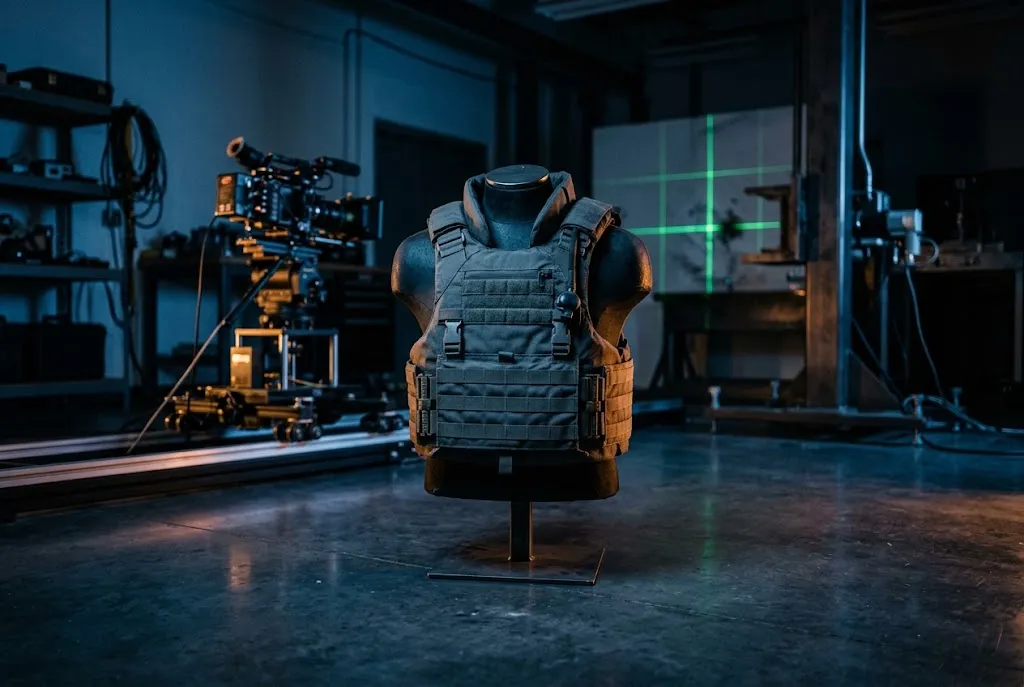
I held a raw swatch of ballistic aramid cloth once in a materials workshop, and my immediate reaction was disbelief. It felt shockingly mundane. It had the approximate heft of heavy canvas work pants, dyed a pale mustard yellow.
Yet that same pliable sheet, layered twenty to thirty times over, can intercept a copper-jacketed piece of lead traveling faster than a commercial jetliner and stop it cold in less than three inches of space.
Hollywood has spent a century lying to us about this process. In action films, body armor behaves like medieval knight plate. A bullet strikes the hero's chest, sparks shower into the dark, a tiny metallic clink sounds as the deformed slug falls onto the pavement, and the protagonist keeps sprinting forward without breaking stride.
Real life does not work that way. At all.
Bullets do not ricochet off flexible body armor. If they did, that deflected energy would simply redirect lethal fragments into your arms, neck, or femoral artery. Instead, modern body armor works on a principle far closer to a soccer net catching a penalty kick at point-blank range—relying on brutal friction, immense tensile deformation, and the rapid redistribution of kinetic energy across millions of molecular chains.
The Web That Catches a Supersonic Bullet
To understand how soft body armor saves a life, you have to look at the horrifying math of a handgun discharge.
A standard 9mm Parabellum round exits a handgun muzzle at roughly 1,200 feet per second. It carries around 400 foot-pounds of kinetic energy concentrated into an impact footprint no wider than a pencil eraser. If that bullet meets human tissue, that intense pressure shears through muscle, shatters bone, and creates temporary cavitation cavities that tear internal organs apart.
Enter Kevlar (opens in a new tab), the synthetic aramid polymer developed by chemist Stephanie Kwolek in 1965.
Kevlar belongs to a class of materials called aromatic polyamides. At the molecular level, its polymer chains are naturally straight, rigid, and organized into parallel bundles held together by remarkably dense hydrogen bonds. When spun into liquid crystal fibers and woven into tight fabric sheets, this orientation gives the material a strength-to-weight ratio roughly five times greater than structural steel.
When a bullet strikes a panel of woven aramid, it cannot easily push through the weave. The fibers resist stretching with astronomical tenacity.
Instead of slicing through, the bullet encounters what is essentially an interwoven highway network of molecular shock absorbers. The impact generates two distinct physical waves inside the fabric: a longitudinal shockwave that races outward along the length of each impacted thread, and a transverse wave that pushes the fabric backward in the direction of the bullet's flight path.
Energy hates staying in one spot. The cross-woven threads pull on the neighboring cross-threads, which immediately drag on their neighbors. In a fraction of a millisecond, the violent energy delivered to a single 9-millimeter point is forced to dissipate across thousands of square millimeters of surrounding cloth.
Why Bullets Flatten and Fibers Stretch
The fabric alone is only half the equation. The projectile itself has to cooperate with the physics, whether it wants to or not.
Most handgun ammunition uses a soft lead core encased in a thin copper jacket. When that relatively malleable metal slams into the unyielding aramid weave at supersonic speed, the immense deceleration forces cause the nose of the bullet to collapse and spread outward. Ballisticians call this mushrooming.
This deformation is critical.
As the bullet mushrooms, its surface area expands drastically, growing from a sleek aerodynamic dart into a jagged, flattened disc. That wider footprint prevents the bullet from sliding between the woven strands. It forces the slug to push against an ever-increasing quantity of yarn with every microsecond of travel.
Over the past two decades, materials science pushed this concept even further with Ultra-high-molecular-weight polyethylene (opens in a new tab) (UHMWPE), marketed under names like Dyneema and Spectra. These panels do not always use a traditional over-under weave. Instead, engineers lay microscopic polyethylene filaments completely parallel in unidirectional sheets, bond them with resin, and cross-ply them at right angles.
UHMWPE fibers are so slippery and light they actually float on water, yet their continuous molecular chains transfer kinetic energy across the panel up to twice as fast as early-generation aramids.
This is why a vest can stop a 9mm round cold, yet leave you with cracked ribs and a massive purple hematoma.
Just as vehicle chassis and car airbags handle violent momentum transfers by stretching deceleration times over vital milliseconds, ballistic fibers must deform without snapping. But that deceleration still has to dump its momentum somewhere.
The Blunt Force Problem: Backface Deformation
Stopping the bullet from penetrating the vest is actually the easy part of the engineering challenge. The brutal part is keeping the vest from killing the wearer anyway.
Physics does not allow kinetic energy to vanish into thin air. Even when thirty layers of fabric capture the slug, the entire localized mass of cloth balloons inward against the wearer's torso.
This inward bulge is called backface deformation.
If that bulge pushes three or four inches into your chest wall, it can fracture your sternum, tear pulmonary arteries, or induce fatal cardiac commotio cordis—even though the bullet itself never touched your skin.
To standardize survival parameters, the National Institute of Justice (opens in a new tab) (NIJ) enforces rigid testing protocols for law enforcement body armor. When certifiers test a vest, they strap it to a solid block of calibrated Roma Plastilina No. 1 modeling clay at room temperature.
After firing test rounds into the panel, technicians pull the vest away and measure the depth of the crater left in the clay.
Under NIJ Standard 0101.06, the maximum allowable backface signature is 44 millimeters (about 1.73 inches). Anything deeper than that, and the vest fails certification because medical research shows internal organ rupture spikes dramatically past that threshold. To combat this, modern vests incorporate closed-cell foam trauma pads or thin polycarbonate inserts behind the ballistic pack to spread that punch across a wider surface area.
Handgun Rounds vs Rifle Bullets: The Ceramic Divide
Soft vests are marvels of mechanical engineering, but they have a hard physical ceiling. They are designed almost exclusively for handguns.
If someone fires an intermediate rifle round—such as a 5.56x45mm NATO or a 7.62x39mm—at a standard soft police vest, the result is catastrophic. The rifle round will zip straight through all twenty-four layers of aramid like they are tissue paper.
Why does soft armor fail so completely against a rifle? Two reasons: velocity and geometry.
A rifle bullet travels at 2,800 to 3,100 feet per second—nearly triple the speed of a handgun slug—carrying upwards of 1,300 foot-pounds of energy. Worse, rifle projectiles are pointed (spitzer) shapes, often reinforced with hardened steel penetrator cores. They do not mushroom against cloth. Instead, the sharp tip wedges between the yarn fibers before the longitudinal wave has time to disperse the stress, shearing through individual strands sequentially.
Defeating a rifle requires an entirely different mechanism: hard ceramic armor.
Instead of flexing, a hard armor plate uses a ceramic strike face made from materials like silicon carbide, boron carbide, or aluminum oxide. These compounds rank just below diamonds on the Mohs hardness scale.
When a supersonic rifle bullet hits a ceramic plate, the ceramic destroys the bullet's geometry in the first three microseconds. The strike face is so hard that the pointed tip of the bullet is instantly blunted, pulverized into dust, or stripped of its copper jacket.
Simultaneously, the ceramic plate sacrifices itself. It shatters in a controlled, conical fracture pattern radiating outward from the impact zone. This intentional fracturing consumes enormous amounts of the bullet's kinetic energy.
Behind that brittle ceramic tile sits a thick backing board of pressed UHMWPE or laminated Kevlar. While the ceramic breaks the bullet, the composite backer catches the resulting high-speed spray of shattered ceramic shards and pulverized lead debris.
| Armor Level | Typical Threat Round | Test Velocity | Typical Construction |
|---|---|---|---|
| Level II | 9mm FMJ RN / .357 Magnum | ~1,300 ft/s (398 m/s) | Flexible woven aramid / thin UHMWPE |
| Level IIIA | .44 Magnum / .357 SIG | ~1,430 ft/s (436 m/s) | Multi-ply aramid weave + trauma backing |
| Level III | 7.62x51mm NATO (M80 ball) | ~2,780 ft/s (847 m/s) | Solid UHMWPE or steel / composite plate |
| Level IV | .30-06 Springfield M2 AP (Armor Piercing) | ~2,880 ft/s (878 m/s) | Boron/Silicon carbide ceramic + fiber backer |
The Icepick Paradox: Why Knives Beat Soft Armor
There is a peculiar, deeply unnerving paradox in ballistic science that catches almost everyone off guard: a soft vest rated to stop a bone-crushing .44 Magnum can be punctured by a cheap kitchen ice pick or a hunting broadhead arrow pushed by hand.
It sounds impossible. It isn't.
Bullets kill with brutal kinetic momentum; pointed edged weapons defeat armor with pressure and geometry. A bullet spreads its force across several square millimeters, gripping multiple woven yarns simultaneously.
An ice pick, however, has a microscopic needle tip measuring a fraction of a millimeter in diameter. It generates immense pressure at a single point with almost zero surface friction.
Because the tip is narrower than the microscopic gap between woven threads, the point does not stretch the aramid fibers—it slips directly between them, wedging the weave apart like a pry bar.
(And honestly, the first time I saw a testing technician push an ordinary awl through twelve layers of unrated ballistic cloth with one firm thrust, I had to stare at the hole for a solid minute).
To stop blades and spikes, manufacturers must build dedicated stab-resistant vests. These do not rely on standard loose weaves. Instead, they incorporate tightly packed chainmail meshes, micro-engineered titanium foils, or fabric infused with shear-thickening fluids—non-Newtonian liquid suspensions that instantly lock into rigid solids the instant an edged point tries to push through them.
Surviving extreme dynamic impacts is always a game of redirecting energy before it concentrates—a challenge shared by engineers designing airplane black boxes to endure violent crashes.
Environmental Wear and the Expiration Date
Body armor does not last forever. In fact, most soft body armor carriers have an operational lifespan of exactly five years.
That expiration date is not a marketing trick designed to force police departments to buy more gear; it is grounded in polymer chemistry. Aramid fibers are notoriously vulnerable to ultraviolet light, high ambient moisture, and salt.
When an officer wears a vest daily, perspiration seeps past protective nylon sleeves. Sweat contains sodium chloride and moisture that steadily break down the secondary hydrogen bonds linking the polymer chains together. Over years of thermal cycling and mechanical flexing, the fibers slowly lose their tensile stiffness.
If you shoot a ten-year-old, salt-degraded Kevlar vest that was stored in a hot patrol car trunk, the fibers may snap instead of stretching, allowing a round to penetrate that would have been stopped effortlessly when the vest was fresh from the factory.
Nothing about body armor is magical. It is simply an unforgiving calculation of kinetic transfer, tensile wave velocity, and sacrificial materials. The armor does not make a wearer invulnerable—it simply forces the universe to spend a bullet's lethal momentum on breaking molecules instead of breaking you.


Conversation0
No comments yet. Be the first to share a thought — the best questions often become new stories.