


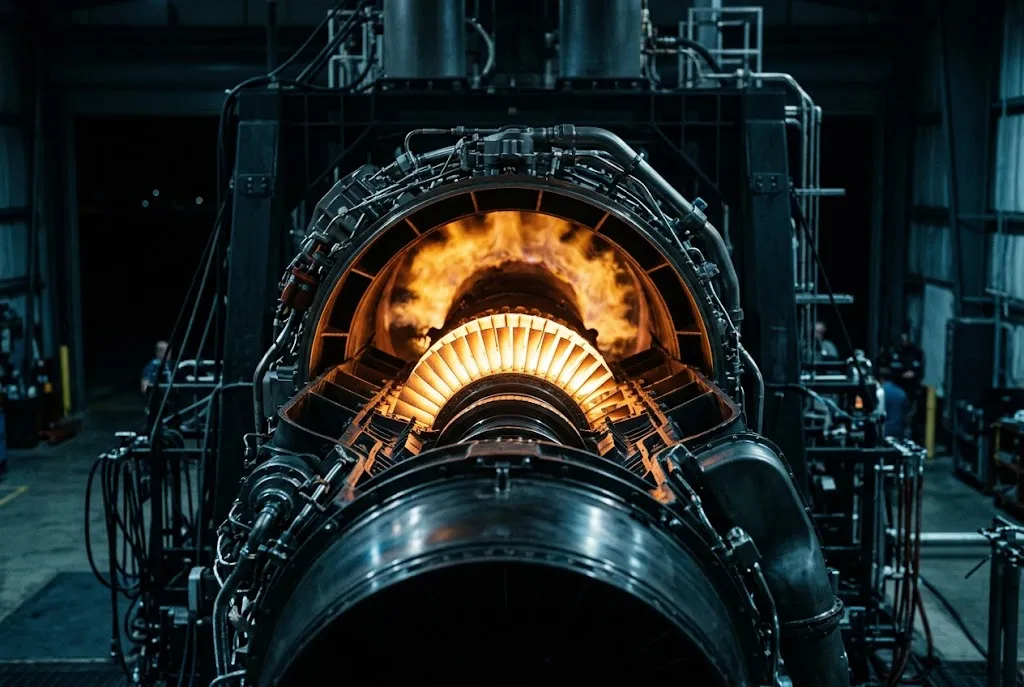
The Thermal Suicide of the Modern Turbofan
The first time an aerospace engineer handed me a discarded turbine blade from a commercial jet, I expected it to feel heavy. It didn't. It sat in my palm like a dense piece of sculpted jewelry—curved, hollowed out, and pocketed with tiny pinpricks along its leading edge. Then he told me where it had lived.
Inside the core of a modern turbofan, that five-inch fin of alloy spins at over 10,000 RPM while bathed in gas hot enough to liquefy iron.
It shouldn't exist. By every basic rule of everyday chemistry, that piece of metal should have melted into slag before the aircraft even reached cruising altitude. Yet it routinely survives thousands of flight hours without a scratch.
So why don't jet engines melt?
To grasp how absurd this engineering is, you have to look at the numbers. In the combustor of a modern high-bypass turbofan, atomized jet fuel mixes with hyper-compressed air and ignites. Combustion gas temperatures routinely surpass 1,700°C (3,090°F). In peak throttle maneuvers like takeoff, localized gas pockets can spike past 2,000°C.
Now look at the metallurgy. The blades sitting fractions of an inch from that inferno are forged from state-of-the-art nickel-based superalloys. Their absolute physical melting point? Roughly 1,350°C.
Do the math. The gas flowing across the turbine is 300 to 400 degrees hotter than the temperature required to turn the turbine itself into liquid sludge.
It gets worse.
If you left a piece of steel in a blacksmith's forge at 1,000°C, it would soften into malleable putty. In a jet engine, these blades aren't just sitting in the heat. They are spinning furiously. The centrifugal force pulling on a single high-pressure blade exceeds ten tons—roughly the weight of a double-decker bus pulling outward on an object the size of your thumb.
Spin soft metal under that kind of load, and it stretches like warm taffy. Metallurgists call this mechanical stretch creep. If a turbine blade (opens in a new tab) stretches even a single millimeter, it scrapes the outer engine casing at supersonic speeds, triggering catastrophic disintegration.
And yet, modern airliners cross oceans every single day without the turbine so much as warping. The answer isn't an undiscovered element from science fiction. It is a four-tier thermodynamic shield.
Borrowing Air to Freeze a Firestorm
The first line of defense against the inferno sounds completely counterintuitive: engineers cool the engine using its own scorching air.
Jet engines don't carry coolant tanks. There is no radiator, no water jacket, and no closed freon loop. Every ounce of cooling has to come from the atmosphere rushing into the intake nacelle. But passing ambient air directly from the outside into the high-pressure turbine is impossible because the air pressure inside the combustion chamber is enormous. Air would blast backward out of the cooling lines instead of inward.
So engineers siphon air from the compressor.
Before air enters the combustion chamber to be drenched in jet fuel, a fraction of it is bled off from the final high-pressure compressor stages. By the time air has been squeezed through ten or twelve stages of spinning compressor blades, it has heated up to around 600°C simply from mechanical compression.
Calling 600°C air "coolant" sounds absurd. But in an environment where the surrounding gas stream is blazing at 1,700°C, a 600°C air stream feels like an arctic blast. It provides an immediate 1,100-degree thermal gradient.
This bleed air is routed around the combustion chamber through dedicated bypass channels and injected directly into the base of each spinning turbine blade. If you examine the root of a blade—the grooved, dovetail "fir-tree" shape that locks it into the central rotor disc—you will see open intake slots.
Those slots feed an internal labyrinth.
Inside each blade lies an intricate, three-dimensional maze of serpentine passageways. As the blade spins, cooling air rushes through these miniature tunnels, pulling heat out of the metal from the inside out through convective heat transfer. To make this process even faster, engineers line the interior walls with tiny raised ridges called turbulators. These trip strips churn the air into microscopic vortices, preventing a sluggish, insulating boundary layer from forming against the interior walls.
This is why you hear that distinct, hollow whistle change pitch when an airliner idles on the tarmac—the pneumatic bleed valves are opening and modulating to circulate compressor air through the turbine core before the pilots push the throttles forward.
The Invisible Blanket: Aerodynamic Film Cooling
Internal cooling alone is never enough. Even if the inside of the blade stays cool, the outer skin is still making physical contact with 1,700°C combustion gases. Heat conduction would eventually overwhelm the alloy.
The engineering solution is breathtakingly clever: never let the fire touch the metal.
Engineers drill thousands of microscopic holes into the surface of each blade using high-precision electrical discharge machining and pulsed lasers. If you look closely at the leading edge of a modern turbine blade, it looks like a perforated showerhead.
These holes aren't drilled straight through. They are angled backward at shallow trajectories, often flared into subtle fan shapes at their exits.
As the bleed air finishes its journey through the internal labyrinth, it vents outward through these micro-holes. Thanks to the carefully shaped exit geometry, the rushing external gas doesn't blow the cooling air away. Instead, aerodynamic boundary-layer physics forces that cooler air to spread out flat against the blade's curved outer contour.
It creates an invisible, insulating blanket of air—a continuous micro-film barely a fraction of a millimeter thick.
The roaring combustion gas flows over this protective film without ever making direct contact with the nickel alloy underneath. The firestorm is effectively surfing on an invisible cushion of air.
If that film breaks down for even a fraction of a second, the metal beneath begins to oxidize and pit. Maintaining that boundary layer across radical throttle swings, turbulence, and atmospheric shifts is one of the greatest fluid dynamics achievements in human history.
Growing Metal as a Single Living Crystal
Even with an insulating micro-film of air, the blade's metallic skeleton must still operate at blistering temperatures between 900°C and 1,000°C. Normal metals cannot handle that kind of thermal stress under tension.
When metal freezes from a liquid into a solid, crystals begin nucleating at thousands of different points simultaneously. These growing crystalline patches eventually bump into each other, forming a patchwork quilt of microscopic grains separated by boundaries.
In a kitchen knife or an engine block, these grain boundaries are completely harmless. In a turbine blade spinning at 12,000 RPM at 1,000°C, they are fatal.
Grain boundaries are structural weak points. Under extreme heat and continuous centrifugal tension, atoms slowly slide past one another along these seams. Microscopic cavities open up. Cracks propagate. The blade stretches, deforms, and eventually snaps.
Aerospace metallurgists solved this by eliminating grain boundaries altogether.
Modern turbine blades are grown as a single, unbroken crystal of nickel-based superalloy (opens in a new tab) using a technique called directional solidification. Molten alloy is poured into a preheated ceramic mold seated on a water-cooled chill plate. As the metal cools from the bottom up, a crystalline lattice begins climbing upward.
Just above the base, engineers force the cooling metal through a microscopic corkscrew passage called a spiral grain selector.
Only a single crystal orientation can navigate the twists of the spiral. All competing crystals hit dead ends and stop growing. When the metal emerges from the top of the corkscrew into the blade cavity, that lone crystal replicates itself across the entire geometry of the blade.
The result is a solid, seamless object with zero internal grain boundaries. The entire blade—from the root that locks into the rotor to the razor-thin trailing tip—is literally one continuous metallic crystal.
Creep resistance skyrockets. The blade can withstand continuous mechanical loads that would shatter ordinary forged alloys into pieces.
Painting Blades with Shatter-Proof Ceramic
The final layer of the armor is a coat of high-tech ceramic.
Metals are fantastic conductors of heat; ceramics are terrible at it. But anyone who has ever dropped a coffee mug knows the problem with ceramics: they are brittle. If you apply a standard ceramic coating to a metal blade, the metal will expand as it heats up while the ceramic stays rigid. The coating will buckle, crack, and flake off—a disaster known as spallation.
Engineers sidestep this flaw using electron-beam physical vapor deposition to apply a material called thermal barrier coating (opens in a new tab) (TBC), typically yttria-stabilized zirconia.
Inside a vacuum chamber, a high-energy electron beam vaporizes ceramic ingots, sending a cloud of ceramic atoms condensing onto the spinning superalloy blades. But the ceramic isn't deposited as a solid, monolithic sheet. It grows into microscopic columnar pillars standing perpendicular to the metal surface, like the bristles on a microscopic brush.
When the underlying metal expands during takeoff, these ceramic pillars simply tilt and flex without shearing away from each other.
This ceramic layer is razor-thin—typically between 100 and 250 micrometers, about the thickness of two sheets of printer paper. Yet because ceramic conducts heat so poorly, that tiny sliver creates a massive temperature drop of up to 200°C between the outer surface and the metal underneath.
Ceramics behave very differently here than they do in atmospheric reentry heat shields, where ablative layers are designed to burn away and carry heat with them. A jet engine's ceramic barrier must remain perfectly intact for tens of thousands of hours of continuous flight.
It is the same philosophy of multi-layered, unforgiving tolerance that lets stealth jets slip past radar: every single millimeter of the surface serves an active, life-saving physical purpose.
The Thermodynamic Sweet Spot
When you stack all four technologies together, the paradox disappears:
- Combustion Gas Temperature: ~1,700°C.
- Aerodynamic Film Cooling: Drops the temperature directly above the surface by hundreds of degrees.
- Thermal Barrier Coating: Sheds another 150°C to 200°C across a paper-thin ceramic shield.
- Internal Serpentine Cooling: Continuously pulls heat out of the core, keeping the structural metal around 950°C.
- Single-Crystal Architecture: Guarantees that at 950°C, the metal won't creep or snap under ten tons of centrifugal pull.
All of this begs an obvious question: why push temperatures this dangerously close to the brink in the first place? Why not just burn less fuel and keep the engine cooler?
Thermodynamics.
The fundamental efficiency of any heat engine is governed by the Carnot cycle. The greater the temperature difference between the combustion fire and the exhaust air, the more kinetic energy you can extract from every single drop of fuel.
This is why modern long-haul airfares dropped so drastically over the last thirty years: raising combustion temperatures by just 100 degrees Celsius makes an engine massively more fuel-efficient, saving millions of gallons of kerosene across a fleet's lifespan.
The next time you settle into an airline seat and watch the wing flex as the engines spool up for takeoff, take a second to picture what is happening inside that nacelle. Right beside you, a ring of single-crystal blades is spinning through a man-made hellstorm, wrapped in invisible air blankets and dancing fractions of a millimeter away from thermal death—and doing it with effortless, routine perfection.


Conversation0
No comments yet. Be the first to share a thought — the best questions often become new stories.