


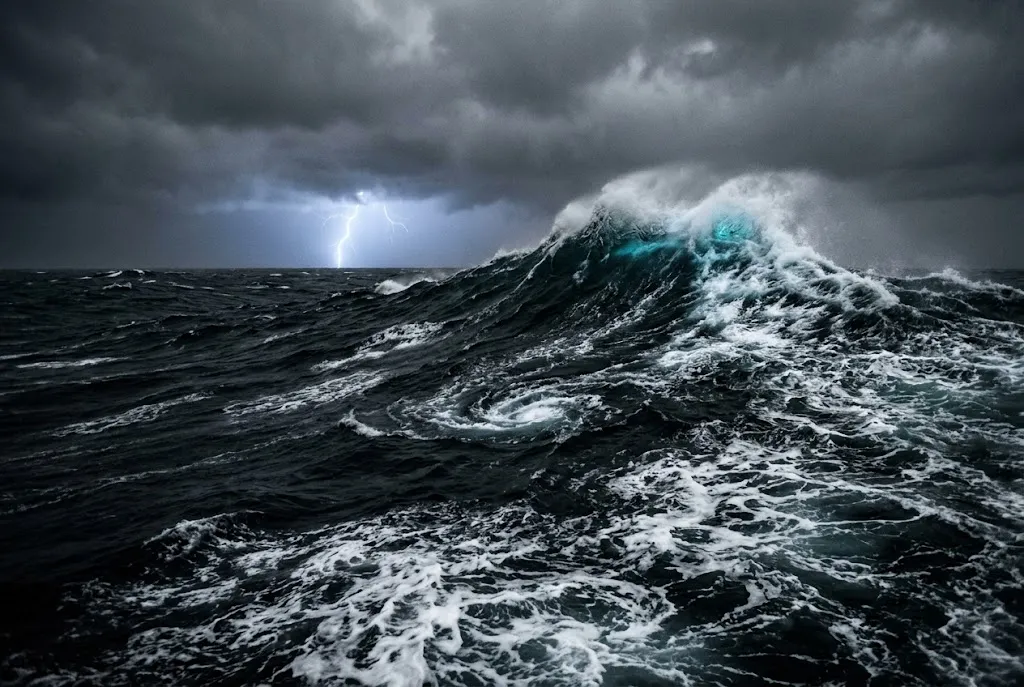
The 84-Foot Wall That Upended Ocean Science
I spent years assuming rogue waves were nothing more than tavern folklore. Salty sailors exaggerating the size of a swell over rum.
Naval architects certainly thought so throughout the entire twentieth century. They designed supertankers and container ships under a comfortable mathematical assumption: ocean waves follow a Gaussian distribution. A bell curve. Under linear wave theory, you can calculate the statistical probability of encountering an extreme swell. The odds of an 80-foot wave rearing up in typical North Sea conditions were pegged at once every 10,000 years. Basically impossible.
Then arrived January 1, 1995.
At 3:20 PM on New Year's Day, a downward-facing laser rangefinder mounted beneath the Draupner gas platform in the North Sea registered something that broke maritime engineering. Amidst a sea of uniform 39-foot swells, an 84-foot water wall slammed into the steel platform at 45 miles per hour. (And honestly, the first time I saw the raw radar trace from Draupner, I thought it was an electrical spike).
It wasn't a glitch. The physical scaffolding above the waterline took direct structural damage. The sensor had captured the first verifiable Draupner wave (opens in a new tab) in human history.
The ocean was not behaving like a polite bell curve. Not even close.
What Actually Qualifies as a Rogue Wave?
Oceanographers have a strict mathematical threshold for these leviathans. A rogue wave is not just a "very big wave."
To earn the title, a wave's crest-to-trough height must be at least twice the significant wave height () of the surrounding sea state. Significant wave height is the statistical average of the tallest one-third of waves recorded during a specific observation window. If the prevailing sea is kicking up 20-foot swells, a rogue wave must clear 40 feet. If the surrounding storm chop is 35 feet, the rogue wave has to top 70 feet.
They appear abruptly. They travel in directions completely out of alignment with the prevailing wind and swell.
And unlike tsunamis, which have barely noticeable surface amplitude in deep water and only steepen as they hit shallow coastlines, rogue waves are deep-ocean ambush predators. They rise, strike, and vanish in under three minutes.
Constructive Interference: When Swells Collide
For decades, physicists tried to explain these monster waves using classical linear theory. The easiest culprit is constructive interference.
Think of it like audio waves beating together. Ocean waves don't all travel at identical speeds or wavelengths. When storms rage across thousands of miles of open water, they spawn wave trains traveling in slightly different directions at different velocities. Eventually, a faster swell catches up to a slower one.
If the crest of one wave happens to line up with the crest of another, their amplitudes add together.
Simple addition: a 25-foot swell meets another 25-foot swell, producing a momentary 50-foot monster.
Linear superposition.
It explains some rogue waves, particularly in crossing seas where two distinct weather systems collide at right angles. But linear physics has a fatal flaw. It cannot account for how frequently these waves actually occur in the wild.
Non-Linear Physics: Waves That Steal Energy
The real breakthrough came when researchers stopped treating water like a polite, linear system and started modeling ocean swells with the Non-Linear Schrödinger Equation (NLSE).
In deep water, surface gravity waves are non-linear. They interact with their neighbors in ways that defy basic arithmetic. When waves become steep enough, an instability known as modulational instability (opens in a new tab) takes over. You might hear physicists call it the Benjamin-Feir instability.
Here is what happens: a wave packet begins to siphon energy from the waves directly in front of and behind it.
It doesn't just add to them. It drains them.
The central wave grows taller and steeper while the adjacent waves flatten out, creating a terrifyingly deep trough in front of the swelling giant. Sailors historically called this "the hole in the sea."
This is pure non-linear hydrodynamic focusing. The wave concentrates kinetic energy into a razor-thin point of spacetime.
This is why a modern 1,000-foot container ship built to handle standard force-12 storms can still have its steel bow sheared off in seconds by a single, solitary wall of water.
The vessel plunges nose-first into a hollow 50-foot trench, and before the hull can generate buoyant lift, thousands of tons of green water crash down onto the forward deck plating.
Current Collisions: The Agulhas Death Trap
Geography turns this mathematical quirk into a shooting gallery.
Off the southeast coast of South Africa sits the notorious Agulhas Current (opens in a new tab). It moves warm water south at speeds of up to five knots, directly colliding with massive swells pushing up from Antarctica's Roaring Forties.
When high-speed storm waves crash head-on into a swift, opposing current, the physics resembles a car hitting a brick wall. The opposing current compresses the wave's horizontal wavelength. Because the total energy has nowhere else to go, the wave has only one direction to expand: straight up.
The wavelength shortens, the wave speed drops, and the crest steepens into a near-vertical cliff of water. Scores of cargo vessels have vanished along the South African coast without a trace.
Much like how naval engineers track subsurface acoustic layers when designing deep-sea oxygen-generating submarines, commercial shipping routes now actively model current-wave interactions to divert hulls around these compression zones.
Space Radars Prove the Skeptics Wrong
Even after the Draupner record in 1995, many oceanographers still assumed it was an extraordinary one-off anomaly. To settle the argument, scientists turned to orbital space.
The European Space Agency's MaxWave project (opens in a new tab) tasked the ERS-1 and ERS-2 satellites with scanning the global oceans using Synthetic Aperture Radar (SAR).
Similar to the microwave pulse compression principles that let a police radar gun calculate vehicle velocity, these satellites bounced microwave beams off ocean swells to map sea-surface topography from hundreds of miles up.
The results stunned the maritime community.
In just a three-week window, the radar sensors identified more than ten individual rogue waves towering over 80 feet across the globe. They weren't mythical unicorns. They happen daily.
When a massive cargo vessel sinks in minutes, maritime investigators scouring data from recovered crash-resistant black boxes frequently find sudden, catastrophic structural strain signatures consistent with these orbital radar findings.
Why Predicting Them Remains a Mathematical Nightmare
Can we forecast them in real time? Barely.
Because non-linear focusing depends on tiny, localized phase shifts across neighboring wave crests, forecasting a rogue wave requires millimeter-precision tracking of millions of shifting water particles. Current buoy networks simply lack that resolution.
Marine engineers have instead altered their design parameters. They threw out the old 100-year wave safety standards. Ship hulls are now modeled under chaotic, non-linear stress simulations to withstand sudden slamming loads exceeding 100 kilopascals.
Rogue waves aren't supernatural. They aren't sea monsters.
They are something far more humbling: pure, non-linear hydrodynamics reminding us that the ocean is never a well-behaved bell curve.




Conversation0
No comments yet. Be the first to share a thought — the best questions often become new stories.