


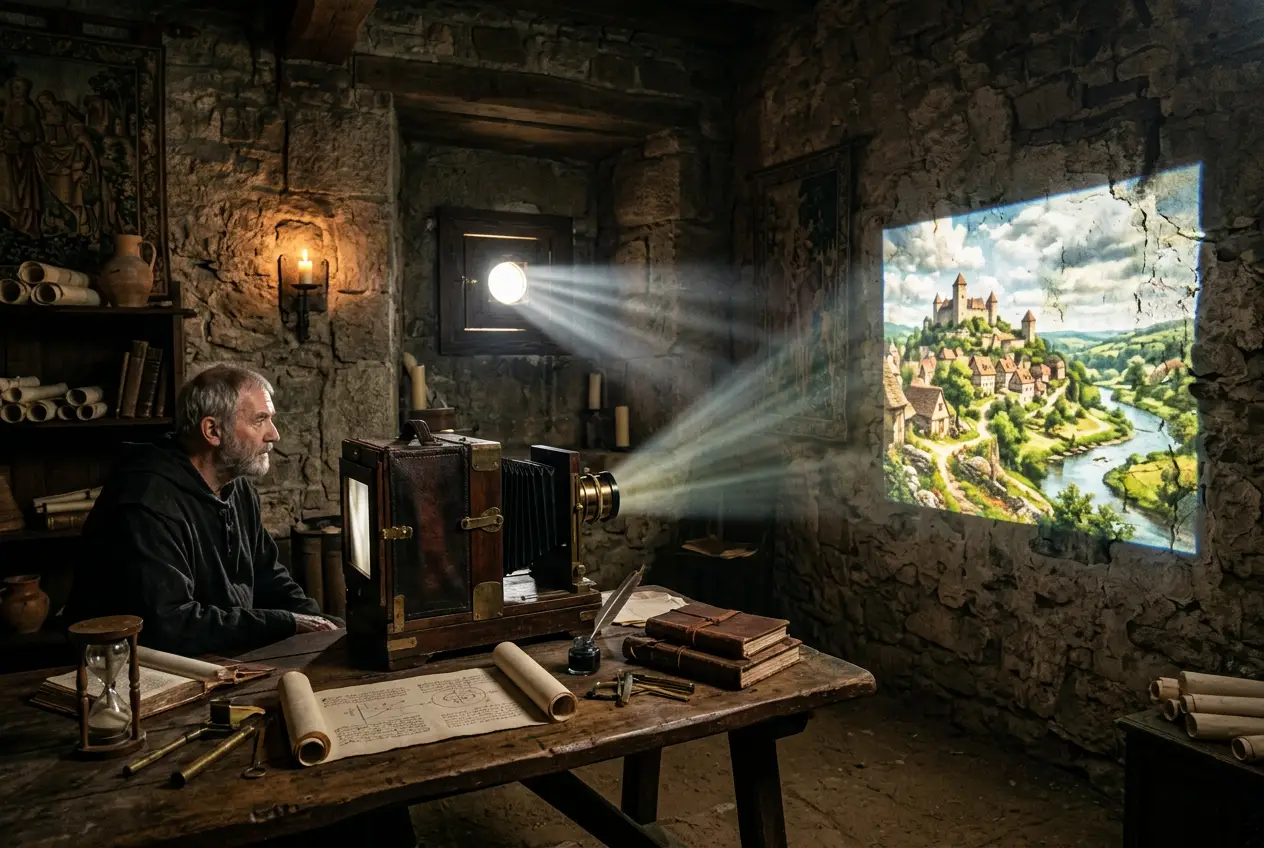
I remember scrolling through articles about forgotten technologies, and a thought struck me: we marvel at the intricate carvings and detailed frescoes left by ancient civilizations, but what if their methods of documentation went beyond chisel and brush? What if, long before Niepce or Daguerre, ancient innovators had found a way to capture images using sunlight itself? The idea sounds like something out of a historical sci-fi novel, a whispered secret lost to the sands of time. Yet, the more I delved into the capabilities of ancient minds and their often-underestimated scientific understanding, the more this seemingly outlandish concept began to spark a genuine scientific curiosity.
Could civilizations like the Egyptians, Greeks, or Romans, with their profound understanding of optics and chemistry, have devised a crude form of "sun printing" or even a precursor to photography? It’s a compelling thought, pushing the boundaries of what we typically consider "ancient technology."
The Fundamentals: Light, Lenses, and Pinhole Magic
To understand if ancient cultures could have captured sunlight images, we first need to dissect the basic principles of photography. At its core, photography relies on two main components:
- An optical system: Something to focus light and form an image.
- A light-sensitive medium: A surface that reacts chemically or physically to light, permanently recording the image.
Ancient civilizations were surprisingly adept at optics. Lenses, crafted from polished quartz or obsidian, have been found in archaeological sites dating back thousands of years. The Nimrud lens, discovered in modern-day Iraq, is over 3,000 years old, sparking debates about its use as a magnifying glass or even part of a telescope. Similarly, the Romans were masters of glass-making, creating intricate pieces that hinted at a sophisticated understanding of light manipulation. While we’ve explored topics like whether ancient lenses revealed hidden worlds, the idea of using them to capture images is another leap entirely.
Even simpler than a sophisticated lens, the camera obscura (Latin for "dark room") was a well-known phenomenon. It’s essentially a darkened room or box with a small hole on one side. Light from an external scene passes through this pinhole, projecting an inverted image onto the opposite surface inside. The Chinese philosopher Mozi described this effect as early as the 5th century BC, calling it a "collecting place" or "locked treasure room." Later, Aristotle, Euclid, and then Arab scholars like Ibn al-Haytham (Alhazen) also detailed the principles of the camera obscura. Renaissance artists famously used it as an aid for drawing and painting, tracing the projected images. You can learn more about its history on Wikipedia: Camera Obscura (opens in a new tab).
So, the optical component—a way to form an image—was certainly within the grasp of ancient minds. The challenge then shifts to the second, more complex part: the light-sensitive medium.
The Alchemist's Challenge: Finding a Light-Sensitive Medium
This is where the theory truly gets intriguing. Early photography, pioneered in the 19th century, relied heavily on chemical reactions. Joseph Nicéphore Niépce, often credited with the first permanent photograph, used bitumen of Judea, which hardens when exposed to light, on a pewter plate. This process, called heliography, literally "sun drawing," required hours of exposure. Later, Louis Daguerre and William Henry Fox Talbot advanced the field using silver salts, particularly silver halides, which are highly sensitive to light. Read more about heliography on Wikipedia: Heliography (opens in a new tab).
Did ancient civilizations possess knowledge of substances that could react to light in a similar way? Let's consider a few possibilities:
Silver Salts: The Untapped Potential?
The properties of silver were well known in ancient times. It was used for coinage, jewelry, and even medicinal purposes. Ancient metallurgists and alchemists certainly handled silver compounds. While they might not have understood the precise chemical reactions at a molecular level, they could have observed phenomena. For instance, silver chloride darkens dramatically upon exposure to light. This effect was known to alchemists as early as the 16th century, though its potential for image capture wasn't immediately recognized.
Could ancient artisans, perhaps in Egypt or Mesopotamia, have stumbled upon this property accidentally? Imagine a silver-plated object, perhaps coated with some organic residue, left in the sun, showing a faint impression of an object that once rested on it. Such an observation, if repeatable, could have been a starting point. The idea of Egyptian artisans working with metals and chemicals also brings to mind other ancient "tech" mysteries, like the Dendera Light, where their understanding of electricity or light might have been far more advanced than we assume.
Plant-Based Pigments and Dyes
Many plant extracts contain compounds that are photosensitive. Anthocyanins, found in red cabbage, blueberries, and other plants, change color with pH and can also be affected by light. Ancient cultures were masters of dyes and pigments, extracting vibrant colors from a myriad of botanical sources. It’s plausible that some of these natural dyes, when exposed to intense sunlight for prolonged periods, could undergo irreversible chemical changes, leaving a permanent "sun print."
Consider the process of making indigo dye, which involves complex chemical reactions. It's not a stretch to imagine that other plant-based concoctions, perhaps combined with metallic salts or other minerals, could have yielded light-sensitive properties. The challenge would be fixing the image, preventing it from fading further upon continued light exposure, which was a major hurdle for early photographers too.
Bitumen and Resins
Niépce's use of bitumen in heliography offers another potential ancient pathway. Bitumen, a naturally occurring asphalt, was widely used in ancient Mesopotamia for waterproofing, mortar, and even art. If ancient cultures discovered that bitumen, when mixed with certain oils or solvents, became less soluble after light exposure, they could have inadvertently created a photographic process. The unhardened parts could then be washed away, leaving a permanent image in relief. This is a very basic form of photolithography.
Historical Whispers and Anomalies
The biggest hurdle for this theory, of course, is the lack of definitive physical evidence. No ancient "photographs" have been unearthed. However, absence of evidence isn't always evidence of absence, especially when dealing with organic or ephemeral materials that degrade over millennia.
Could certain enigmatic ancient artifacts or texts be subtly hinting at such knowledge?
- The Turin Shroud: While highly controversial and generally dated to the medieval period, its debate around how an image could be imprinted without paint sometimes brings up theories involving light or chemical reactions.
- Descriptions of "Sun Worship" or rituals involving light: Some ancient cultures performed ceremonies where objects were exposed to the sun for symbolic or ritualistic reasons. Could these rituals, over time, have been an unwitting observation of photosensitive reactions?
- Ancient 'Data Storage': We know ancient civilizations were obsessed with recording information, from the intricate symbols on the Phaistos Disc to elaborate cuneiform tablets. The desire to capture and preserve visual information would have been strong. If they developed a method, however crude, it would have been invaluable.
We also have to consider the context of discovery. If a sun-printed image was created on a highly perishable material like papyrus or treated cloth, it would have long since decomposed. Even if it were on a more durable surface, identifying it as a "photograph" rather than a natural stain or an elaborate painting might prove difficult without modern analytical techniques.
The "What If?" and Our Modern Perspective
If ancient civilizations did possess such a technology, even a rudimentary one, it would profoundly alter our understanding of their scientific capabilities. It would mean that the roots of photography stretch back not just a few centuries, but potentially millennia, woven into the fabric of human ingenuity right alongside other groundbreaking inventions.
Perhaps the technology was too complex, too rare, or too sacred to be widely adopted or recorded. Many advanced skills in ancient times were guarded by priests, alchemists, or specialized artisans, becoming "lost tech secrets" rather than widely disseminated knowledge. We see glimpses of this in other fields, like the precision of ancient alignments that tracked the cosmos, suggesting knowledge far beyond common understanding.
The idea that the earliest "photographs" weren't taken with bulky cameras and chemical-laden darkrooms, but possibly with a simple pinhole and a surface treated with obscure plant extracts, is incredibly humbling. It reminds us that innovation isn't a linear progression but often a series of discoveries, some of which may have been made and then forgotten, only to be reinvented centuries later.
The quest to find evidence of ancient sunlight imaging continues to be a fascinating journey into the intersection of history, science, and boundless human curiosity. While concrete proof remains elusive, the mere possibility pushes us to re-examine what we think we know about the past, inviting us to wonder if the ancients, too, gazed at images fixed by the very light of their gods – the sun.
Further Reading:
Conclusion
The notion of ancient civilizations capturing sunlight images remains largely in the realm of speculative archaeology and historical science. Yet, the components required—an understanding of optics and access to light-sensitive materials—were undeniably present in varying degrees across many ancient cultures. While no indisputable "ancient photograph" has surfaced, the absence of proof doesn't completely negate the possibility. Instead, it invites us to look at ancient artifacts, texts, and even myths with fresh eyes, perhaps seeking subtle clues of a lost art form that harnessed the very essence of light to record the world around them. It's a testament to the enduring human drive to capture moments, a drive that might be as old as civilization itself.




Conversation0
No comments yet. Be the first to share a thought — the best questions often become new stories.