


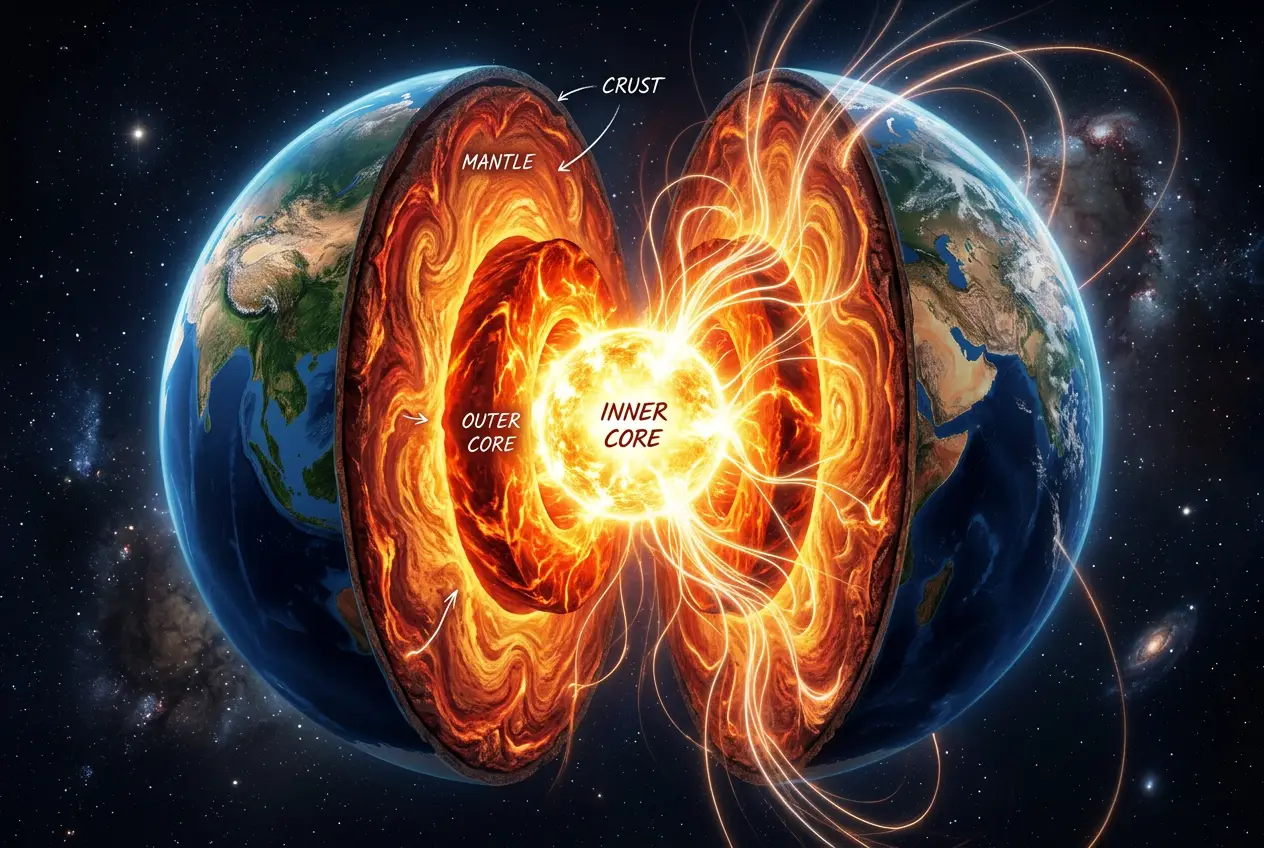
I remember the first time I truly looked at a diagram of Earth's interior. It wasn’t just a pretty picture of layers; it was a testament to immense pressure, unimaginable heat, and dynamic processes churning beneath our feet. For centuries, we’ve marveled at the forces that shape our world, from volcanoes erupting to continents drifting. But what if the engine driving much of this geological ballet, the very heat keeping our planet alive and dynamic, isn’t just residual heat from formation, but something far more active? What if Earth's core, a place more alien than the surface of Mars, harbors a natural nuclear reactor?
It sounds like science fiction, a plot device from a Jules Verne novel, but the concept of a georeactor – a nuclear fission reactor operating naturally within Earth’s deep interior – has been a subject of serious scientific inquiry for decades. It’s a captivating thought: our planet not just a passive cooling sphere, but a colossal, self-sustaining power plant.
The Roaring Heart of Our World
To understand this audacious idea, we first need to appreciate what we do know about Earth's core. Our planet is structured like an onion, with distinct layers: the thin, solid crust we walk on, the viscous mantle beneath it, and then two core layers—a liquid outer core and a solid inner core. The inner core, a sphere of solid iron and nickel roughly the size of the Moon, exists under staggering pressure and temperatures estimated to be as hot as the surface of the Sun, around 5,200 °C (9,392 °F). You can read more about its properties on Wikipedia's Inner Core page (opens in a new tab).
This immense heat is what drives many of Earth's fundamental processes. It powers mantle convection, which in turn moves tectonic plates, causing earthquakes and volcanic activity. Critically, the convection of molten iron in the outer core generates Earth's powerful magnetic field, a shield that protects us from harmful solar radiation and allows life to flourish. Without this internal furnace, Earth would be a very different, likely barren, place.
But where does this heat come from? The conventional wisdom points to two primary sources:
- Primordial Heat: Residual heat left over from the planet’s violent formation 4.5 billion years ago, as gravitational compression and collisions converted kinetic energy into thermal energy.
- Radiogenic Heat: Heat produced by the radioactive decay of unstable isotopes within the mantle and crust, primarily uranium, thorium, and potassium-40.
For a long time, these two sources were considered sufficient to explain Earth's observed heat flux. However, a lingering question remains: are they enough to sustain the observed heat output over geological timescales and explain the dynamic processes we still see today? Some scientists believe there might be a missing piece in the puzzle, leading them to consider the intriguing possibility of a georeactor.
The Georeactor Hypothesis: A Nuclear Furnace Below?
The idea of a natural nuclear reactor isn't entirely unprecedented. In 1972, scientists discovered the Oklo natural nuclear fission reactors in Gabon, Africa. For about 500,000 years, roughly two billion years ago, deposits of highly concentrated uranium-235 (which was more abundant then) underwent self-sustaining nuclear fission reactions. This discovery proved that nature could, under the right conditions, create and sustain nuclear chain reactions. You can delve into this fascinating geological wonder here: Wikipedia on Natural Nuclear Fission Reactors (opens in a new tab).
Inspired by Oklo, American theoretical physicist J. Marvin Herndon proposed in the 1990s that a similar, much larger natural nuclear fission reactor could exist at the center of Earth. Herndon's "georeactor" hypothesis suggests that when Earth formed and underwent planetary differentiation—the process where heavier materials sank to the core and lighter materials rose to the surface (Wikipedia on Planetary Differentiation (opens in a new tab))—heavy elements like uranium and thorium might have concentrated at the innermost part of the core.
How Would it Work?
Imagine a vast, spherical repository of uranium and thorium isotopes, compressed under immense pressure at the very heart of our planet. In Herndon's model, the heat generated by the radioactive decay of these elements would cause them to melt, forming a sub-layer of liquid nuclear fuel surrounding a solid inner "seed" of fission products. As this liquid fuel heats up, it would undergo convection, much like the molten iron in the outer core. This convection would periodically bring fissile material into a critical configuration, initiating a self-sustaining nuclear chain reaction.
The tremendous heat generated by this fission process would then diffuse outwards, contributing significantly to Earth's overall heat budget. Herndon argues that a georeactor could:
- Explain the Geodynamo: The magnetic field of Earth, generated by the convective motion of the liquid outer core (known as the geodynamo), requires a sustained and powerful heat source. While conventional models attribute this largely to the cooling of the inner core and the release of latent heat as iron crystallizes, a georeactor could provide an additional, robust energy input, helping to sustain the geodynamo over billions of years. This ties into our understanding of why Earth's magnetic field acts the way it does, even occasionally undergoing reversals, a topic explored in our blog about Earth's Magnetic Field Flipping.
- Account for Excess Heat: Some geophysical models suggest that the total heat flux from Earth's interior is greater than what can be accounted for by primordial and radiogenic heat from the mantle and crust alone. A georeactor could supply this "missing" heat.
- Influence Mantle Plumes and Hotspots: The intense localized heat from a georeactor could potentially initiate deep mantle plumes, which are upwellings of abnormally hot rock from the deep mantle, responsible for phenomena like volcanic hotspots (e.g., Hawaii).
Challenges and Counterarguments
Despite its allure, the georeactor hypothesis faces significant scientific hurdles and has not gained widespread acceptance within the geoscience community.
One of the main challenges is evidence. Directly observing Earth's core is impossible, so scientists rely on seismic waves to infer its structure and composition. While seismic data can tell us about density and state of matter, it cannot directly confirm the presence of fissile elements or nuclear reactions.
Another critical point is the concentration of fissile materials. For a nuclear chain reaction to occur, there needs to be a sufficiently high concentration of fissionable isotopes like uranium-235. While heavy elements do sink during planetary differentiation, it's not clear that uranium and thorium would concentrate so precisely and so abundantly at the very center to form a critical mass, especially given their geochemical properties. Most models suggest these elements are more likely to be concentrated in the mantle rather than fully sinking to the innermost core.
Furthermore, neutrino detection has provided some constraints. Geoneutrinos, antineutrinos produced by radioactive decay within Earth, can be detected by specialized observatories. While current measurements confirm radiogenic heat production from the mantle and crust, they don't yet definitively point to a significant contribution from a core reactor. However, the sensitivity to detect neutrinos specifically from the inner core is still developing.
Many geophysicists argue that conventional models, which combine primordial heat with radiogenic decay in the mantle, are sufficient to explain Earth's thermal history and geodynamo. They point to the ongoing cooling and solidification of the inner core as a primary driver for convection in the outer core, supported by our understanding of heat transfer and material properties under extreme conditions. The immense pressures at the core also pose challenges for sustaining a convective nuclear reaction in the way imagined.
The Broader Implications
Even if the georeactor hypothesis remains speculative, it pushes us to think differently about planetary energy. The very idea that a celestial body could host a natural nuclear furnace challenges our assumptions about geological processes and the longevity of planetary heat sources. It connects our present understanding of Earth's dynamics to ancient processes, echoing the subtle, persistent hum of our planet that some scientists attempt to decipher, a concept akin to Earth's Hidden Pulse.
The pursuit of understanding Earth's internal heat also has practical implications. Harnessing geothermal energy, for instance, is a testament to tapping into this internal heat. While current geothermal power plants typically access heat from relatively shallow crustal sources, the ultimate source of that heat is the deeper Earth. Imagine if we could ever access the true scale of the heat generated by the Earth's core, even without a reactor. Read more about geothermal energy on Wikipedia (opens in a new tab).
The study of planetary cores and their energetic processes is crucial for understanding not just Earth, but exoplanets too. What drives the magnetic fields of other rocky worlds? How long do their internal engines run? The answers could influence their habitability and evolution, and help us discover whether other "living" planets share our active, dynamic core.
Conclusion: A Fiery Debate Continues
The question of whether Earth's core is a natural nuclear reactor remains one of the most intriguing mysteries in geophysics. While the evidence leans towards conventional models of heat generation, the sheer audacity and potential explanatory power of the georeactor hypothesis ensure it continues to spark debate and inspire research. It forces us to peer deeper, both literally and figuratively, into the unknown mechanics of our home planet.
Perhaps one day, with advanced neutrino detectors or revolutionary seismic imaging techniques, we might gather definitive proof one way or the other. Until then, the core of our Earth remains a vast, churning enigma, a testament to the powerful, hidden forces that shape our world and perhaps, in ways we still don't fully comprehend, sustain our very existence. The idea of an unseen, colossal power grid deep within the Earth is a reminder that even our own planet holds profound secrets, much like the broader concepts of unseen energy we explore elsewhere.




Conversation0
No comments yet. Be the first to share a thought — the best questions often become new stories.