


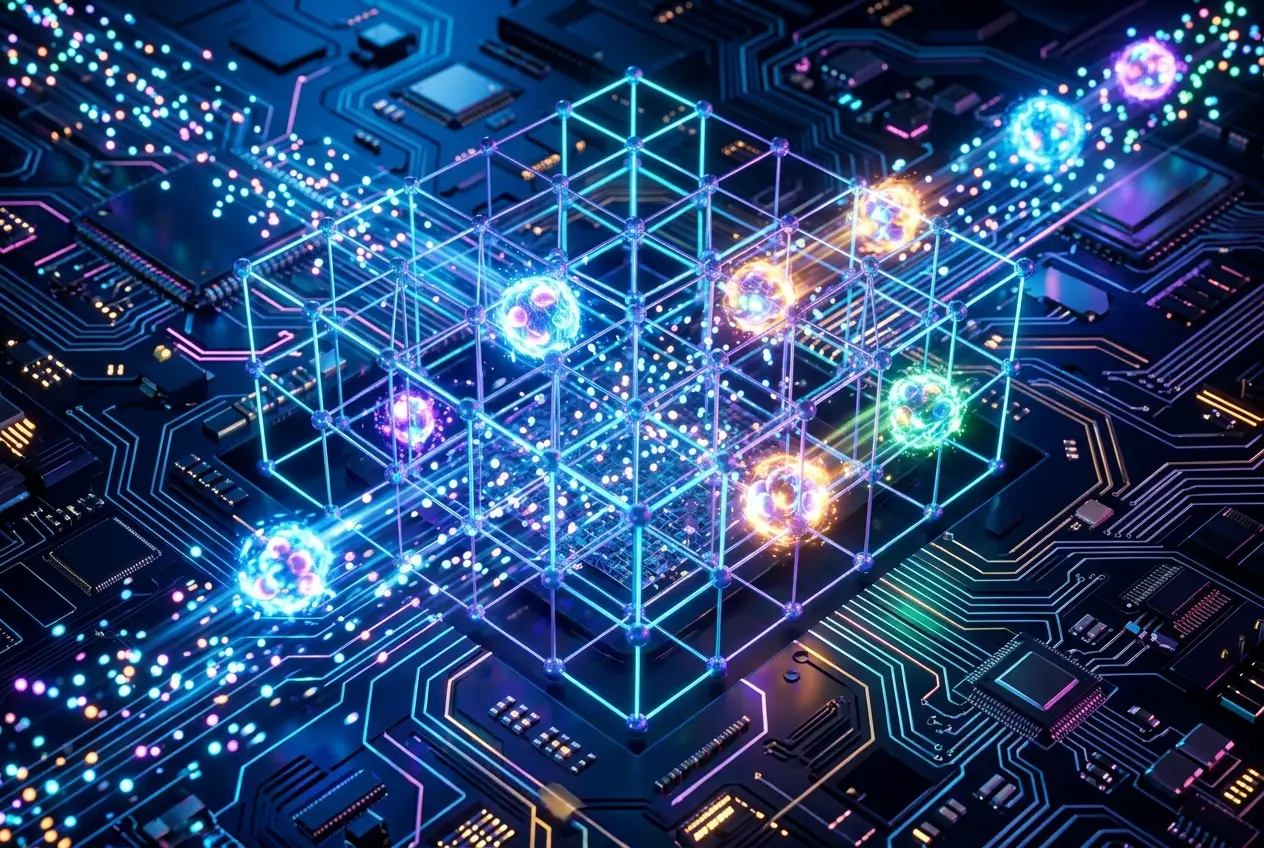
Recently, I was contemplating the fundamental limits of our current electronic devices. We’re pushing silicon to its absolute boundaries, constantly striving for faster, smaller, and more energy-efficient systems. But what if the key to unlocking the next generation of electronics lies not in manipulating individual electrons, but in harnessing something far more ephemeral, a dance between light and matter known as excitons?
Imagine a world where your devices consume a fraction of the power, where data transfer happens at the speed of light within chips, and quantum phenomena are not just theoretical but integral to everyday computing. This isn’t science fiction; it’s the ambitious frontier of excitonics, a burgeoning field exploring these peculiar quasi-particles as potential workhorses for future technology.
What Exactly Are Excitons?
To truly grasp the potential of excitons, we first need to understand what they are. In the simplest terms, an exciton is like an "excited state" in a semiconductor material. When a material absorbs light (photons), the energy from that light can kick an electron out of its usual, lower-energy state, leaving behind a "hole" – essentially a missing electron, which behaves like a positively charged particle.
Now, here's where it gets interesting: the electron, with its negative charge, is attracted to this positively charged hole. Instead of immediately recombining, they can form a temporary, bound pair, orbiting each other like a tiny, hydrogen-atom-like entity. This bound electron-hole pair is what we call an exciton.
The Quantum Dance of Light and Matter
Excitons are fascinating because they bridge the gap between light and matter. They are created by light, carry energy, and can also emit light when the electron and hole finally recombine. This unique duality makes them incredibly versatile. Think of them as tiny, transient energy packets that can move through a semiconductor lattice, carrying information or energy without directly involving the flow of current.
I find it quite profound how these fleeting interactions at the quantum level could revolutionize macro-scale technology. It’s a testament to the intricate dance of particles that governs our universe. For a deeper dive into the quantum realm, you might find our previous article, Do Quantum Ripples Tear Spacetime?, an interesting read.
Why Are Excitons So Special for Electronics?
The magic of excitons lies in several key properties that make them attractive for next-generation electronics:
- Energy Efficiency: Unlike electrons, which dissipate energy as heat when they move through a conductor (electrical resistance), excitons are electrically neutral. They don't carry a net charge, so their movement in certain materials can be far more energy-efficient, leading to less heat generation. This is crucial for microprocessors, which are increasingly limited by thermal management.
- Light-Matter Interaction: Excitons are intimately linked to light. They can be created and annihilated by photons, making them ideal candidates for optoelectronic devices – those that convert electrical signals to light and vice versa. This paves the way for optical computing, where data is transmitted by light instead of electrons, offering significantly faster speeds.
- Quantum Coherence: In certain conditions, excitons can exhibit quantum phenomena, like forming a Bose-Einstein condensate or showing coherence over longer distances. This property could be crucial for developing quantum computing components, where information is stored and processed using quantum states.
- Tunability: The properties of excitons (like their energy and lifetime) can be tuned by changing the material, its size (e.g., in quantum dots), or by applying external fields. This offers immense flexibility in designing devices with specific functionalities.
From Discovery to Potential Revolution
The concept of excitons isn't new. It was first theorized by Yakov Frenkel in 1931, who proposed the existence of these "excited states" in insulating crystals. Since then, physicists have extensively studied their behavior in various materials, from conventional semiconductors to exotic 2D materials like graphene. These studies form the bedrock of a new field known as excitonics, which aims to manipulate excitons for technological applications. You can learn more about the fascinating history and physics of excitons on Wikipedia's Exciton page (opens in a new tab).
The potential applications of excitons are vast and transformative, touching upon multiple aspects of modern technology.
Excitons in Current and Future Tech
While we are still in the early stages of harnessing excitons directly for computing, their underlying physics is already at play in some existing technologies, albeit often indirectly. For instance, the efficiency of LEDs and solar cells relies heavily on understanding how excitons are formed, migrate, and recombine to produce light or generate current. The development of highly efficient organic LEDs (OLEDs) for displays owes much to research into exciton dynamics in organic semiconductors.
The Promise of Excitonic Devices
The real game-changer lies in excitonic devices, which aim to directly exploit excitons for computation and communication:
- Excitonic Transistors and Logic Gates: Imagine replacing traditional electron-based transistors with exciton-based ones. Since excitons are neutral, they could potentially switch much faster and with less energy loss. Researchers are exploring ways to control exciton flow and interaction to build logic gates, forming the fundamental building blocks of future computers.
- Optoelectronic Computing: This is where excitons truly shine. By converting electrical signals into excitons and then into light, we could achieve ultra-fast data transfer within computer chips and between components. This could fundamentally change how our computers are designed, moving towards a blend of electronic and optical processing. This concept ties into the grand vision of using light for computation, a topic we touched upon in Is Light Our Universe's Fastest Computer?.
- Quantum Information Processing: The quantum nature of excitons, especially in confined structures like quantum dots, makes them candidates for qubits – the basic units of quantum information. Manipulating exciton spin or energy states could pave the way for novel quantum computing architectures. More on quantum phenomena can be found in our blog, Can Quantum Computers Break Time's Rules?.
- Ultrafast Data Storage: The ability to create and manipulate excitons on extremely short timescales could lead to new forms of volatile memory that are significantly faster than current RAM technologies.
- Advanced Sensors: Excitons are highly sensitive to their environment. Changes in temperature, pressure, or chemical composition can alter their properties, making them excellent candidates for developing highly sensitive and miniature sensors for medical diagnostics, environmental monitoring, or industrial applications.
Challenges and the Road Ahead
Despite their immense potential, excitonics faces significant challenges. One major hurdle is controlling excitons at room temperature. Many of their fascinating quantum properties are only stable at extremely low temperatures, making practical applications difficult. Researchers are actively working on materials that can sustain excitons at higher temperatures, such as specific perovskites or advanced 2D materials.
Another challenge is engineering materials with the precise properties required to efficiently generate, manipulate, and detect excitons. This involves advanced materials science, nanotechnology, and quantum physics. The ability to grow ultra-pure crystals and precisely structure them at the nanoscale is critical.
However, the scientific community is making remarkable progress. Innovations in nanomaterials, particularly quantum dots and 2D materials like graphene (which also holds promise for future computing, as explored in Can Graphene Chips Unleash AI Superpowers?), are opening new avenues for exciton research. The dream of an "excitonic circuit board" is becoming less a distant fantasy and more a tangible goal for future generations of electronics.
In my view, the journey to harness excitons is emblematic of humanity's relentless pursuit of understanding and manipulating the fundamental forces of nature for technological advancement. It’s a field brimming with the promise of unprecedented energy efficiency, computational speed, and entirely new functionalities for the devices that shape our lives. The invisible dance of electrons and holes might just be the quiet revolution we've been waiting for.





Conversation0
No comments yet. Be the first to share a thought — the best questions often become new stories.