


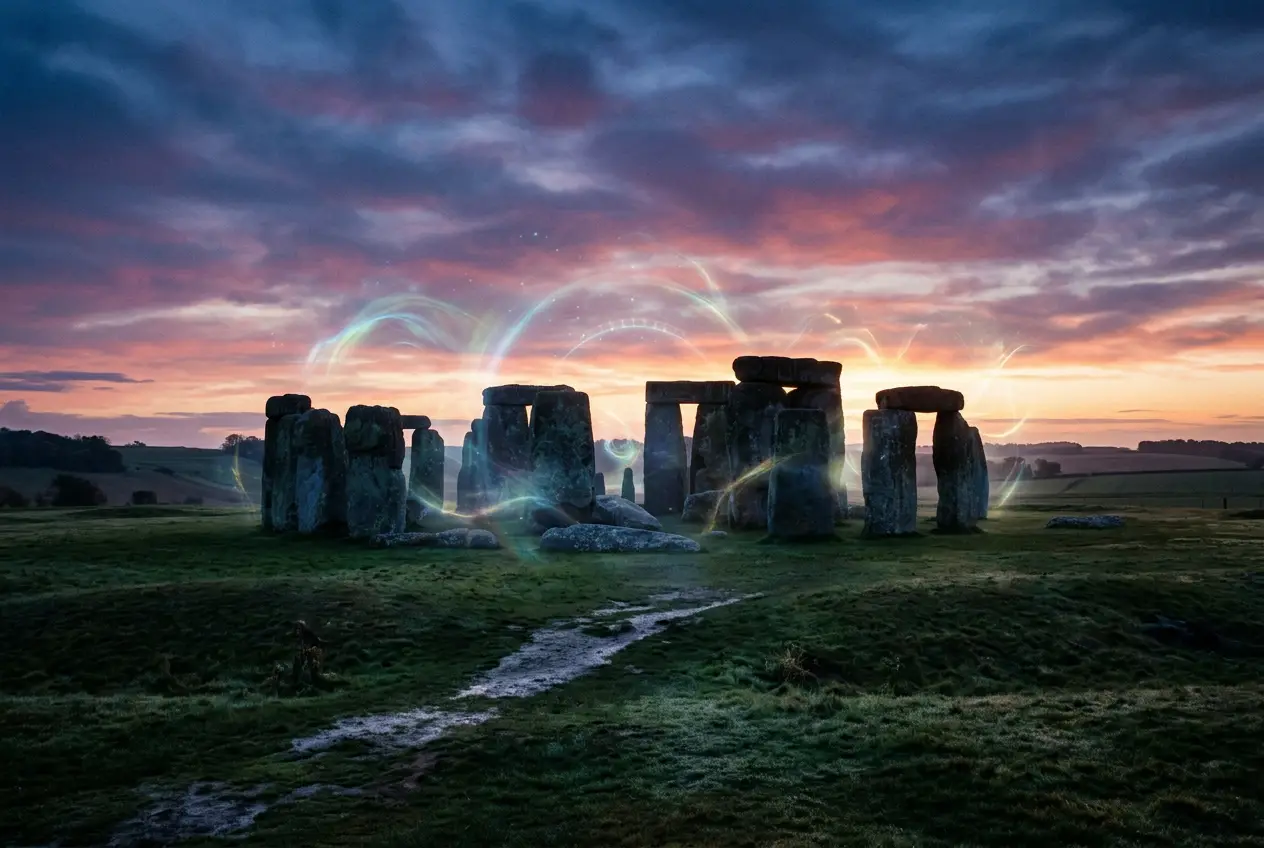
I remember the first time I stood before Stonehenge. The sheer scale, the silent majesty, the palpable sense of history — it was overwhelming. But beyond the awe, a question lingered: what was its true purpose? For centuries, we’ve marvelled at this colossal prehistoric monument, often viewing it primarily as an astronomical calendar or a ceremonial site. Yet, what if its true function was far more sophisticated, tapping into principles we’re only now beginning to grasp? What if the megalithic marvel of Salisbury Plain was, in essence, an ancient quantum sensor?
This isn't a flight of pure fantasy, but a journey into the tantalizing overlap of archaeoastronomy, acoustics, geology, and emerging quantum theories. I’ve always been fascinated by the idea that our ancestors, with their deep connection to the natural world, might have understood subtle energies and complex systems in ways that modern science is only now rediscovering. Could Stonehenge have been designed to interact with, amplify, or even detect unseen forces?
The Enduring Mystery of Stonehenge's Purpose
Built thousands of years ago, between 3000 BC and 2000 BC, Stonehenge is a masterpiece of prehistoric engineering. Its massive sarsen stones, some weighing up to 30 tons, and the smaller bluestones, transported hundreds of miles from Wales, speak of an incredible commitment and organizational prowess. While its precise function remains debated, archaeological evidence points to its significance as a burial ground, a place of healing, and certainly an astronomical observatory, aligning perfectly with the solstices.
But these interpretations, while valid, might only scratch the surface. The monumental effort involved, the precision of its alignment, and the unique properties of its materials suggest a purpose far beyond simple observation or ritual. Could the very fabric of Stonehenge itself have been designed to serve as a kind of ancient technology? For more on its historical context, a deeper dive into its construction can be found on Wikipedia's Stonehenge page (opens in a new tab).
Beyond Astronomical Alignment: The Acoustical Anomaly
One of the most intriguing aspects of Stonehenge, often overlooked, is its acoustic properties. Recent studies in archaeoacoustics have revealed that the bluestones, in particular, possess unusual sonic qualities. When struck, many of them resonate like bells, gongs, or drums. This phenomenon has led researchers to believe that sound played a significant role in the monument's use.
I recall reading about a fascinating experiment where researchers, using specialized equipment, mapped the acoustic landscape of Stonehenge. They found that the arrangement of the stones created unique sound reflections and resonant frequencies within the circle. Imagine a prehistoric ceremony within those stones, where sounds were amplified, distorted, and echoed in ways that could have been profoundly moving or even disorienting. Could these acoustic properties have been integral to its "sensing" capabilities?
Some theorize that the sound produced or amplified by the stones could have been used to induce altered states of consciousness, facilitating a connection to the spiritual realm. But what if the sound had a more "scientific" purpose? In modern physics, sound waves can interact with other forms of energy. Could the specific acoustic environment of Stonehenge have been designed to resonate with subtle earth energies or even cosmic frequencies?
Earth Energies and Geomagnetic Grids
The location of Stonehenge is not accidental. It sits on a spot within Salisbury Plain where several "ley lines" – hypothetical alignments of ancient sites – are said to converge. While ley lines remain a pseudoscientific concept, the idea that ancient cultures were sensitive to subtle geological energies is gaining traction. The Earth itself is a giant magnet, constantly emitting a complex tapestry of electromagnetic fields. It’s not far-fetched to consider that ancient peoples, deeply connected to their environment, might have sensed these fields.
Some theories propose that megalithic sites like Stonehenge were deliberately placed to tap into or manipulate these natural geomagnetic currents. Imagine the bluestones, with their unique piezoelectric properties (the ability to generate an electric charge in response to mechanical stress, or vice versa), acting as transducers. If sound waves were generated within the circle, and the bluestones had piezoelectric properties, could they have converted mechanical vibrations into subtle electrical signals, or vice versa? For further reading on geomagnetic fields and their potential ancient interactions, see Wikipedia on geomagnetism (opens in a new tab).
This brings me back to the idea of a "sensor." A sensor, at its most basic, detects and responds to stimuli. If Stonehenge was designed to resonate acoustically, and its stones had properties that could interact with the Earth's subtle energies, it begins to sound a lot like a complex, low-tech sensing apparatus. Perhaps it wasn't a computer in the modern sense, but a finely tuned instrument for perceiving environmental fluctuations that were otherwise invisible.
The Quantum Connection: A Leap of Speculation (Grounded in Science)
Now, let's take a speculative leap into the realm of quantum mechanics. Quantum sensing is a rapidly developing field in modern technology, utilizing the principles of quantum physics – like superposition and entanglement – to achieve unprecedented sensitivity in detecting minuscule changes in magnetic fields, gravity, and even time. Could ancient builders have intuitively stumbled upon principles that, when viewed through a modern lens, resemble early forms of quantum interaction?
I'm not suggesting that Neolithic people understood Schrödinger's equation or built quantum computers. That would be absurd. However, I am pondering if their deep, observational knowledge of nature led them to construct structures that, by virtue of their materials, arrangement, and location, could inadvertently (or even intentionally, through trial and error) exploit certain quantum phenomena at a macroscopic level.
Consider the bluestones again. Some of these stones are dolerite, an igneous rock containing magnetite, a naturally magnetic mineral. Could the specific arrangement of these magnetic stones within a resonant acoustic environment, situated on a geomagnetically active site, have created a subtle interference pattern or energy field that could be "read" or experienced?
In quantum biology, we're discovering how living organisms, from birds navigating using the Earth's magnetic field to plants utilizing quantum coherence in photosynthesis, leverage quantum effects. If nature itself employs these subtle interactions, is it so far-fetched to imagine that sophisticated ancient structures, crafted by observers of nature, might have attempted to replicate or harness them? This echoes some of the ideas discussed in our previous blog about the possibility of quantum biology unlocking animal super senses.
Perhaps Stonehenge was a giant "earth antenna," designed not to transmit signals in a modern sense, but to receive subtle cosmic or telluric information. The astronomical alignments could have been crucial for calibrating this "sensor" – knowing when specific celestial bodies (like the sun or moon during solstices) influenced the Earth's energy field most powerfully.
The Mind-Body Connection and Healing
Another compelling theory involves the use of Stonehenge for healing. Archaeological evidence, including skeletal remains showing signs of injury and disease, suggests people travelled great distances to the site. If Stonehenge was a "sensor" that could interact with subtle energy fields, could it also have had a therapeutic effect?
The unique acoustics, combined with potential geomagnetic interactions, might have influenced brainwave patterns or cellular activity. This aligns with ancient practices that often blurred the lines between spirituality, medicine, and what we now call science. We've explored similar ideas about ancient healing practices in our blog, "Lost Frequency: Did Ancients Heal with Sound?", which delves into the power of sound in ancient contexts.
As Dr. Rupert Sheldrake, a biologist and author, has often suggested, there might be morphic fields – invisible organizational fields that influence physical reality. While highly controversial, if such fields exist, could Stonehenge, as a monumental structure built with specific materials and alignments, have acted as a focal point or resonator for these unseen energies, impacting human consciousness or physiology? I find myself wondering if the ancients possessed an intuitive understanding of these interactions long before we had the vocabulary of "quantum" or "field theory."
Replicating Ideas, Not Copying Content
It’s important to reiterate that this theory isn't about claiming the Neolithic builders had particle accelerators. It's about exploring the idea that they might have created a structure capable of interacting with environmental energies in a sophisticated way that, from our modern perspective, hints at concepts like quantum sensing. We are replicating the idea of ancient high-tech, applying a modern scientific lens to historical anomalies.
The challenge lies in deciphering what "information" such a sensor could have gathered. Seasonal changes? Subtle shifts in Earth's magnetic field? Periods of heightened cosmic radiation? The answers remain elusive, lost to the mists of time and the absence of written records. However, the sheer ingenuity and effort invested in Stonehenge compel us to look beyond conventional explanations. For a fascinating perspective on how ancient cultures interacted with their environment, the work of historians like Graham Hancock offers thought-provoking theories, though some are contentious, often found through resources like ancient-origins.net (opens in a new tab).
Perhaps Stonehenge served multiple purposes, each layered upon the other. An astronomical calendar, a ceremonial ground, a healing centre, and – just perhaps – an incredibly sophisticated, intuitive ancient sensor of cosmic and telluric energies, a proto-quantum instrument built from stone and ingenuity.
Conclusion: A Legacy of Unseen Potential
As I reflect on the imposing stones of Stonehenge, I can't help but feel a profound connection to the minds that conceived and constructed it. Their world was devoid of our advanced technology, yet rich in observation and intuition. The notion that they might have built a "quantum sensor" is a testament not to alien intervention or lost super-civilizations, but to the incredible intellectual capacity of early humans to understand and interact with their environment in ways we are only beginning to re-appreciate.
The real mystery of Stonehenge might not just be how it was built, but what it was built to do in its entirety – a question that continues to challenge our assumptions about ancient capabilities and the very fabric of reality itself.





Conversation0
No comments yet. Be the first to share a thought — the best questions often become new stories.