


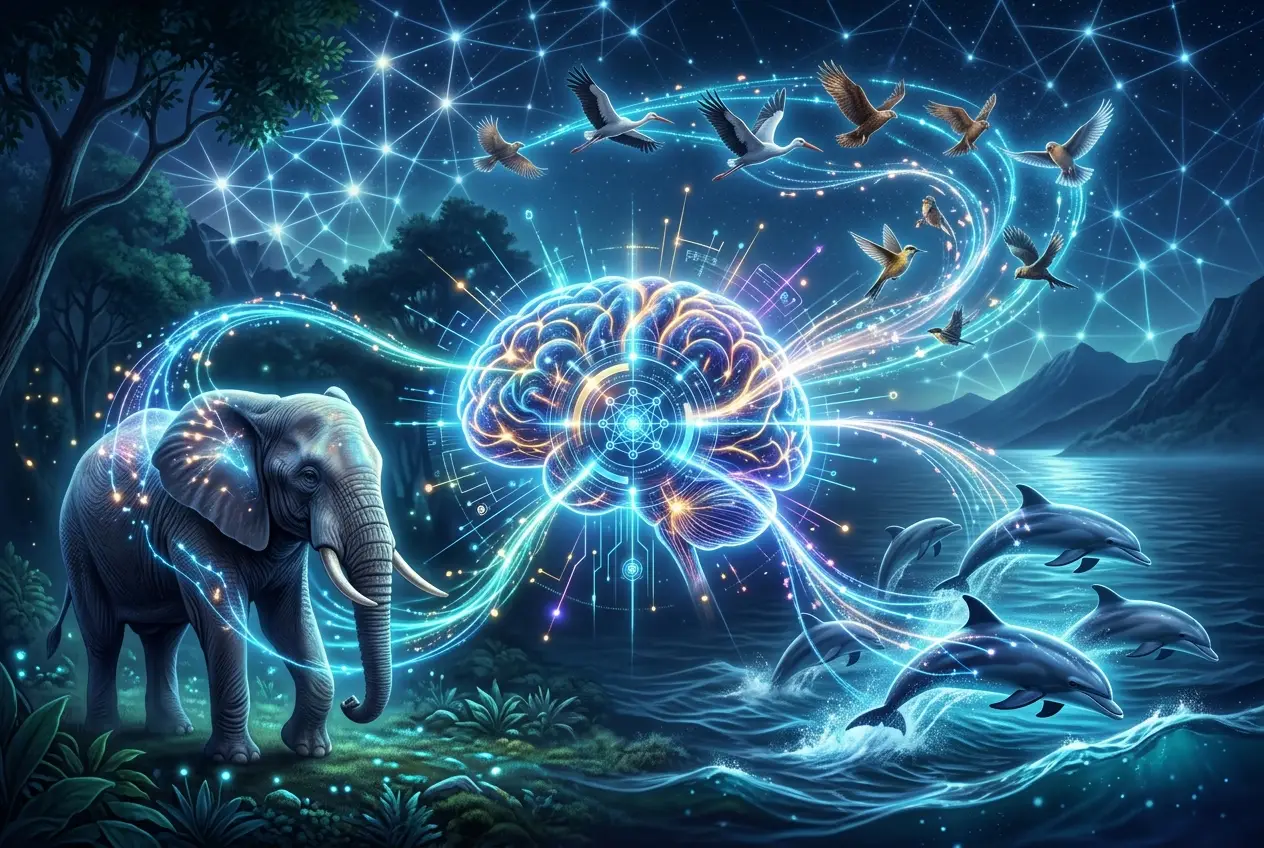
I’ve always been captivated by the idea of understanding other species. Not just observing them, but truly comprehending their communication—their calls, their gestures, their intricate social exchanges. It's a dream that feels straight out of science fiction: to finally break the language barrier between humans and the animal kingdom. But what if this isn't just a fantasy? What if we're on the cusp of a revolutionary breakthrough, powered by artificial intelligence, that could serve as a "New Rosetta Stone" for the voices of the wild?
Recently, I stumbled upon some fascinating research that suggests this very possibility. Scientists and technologists are increasingly turning to AI to analyze the complex vocalizations and behaviors of animals, seeking patterns that our human ears and minds might miss. It’s a pursuit that promises to redefine our relationship with nature, offering insights into animal consciousness, environmental health, and perhaps even unlocking ancient wisdom encoded in their forms of communication.
The Enigma of Animal Communication
For centuries, humans have tried to understand animal communication. From studying bird calls to deciphering dolphin clicks, we’ve always known that animals don't just make random noises; they convey information. They warn of predators, attract mates, signal territories, and even coordinate hunting strategies. But the sheer complexity of these "languages" has largely eluded us. Is it a simple set of signals, or are there underlying grammatical structures, subtle nuances, and even abstract concepts being exchanged?
Consider the intricate songs of humpback whales, which can last for hours and evolve over seasons, shared across vast ocean expanses. Or the sophisticated alarm calls of vervet monkeys, which distinguish between different types of predators, prompting specific escape behaviors. Then there are the chemical signals of ants, the electrical pulses of certain fish, and the elaborate dances of honeybees, all conveying critical information within their communities. These aren't just instinctive reactions; they demonstrate a remarkable level of information processing and transmission.
Traditional methods of studying animal communication, relying on human observation and statistical analysis, have yielded valuable insights but often hit a wall. The sheer volume of data, the subtle variations, and the contextual complexities are simply too much for human researchers alone. This is where AI steps in.
AI: The Ultimate Pattern Recognizer
Artificial intelligence, particularly machine learning and deep learning, excels at finding patterns in vast and complex datasets. This capability makes it an ideal tool for tackling the challenges of animal communication. AI algorithms can process hours of audio recordings, analyze countless video frames, and sift through reams of physiological data at speeds and scales impossible for humans.
One of the most promising applications is in bioacoustics. Researchers are using AI to identify individual animal calls, distinguish between species, and even detect emotional states. For instance, deep learning models can be trained on recordings of individual elephants to recognize their unique rumbles, helping us understand their social networks and family structures. Similar efforts are underway with bats, birds, and even insects.
"The quest to understand animal language is a fundamental scientific challenge, mirroring our own search for intelligence in the universe. AI is not just a tool; it's a paradigm shift in how we approach this mystery." – Dr. Karen Bakker, Author of The Sounds of Life.
Project CETI (Cetacean Translation Initiative), for example, is a monumental effort aimed at deciphering the communication of sperm whales. They are collecting massive amounts of underwater vocalizations using hydrophones and autonomous underwater vehicles. AI algorithms are then used to identify individual clicks and codas, analyze their sequences, and look for recurring patterns that might indicate a syntax or semantic meaning. The hope is that by identifying these patterns, we might eventually be able to "chat" with whales. You can learn more about their incredible work on the Project CETI Wikipedia page (opens in a new tab).
Beyond Sound: Multimodal Communication
Animal communication isn't just about sound. It’s a rich tapestry of visual cues, chemical signals, tactile interactions, and even electrical discharges. AI can handle this multimodal complexity. Computer vision, a branch of AI, can track animal movements, facial expressions, and body postures, identifying subtle signals that convey dominance, submission, alarm, or courtship. For instance, AI systems are being developed to analyze the waggle dance of honeybees, understanding the direction and distance to food sources based on their precise movements.
Imagine a system that not only analyzes the sound of a chimpanzee’s call but also simultaneously processes its facial expression, body language, and even its physiological state (e.g., heart rate, hormone levels). By integrating these diverse data streams, AI can build a far more comprehensive picture of what an animal is trying to communicate, moving beyond simple signal detection to a deeper understanding of intent and context. This holistic approach is crucial for decoding truly complex communication systems.
The potential for AI to unravel biological mysteries extends beyond communication. Recent research explored if living organisms could compute, suggesting that nature itself might hold keys to complex information processing, a topic we touched on in our blog, Can Living Organisms Compute? The Rise of Biocomputing. The methods used to understand such biological computational processes often overlap with those applied to decode animal languages.
Challenges and Ethical Considerations
While the prospects are thrilling, the journey to a "New Rosetta Stone" is fraught with challenges. One major hurdle is the sheer volume and diversity of animal communication. Each species, and even individual populations, might have unique dialects or communication styles. Building models that generalize across species or even within broad categories will require immense datasets and sophisticated algorithms.
Another challenge is the "ground truth" problem. How do we verify that our AI models are truly understanding animal communication, rather than just identifying correlations? We can't directly ask an animal what it means. This often requires careful experimental design, observing animal responses to specific generated signals, and cross-referencing with extensive behavioral studies. For example, if an AI decodes a whale call as a "warning," researchers would need to see if whales indeed exhibit warning behaviors when that specific call is played back.
Furthermore, ethical considerations are paramount. If we gain the ability to understand and potentially "speak" animal languages, what are our responsibilities? How do we prevent exploitation or manipulation? The implications for conservation, animal welfare, and even our understanding of sentience are profound. We must ensure that this powerful technology is used to foster respect and coexistence, not to exploit. The ethical framework around AI's capabilities is a growing field, as we've seen with questions like Can AI Truly Feel? Decoding Digital Empathy.
The Promise: A Deeper Connection to Nature
Despite the challenges, the potential rewards are immense. Decoding animal language could revolutionize conservation efforts. Imagine understanding exactly why a population of birds is declining, not just through ecological observation but by directly comprehending their distress signals or changes in their communication patterns. It could help us identify pollution hotspots, predict environmental changes, or even uncover the early signs of disease outbreaks in wildlife populations.
Beyond practical applications, a successful "New Rosetta Stone" could fundamentally change our perception of the animal kingdom. It would be a monumental step towards recognizing the intelligence and emotional depth of other species, potentially leading to a paradigm shift in how we treat animals and the natural world. It might even reveal shared cognitive structures or universal principles of communication that transcend species barriers, offering insights into the very nature of language itself.
Consider the notion of historical tech; ancient civilizations sometimes built structures that mirrored cosmic patterns, as discussed in Did Ancient Observatories Map Cosmic Events?. Similarly, unlocking animal communication could reveal "ancient" biological patterns and communication systems that have evolved over millions of years, offering a window into the planet's deep ecological history.
The Road Ahead
The journey to decode animal language is just beginning, but with every advance in AI, we inch closer to a future where interspecies communication is not just a dream but a reality. This isn't about teaching animals human language, but rather about learning theirs. It’s about building a bridge of understanding, fostering empathy, and deepening our connection to the intricate web of life on Earth. As I reflect on these possibilities, I feel a profound sense of excitement and responsibility. The "New Rosetta Stone" might not be a physical slab of stone, but a sophisticated network of algorithms, perpetually learning, listening, and bridging the silent divides between species.
This technological frontier reminds us that the greatest mysteries often lie not in distant galaxies, but right here on our own planet, in the languages spoken by our fellow inhabitants.




Conversation0
No comments yet. Be the first to share a thought — the best questions often become new stories.