


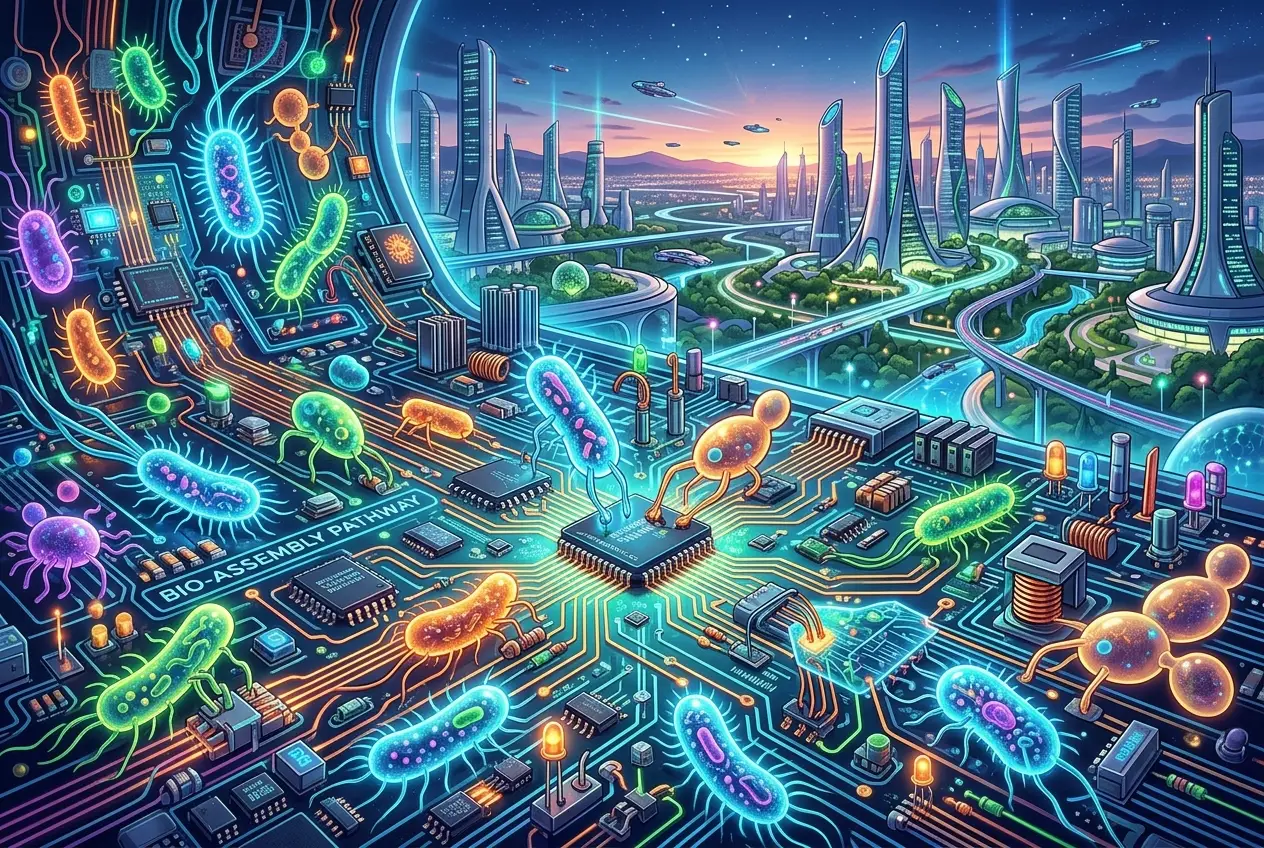
I recently found myself marveling at a humble fern in my garden, specifically how its intricate fronds unfurl with perfect symmetry, each cell knowing exactly where to go, what to become. It’s a silent symphony of self-assembly, a process nature perfected over billions of years. This elegant, low-energy construction contrasts sharply with our modern manufacturing—factories churning, machines grinding, consuming vast amounts of energy and raw materials to build everything from smartphones to skyscrapers. It made me wonder: what if we could tap into nature's secret, not just to inspire design, but to literally grow our technology? What if the tiniest, most ancient architects on Earth – microbes – could self-assemble our future tech?
The idea might sound like science fiction, a microscopic army building our next-generation gadgets, but the truth is, the burgeoning field of synthetic biology is already pushing the boundaries of what these tiny organisms can do. Scientists are actively programming microbes to produce everything from advanced materials to potential living circuits. We’re moving beyond simply harnessing their natural processes to actively directing them towards complex technological creation.
The Blueprint of Life: Nature's Nanomachines
Think about it: every living organism, from a single-celled bacterium to a towering redwood, is a masterclass in self-assembly. Proteins fold into specific three-dimensional structures, cells organize into tissues, and tissues form organs – all without direct human intervention, often at ambient temperatures and with remarkable efficiency. This biological self-assembly is driven by molecular interactions, coded within DNA, leading to complex, hierarchical structures.
At the nanoscale, cells are incredibly sophisticated factories, producing a vast array of molecules and structures with astonishing precision. They create enzymes that catalyze reactions with incredible specificity, build robust cell walls, and even generate electricity. Our human-made factories, for all their power, often pale in comparison to this natural sophistication when it comes to efficiency and waste reduction. For a deeper dive into how life itself computes and organizes, you might find our previous article, Can Living Organisms Compute? The Rise of Biocomputing (opens in a new tab), quite illuminating.
The allure for scientists is obvious: if we could harness and direct this innate ability for self-assembly in microbes, we could unlock a paradigm shift in manufacturing. Imagine materials that literally grow themselves, or electronic components that weave their own connections.
Microbes as Bio-Engineers: From Concept to Reality
The journey to making microbes into manufacturing workhorses began decades ago with simple genetic engineering, primarily for producing pharmaceuticals like insulin. Today, synthetic biology has advanced to allow us to design and build new biological parts, devices, and systems, or to re-design existing natural biological systems for useful purposes. This means we're not just tweaking existing microbial functions; we're reprogramming them.
One fascinating area is the microbial production of advanced materials. Researchers have engineered bacteria and yeast to produce:
- Spider Silk Proteins: Far stronger and more elastic than steel on a weight-for-weight basis, these proteins are incredibly difficult to synthesize chemically. Genetically modified microbes offer a sustainable pathway to produce these materials for applications ranging from lightweight armor to biomedical implants. Read more about synthetic biology on Wikipedia's Synthetic Biology page (opens in a new tab).
- Bio-cellulose: A highly pure form of cellulose produced by certain bacteria, bio-cellulose has exceptional strength and purity. It's already used in medical wound dressings and acoustic membranes, and its potential for sustainable packaging and advanced textiles is enormous.
- Conductive Nanowires: Some bacteria, like Geobacter sulfurreducens, naturally produce protein nanowires that can conduct electricity. Scientists are exploring how to enhance this capability and use these "living wires" to connect components in bio-electronic devices. This is a game-changer for building truly integrated biological and electronic systems.
This isn't just about microbes producing raw materials; it’s about their potential to arrange these materials into functional structures. The key lies in designing genetic circuits within the microbes that dictate not just what they produce, but how and where they deposit or organize it. Imagine a microbial colony growing a miniature antenna, or a sensor.
The Promise of Living Circuits and Materials
The concept of "living technology" extends far beyond simple material production. It promises a future where our devices are more sustainable, adaptable, and even self-healing.
Bio-electronic Interfaces: The Dawn of Living Circuits
The integration of biology and electronics is perhaps one of the most exciting frontiers. Microbes can not only produce conductive materials but can also generate electrical signals themselves or act as biosensors. Researchers are developing:
- Microbial Fuel Cells: These systems use bacteria to break down organic matter and generate electricity. While still in early stages for large-scale power, they show potential for self-powered, remote sensors.
- Bio-Logic Gates: Scientists have created bacteria that act as simple logic gates (AND, OR, NOT), the fundamental building blocks of computers. While far from a CPU, it demonstrates the possibility of biological computation. We explored similar concepts in Can Living Cells Build Our Next Supercomputers? (opens in a new tab).
- Self-Assembling Sensors: Microbes could be engineered to detect specific chemicals or pollutants and then self-assemble into a network that communicates this information, potentially even changing color or emitting light as a signal.
Self-Healing and Sustainable Materials
One of the most compelling aspects of microbial self-assembly is the potential for self-healing materials. Imagine a concrete structure or a plastic component embedded with dormant microbial spores. If a crack appears, these microbes could activate, consuming nutrients and excreting mineral compounds that fill and repair the damage. This would drastically extend the lifespan of infrastructure and products, reducing waste and the need for constant maintenance.
Moreover, manufacturing with microbes could be inherently more sustainable. Microorganisms can operate at room temperature and pressure, often using waste products as their raw materials, leading to significantly lower energy consumption and reduced reliance on fossil fuels. This aligns perfectly with the future of sustainable development, a topic we touched upon in Could Microbes Greenify Mars? The Bio-Engineering Dream (opens in a new tab).
The Challenges and Ethical Landscape
Despite the incredible potential, the path to microbe-designed tech is fraught with challenges.
- Precision and Scalability: Achieving the precise control needed for complex technological designs, especially on a large scale, is incredibly difficult. Living systems are inherently dynamic and often less predictable than inorganic manufacturing processes.
- Stability and Robustness: Maintaining the viability and function of living components in diverse environments, especially outside their natural habitat, is a major hurdle. How do you ensure a microbial-built circuit doesn't "die" or get contaminated?
- Ethical and Safety Concerns: Introducing genetically modified organisms into manufacturing raises important questions. What are the environmental risks if these engineered microbes escape? How do we ensure the safety of products made with or by living systems? Robust regulatory frameworks and public engagement are crucial here.
- Complexity of Design: Designing the genetic circuits to perform highly specific, complex assembly tasks is an immense computational and biological challenge. It requires a deep understanding of cellular pathways and advanced bioinformatics tools. You can learn more about the broader concept of bio-manufacturing on Wikipedia's Bio-manufacturing page (opens in a new tab).
A Glimpse into the Future: The Microbial Revolution
If we overcome these challenges, the future could be truly transformative. Imagine a world where:
- Cities Grow Their Own Infrastructure: Buildings that self-repair, roads that grow over time, and water filtration systems that actively purify themselves, all orchestrated by engineered microbial communities.
- Personalized, On-Demand Manufacturing: Imagine a "bio-printer" that uses microbes to grow custom electronics, clothing, or even medical implants right in your home.
- Dynamic, Adaptable Technology: Devices that can sense their environment, repair themselves, and even evolve their functions in response to changing needs. This echoes some of the ideas about Programmable Matter: Will Anything Be Solid in the Future? (opens in a new tab).
- A Truly Circular Economy: Where waste from one process becomes the raw material for another, all facilitated by the tireless work of microbial engineers.
The thought of designing complex technologies at the molecular level, guided by the ancient wisdom of life itself, is both humbling and exhilarating. We are at the cusp of a microbial revolution that could redefine not just how we build, but what "building" even means. The fern in my garden, and the invisible microbial world beneath my feet, might just hold the keys to humanity's most sustainable and innovative future.
What do you think? Are we ready to hand over the blueprints to our microscopic helpers, or will the complexities of living tech prove too great?






Conversation0
No comments yet. Be the first to share a thought — the best questions often become new stories.