I remember the first time I truly wrapped my head around graphene. It wasn't just another material; it felt like science fiction pulled into the tangible world. Imagine a substance so thin it’s literally two-dimensional – just one atom thick. Now imagine this same substance being 200 times stronger than steel, lighter than paper, and an exceptional conductor of electricity and heat. Sounds like something out of a futuristic movie, doesn't it? Yet, graphene is very real, and it’s been quietly revolutionizing the world of materials science since its isolation in 2004.
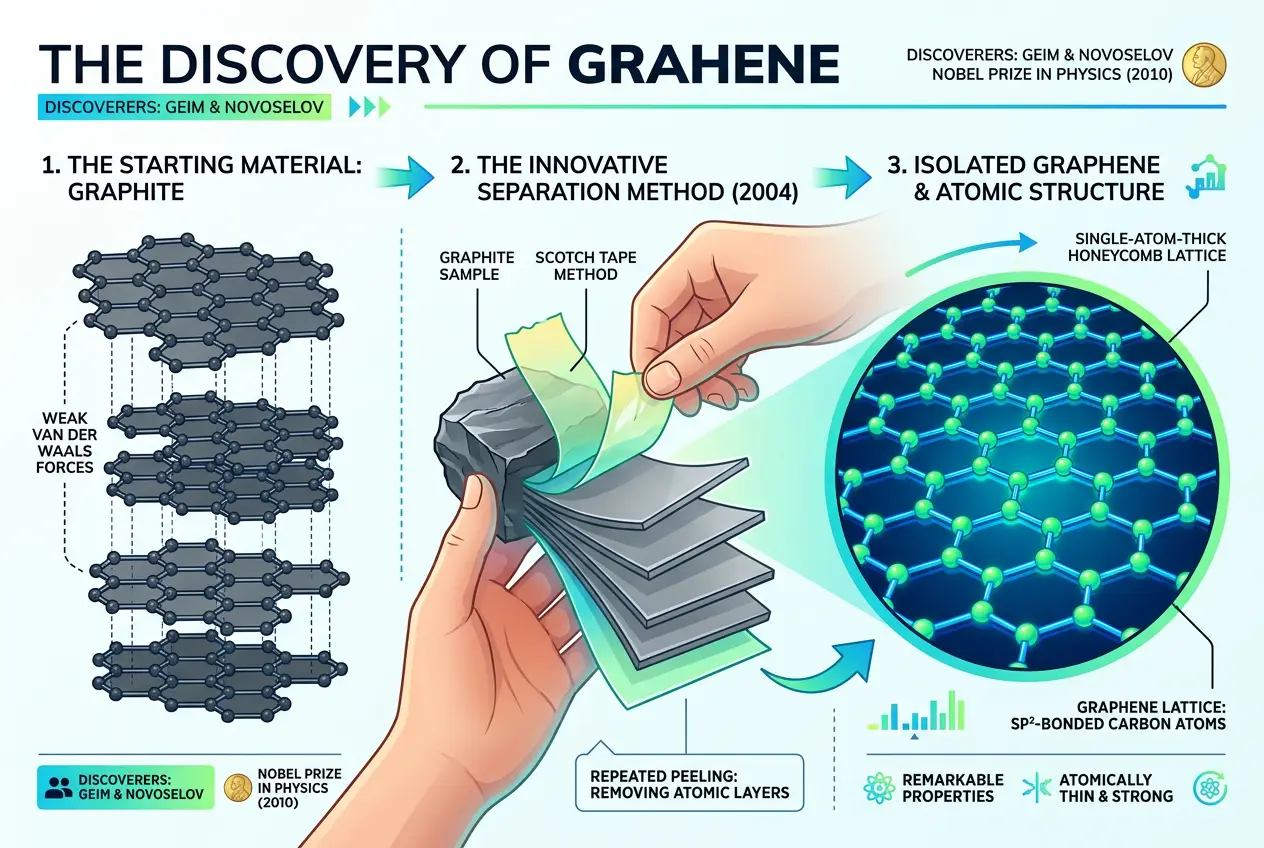
For decades, scientists theorized about the existence of 2D materials like graphene, but many believed they were inherently unstable and couldn't exist independently. The breakthrough came when Andre Geim and Konstantin Novoselov at the University of Manchester managed to isolate graphene using a remarkably simple method: Scotch tape and a piece of graphite. Their discovery earned them the Nobel Prize in Physics in 2010 and opened a Pandora's Box of possibilities, fundamentally altering our understanding of materials at the nanoscale.
## The Unrivaled Properties of Graphene
What makes graphene so special, and why is it often hailed as a "wonder material"? Its uniqueness stems from a combination of extraordinary properties, many of which are unparalleled in other known materials.
### 1. Strength and Lightweight Design
Graphene is the **strongest material ever discovered** relative to its weight. A single layer of graphene is 200 times stronger than steel. To put this into perspective, a sheet of graphene large enough to cover a football field would weigh less than a single gram, yet theoretically, it could support a weight of several tons. This incredible strength, combined with its minimal weight, makes it an ideal candidate for applications requiring robust yet light materials, from aerospace components to bulletproof vests. Imagine lighter, stronger cars, aircraft, or even building materials that can withstand extreme forces.
### 2. Exceptional Electrical Conductivity
Graphene is the **most conductive material** known at room temperature. Its electrons move almost effortlessly through its honeycomb lattice structure, exhibiting properties typically seen in relativistic particles. This super-efficient electron transport means less energy loss and faster signal processing, making it a game-changer for electronics. Current silicon-based technology is rapidly approaching its physical limits in terms of miniaturization and speed, and graphene offers a compelling alternative to surpass these barriers. For instance, imagine flexible circuits or transparent touchscreens that are orders of magnitude faster and more energy-efficient.
### 3. Thermal Conductivity
Beyond electrical prowess, graphene is also an **outstanding thermal conductor**. It can dissipate heat much more efficiently than copper, which is the standard in most current electronic cooling systems. In an era where devices are becoming smaller and more powerful, managing heat is a critical challenge. Graphene could lead to cooler, more reliable electronics, extending their lifespan and improving performance, especially in high-power applications like servers and supercomputers.
### 4. Transparency and Flexibility
Despite its strength, graphene is also incredibly transparent and flexible. A single layer is virtually invisible, absorbing only 2.3% of visible light. This unique combination opens doors for flexible, transparent electronics, such as bendable smartphones, wearable tech that conforms to your body, or even smart windows that can generate electricity. The ability to integrate electronics into everyday objects without sacrificing aesthetics or functionality is a huge leap forward.
## Beyond the Lab: Real-World Applications
The theoretical potential of graphene is vast, but what about its practical applications? Scientists and engineers worldwide are actively exploring its use across numerous sectors.
### Electronics and Computing
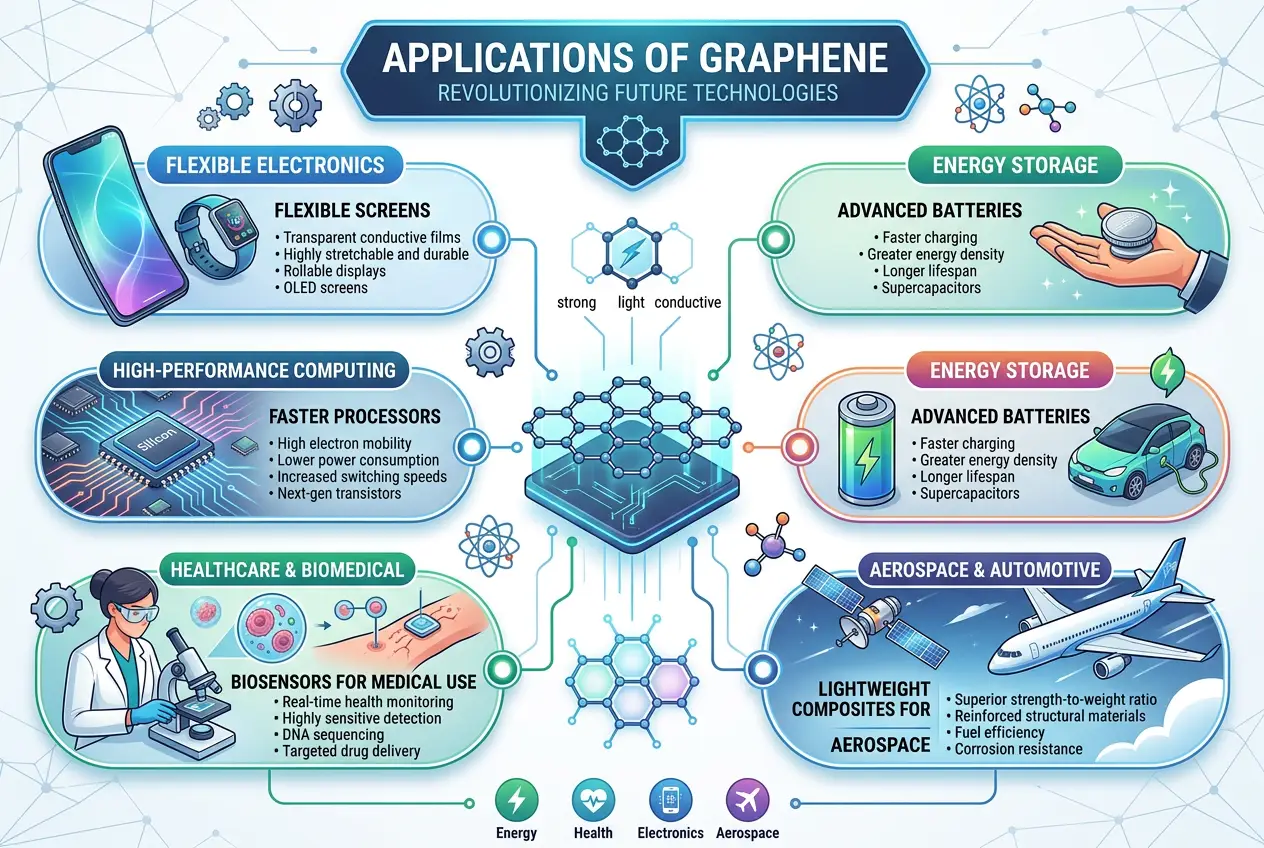
The semiconductor industry is keenly interested in graphene as a successor to silicon. Its high electron mobility could lead to transistors that operate at much higher frequencies, enabling incredibly fast processors. Furthermore, the development of **graphene-based photodetectors** could revolutionize optical communication, making data transfer faster and more efficient. Imagine devices that are not just faster but also consume significantly less power. For a deeper dive into the future of computing materials, you might be interested in our article on how new materials could redefine computing, such as when we asked, "Could Light Replace Silicon in Future Computers?"
### Energy Storage
One of graphene’s most promising applications is in energy storage. Its massive surface area and excellent conductivity make it ideal for supercapacitors and batteries. Graphene-enhanced batteries could charge much faster, hold more energy, and last longer than traditional lithium-ion batteries. This has profound implications for electric vehicles, portable electronics, and grid-scale energy storage, potentially accelerating the transition to renewable energy sources. Imagine fully charging your smartphone in seconds or an electric car in minutes.
### Medical and Biomedical Devices
The biocompatibility and unique properties of graphene are also attracting significant attention in the medical field. Researchers are developing **graphene-based biosensors** that can detect diseases at earlier stages with greater sensitivity, or even monitor vital signs continuously and non-invasively. Its strength and flexibility also make it suitable for advanced prosthetics or neural interfaces. Some speculate that graphene could play a role in advanced bio-integrated technologies, blurring the lines between human and machine, a concept we've explored in topics like "Can Living Cells Build Our Next Supercomputers?"
### Water Filtration and Desalination
Graphene oxide membranes have shown incredible promise in water purification. Their atomic thinness and precisely sized pores allow water molecules to pass through rapidly while blocking even the smallest impurities, including salts. This could provide a highly efficient and cost-effective solution for providing clean drinking water globally, especially in regions suffering from water scarcity. This technology has the potential to dramatically lower the cost of desalination, making it accessible on a much wider scale.
### Composites and Coatings
Due to its strength, graphene can be incorporated into various materials to enhance their properties. Adding tiny amounts of graphene to plastics, metals, or ceramics can create composites that are significantly stronger, lighter, and more durable. This could lead to self-healing materials, highly durable paints, or even stronger athletic gear. The potential for such reinforced materials is immense, from construction to consumer goods.
## The Challenges on the Road Ahead
Despite its incredible potential, graphene isn't without its challenges. The primary hurdle lies in scaling up its production cheaply and consistently while maintaining its high quality. Current methods for producing high-quality, single-layer graphene are often expensive and difficult to mass-produce.
* **Cost-Effective Mass Production:** While research continues, finding an economically viable method to produce large quantities of high-quality graphene remains a significant barrier.
* **Integration into Existing Manufacturing:** Integrating a novel 2D material into existing, highly specialized manufacturing processes for electronics or other industries requires significant investment and retooling.
* **Standardization and Quality Control:** Ensuring consistent quality and performance across different production batches is crucial for industrial adoption.
However, the scientific community is highly motivated, and new methods like chemical vapor deposition (CVD) and liquid-phase exfoliation are continuously being refined to overcome these obstacles.
## The Future is 2D
The journey of graphene from theoretical concept to Nobel Prize-winning discovery, and now to a material poised to reshape industries, is a testament to human ingenuity. While it might take a few more years for graphene to become as ubiquitous as silicon, the groundwork is being laid. From revolutionizing how we power our homes to making our devices smarter and our bodies healthier, graphene promises a future that is stronger, faster, and more efficient.
As we continue to push the boundaries of materials science and discover new applications, graphene stands as a beacon of modern innovation. It reminds us that sometimes, the most revolutionary advancements come from understanding the simplest structures at their most fundamental levels. Keep an eye on this wonder material; I have a feeling it’s just getting started. If you're fascinated by the potential of cutting-edge materials to transform technology, you might also be interested in how "Smart Dust: Will Our World Get a Digital Skin?" could utilize such advancements.
**External Sources:**
* [Graphene on Wikipedia](https://en.wikipedia.org/wiki/Graphene)
* [Andre Geim on Wikipedia](https://en.wikipedia.org/wiki/Andre_Geim)
* [Konstantin Novoselov on Wikipedia](https://en.wikipedia.org/wiki/Konstantin_Novoselov)
Frequently Asked Questions
Graphene is a material made of a single layer of carbon atoms arranged in a hexagonal lattice. It's called a 'wonder material' due to its extraordinary properties, including being 200 times stronger than steel, highly conductive of electricity and heat, incredibly lightweight, transparent, and flexible.
Graphene was first isolated in 2004 by Andre Geim and Konstantin Novoselov at the University of Manchester, who used a simple method of repeatedly peeling layers from graphite with Scotch tape until they achieved a single atomic layer. They were awarded the Nobel Prize in Physics for this breakthrough.
Graphene has potential applications in numerous fields: it could replace silicon in next-generation electronics for faster devices, create more efficient and rapid-charging batteries and supercapacitors, develop highly sensitive biosensors for medical diagnostics, enhance water filtration systems, and produce stronger, lighter composite materials.
The main challenges for graphene's widespread adoption include the high cost and difficulty of mass-producing high-quality, single-layer graphene, integrating it into existing manufacturing processes, and ensuring consistent quality control across different production batches.
While graphene shows immense promise as a successor to silicon, it's more likely that it will complement existing silicon technology in the short to medium term. For example, graphene could be used in specific components where its unique properties offer a significant advantage, such as high-frequency transistors or flexible displays, rather than a complete overhaul of all silicon-based systems immediately.
Verified Expert
Alex Rivers
A professional researcher since age twelve, I delve into mysteries and ignite curiosity by presenting an array of compelling possibilities. I will heighten your curiosity, but by the end, you will possess profound knowledge.
 Join Us



 Alex Rivers

































Leave a Reply
Comments (0)