I remember standing inside an ancient chamber, perhaps a Mayan pyramid or a Roman amphitheater, and being struck by the peculiar acoustics. A whisper carried across vast distances, a clap echoed with an uncanny duration, or a specific tone seemed to resonate deep within my bones. It made me wonder: was this mere architectural coincidence, or did the ancients possess an understanding of sound far beyond what we typically credit them with? Could they have even known about something as advanced as **hypersonic sound**?
The idea feels almost fantastical, like something out of a science fiction novel. We often associate advanced acoustic technology with modern science – directed sound systems, ultrasonic cleaners, medical imaging. Yet, increasingly, anomalies from the ancient world hint at a sophisticated, albeit different, kind of technological prowess. What if, hidden within the very fabric of their monumental structures and enigmatic practices, lay the secrets of sound manipulation that we are only now beginning to rediscover?
## What Exactly is Hypersonic Sound?
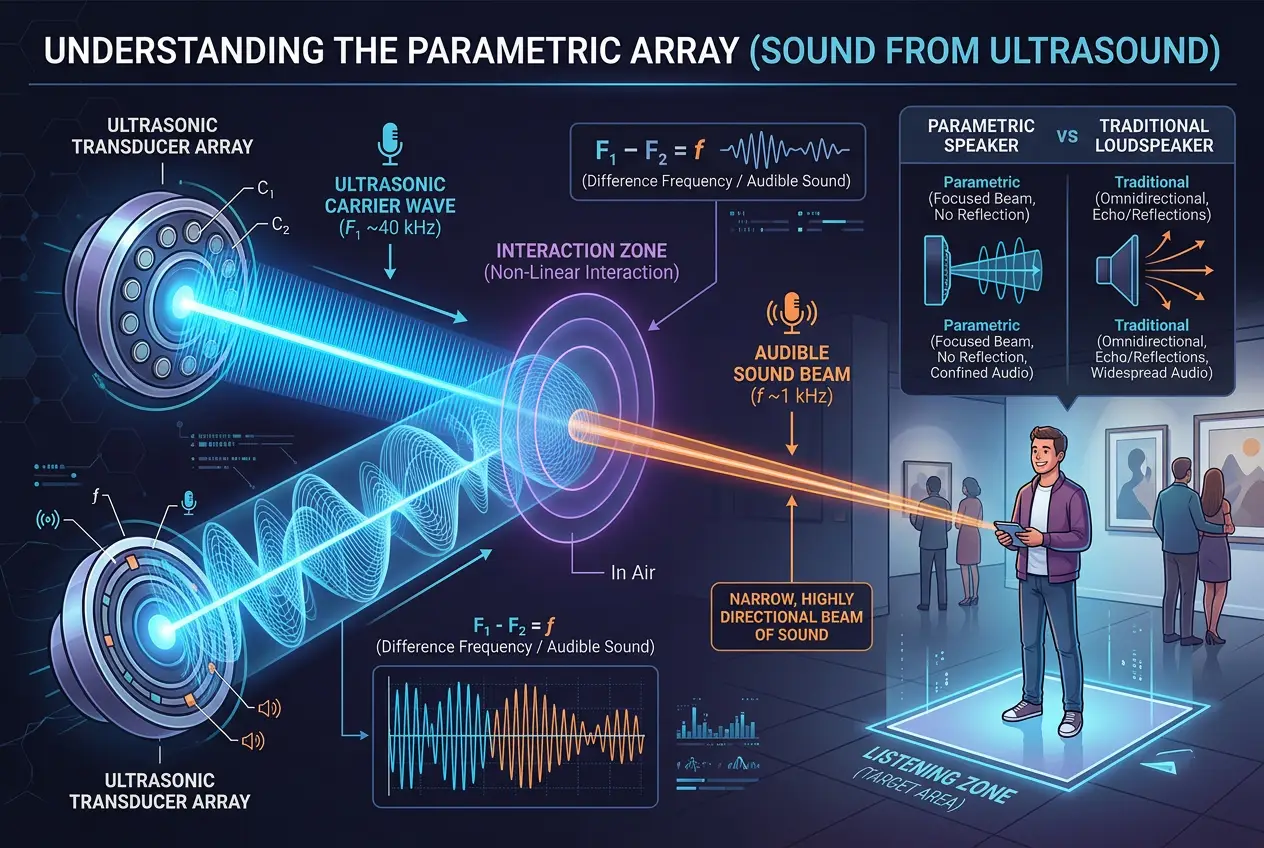
To grasp the audacious claim of ancient hypersonic sound, we first need to understand what it is. In simple terms, hypersonic sound isn't necessarily about sound waves traveling faster than sound in air (that’s supersonic). Instead, it refers to an *extremely directional* audio beam. Imagine a flashlight for sound: instead of sound spreading out in all directions like a conventional speaker, hypersonic sound can be focused into a narrow, precise beam.
This phenomenon is primarily achieved through a technology called a **parametric array**. A parametric array generates sound by emitting two high-frequency ultrasonic waves at slightly different frequencies. These ultrasonic waves, which are inaudible to the human ear, interact with each other in the air. This interaction, a non-linear effect, creates a *third* wave – an audible sound wave – that is remarkably directional. It travels in a tight beam, meaning only someone directly in its path can hear it clearly. Others just a few feet away might hear nothing at all. This highly focused sound beam is what we refer to as hypersonic sound, a term that emphasizes its advanced, directional nature rather you can read more about it on Wikipedia: [Parametric Array](https://en.wikipedia.org/wiki/Parametric_array).
Now, imagine such a technology existed thousands of years ago. The possibilities are mind-boggling, isn't it?
## Whispers of Ancient Acoustic Mastery
While there's no archaeological discovery of an "ancient hypersonic device," the evidence for sophisticated acoustic knowledge in ancient civilizations is tantalizingly indirect. Acoustic archaeology, a growing field, studies the sound properties of ancient sites. Researchers have uncovered remarkable sonic qualities in locations like:
* **Chichen Itza's El Castillo:** Clap your hands at the base of this Mayan pyramid, and the echo famously resembles the chirp of a quetzal bird. This isn't random; the pyramid's staircase and structure seem deliberately designed to create this effect.
* **Oracle of Delphi (Greece):** Ancient texts suggest that priests at Delphi delivered prophecies in chambers with unique acoustic properties, perhaps amplifying voices or creating disorienting soundscapes. Could these spaces have manipulated sound in ways we're only beginning to understand?
* **Newgrange (Ireland):** This megalithic passage tomb exhibits an extraordinary resonance. During the winter solstice, as light enters the chamber, specific low frequencies are amplified, creating an almost palpable hum. Some theories suggest this was used for trance induction or communal rituals. This resonates with discussions on how ancient structures might have connected with natural frequencies, as explored in articles like: Did Ancient Structures Resonate with Earth's Frequencies?
These examples suggest not just an awareness of acoustics but a deliberate engineering of sound environments for cultural, religious, or perhaps even practical purposes. The question then becomes: how advanced was this engineering?
## Theories of Hypersonic Applications in Antiquity
If ancient cultures indeed possessed the ability to generate or manipulate highly directional sound, even in a rudimentary form, the implications are vast and open up a new avenue for understanding their "lost technologies."
### Directed Communication or "Voice of the Gods"
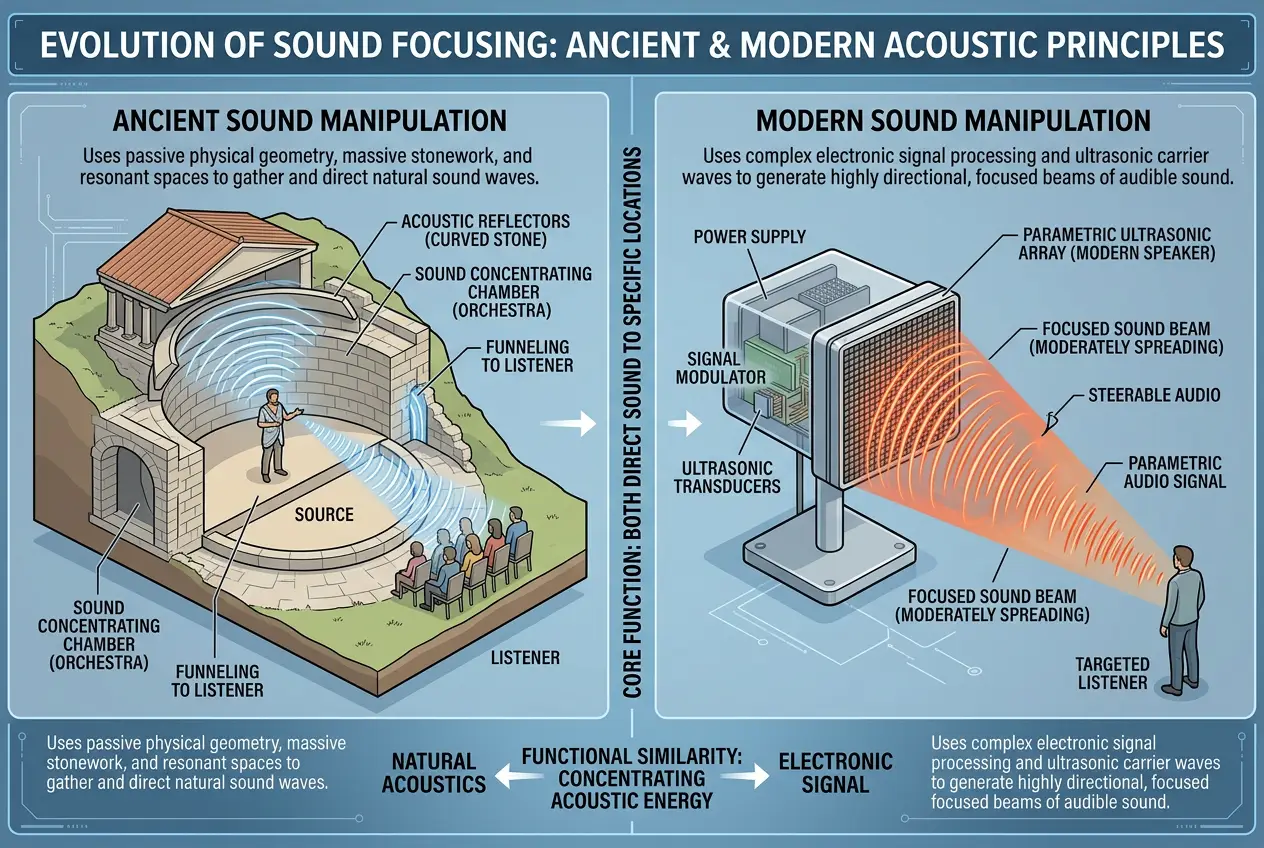
Imagine a priest standing in a temple, his words seemingly projected directly into the mind of a single individual in a crowd, while others hear nothing or a distorted murmur. This "voice of the gods" effect could have been achieved using highly directional sound. Such a phenomenon would undoubtedly bolster religious authority and create powerful, mystical experiences for devotees. Modern directional speakers are used in museums to target specific exhibits, allowing individual visitors to hear audio without disturbing others. A primitive form of this could have existed.
### Sound as a Tool for Healing and Trance
Many ancient cultures revered sound for its healing properties. Tibetan singing bowls, Aboriginal didgeridoos, and shamanic drumming all use specific frequencies and rhythms. If ancients could focus sound precisely, they might have directed specific frequencies to areas of the body for therapeutic effects or induced deep meditative states and trances for spiritual journeys. The idea that sound could be used to influence states of consciousness or even physical well-being is a fascinating area where science and ancient wisdom might converge. For a deeper dive into ancient sound practices, you might enjoy our post: Did Ancients Program Reality Using Sound?
### Material Manipulation and Levitation Legends
This is where the speculation often becomes most dramatic, yet it remains a persistent theme in ancient lore. Legends from various cultures speak of massive stones being moved with the power of sound. While levitation through sound remains firmly in the realm of advanced physics experiments today, the concept of **acoustic levitation** is real. High-frequency sound waves can create pressure fields capable of suspending small objects. Could ancients have applied principles of focused, high-amplitude sound to manipulate lighter objects or even reduce friction for heavier ones, aiding in the construction of monumental structures? This echoes some of the theories we explored in our blog on: Did Ancient Architects Use Sound to Move Mountains?
While purely speculative, the persistent myths coupled with the incredible feats of ancient engineering demand that we consider all possibilities, even those that seem to push the boundaries of conventional history.
### Long-Distance Signaling
Beyond religious contexts, hypersonic sound could have served practical purposes. Imagine sending a focused sound signal across valleys or through dense forests, audible only to a specific receiver. This could have been a method of discreet communication, signaling impending danger, or coordinating activities over long distances without revealing the message to unintended listeners.
## The Challenge of Proof: Why is it a Mystery?
The main reason why the idea of ancient hypersonic sound remains a *mystery* rather than a historical fact is the lack of direct, irrefutable evidence. We don't have ancient blueprints detailing parametric arrays or devices clearly designed for such purposes. The evidence is circumstantial:
* **Interpretive Architecture:** The acoustic properties of ancient sites are observed today, but attributing them to advanced, intentional design for hypersonic sound is an inference. They could also be side effects of other design choices.
* **Lost Knowledge:** If such technologies existed, they would likely have been guarded secrets, passed down through oral traditions or exclusive guilds. The knowledge could have been lost through societal collapse, conquest, or simply a lack of written records.
* **Material Limitations:** Building a modern parametric array requires precise electronics and transducers. The materials and manufacturing capabilities of the ancient world were vastly different. However, this doesn't rule out clever mechanical or architectural solutions that achieved similar effects. We often underestimate ancient ingenuity.
As I’ve often reflected, the past holds many secrets that our modern scientific lens is only beginning to decipher. The notion of a "silent echo" from antiquity continues to spark my curiosity, pushing the boundaries of what we thought was possible for our ancestors.
## Conclusion: An Echo from the Past?
The question of whether ancient civilizations harnessed hypersonic sound technology remains firmly in the realm of intriguing possibility, a fascinating intersection of **historical tech** and **curious phenomena**. While direct evidence is elusive, the exceptional acoustic properties of numerous ancient sites, coupled with a deep appreciation for sound in ancient cultures, compel us to keep an open mind.
Perhaps "hypersonic sound" in antiquity wasn't about complex electronics but about a profound understanding of resonance, wave mechanics, and architectural design that mimicked some of the effects we achieve with advanced equipment today. It’s a testament to the endless well of human ingenuity that we're still discovering surprising connections between ancient wisdom and cutting-edge science. As we continue to delve into the secrets of the past, who knows what other "silent echoes" will emerge from the annals of time, challenging our perceptions of technological progress?
Frequently Asked Questions
Normal sound spreads out in all directions from its source, becoming fainter with distance. Hypersonic sound, enabled by parametric arrays, travels in a narrow, highly directional beam, meaning only listeners directly in its path can hear it clearly, while those nearby hear little to nothing.
Currently, there are no direct archaeological finds, like ancient devices or blueprints, that definitively prove ancient civilizations used hypersonic sound technology. The evidence is primarily circumstantial, based on the unique acoustic properties of ancient structures and the interpretation of historical texts and myths.
While direct replication of modern parametric arrays would be impossible, it's theorized that ancients might have achieved similar directional effects through sophisticated architectural design, manipulating chambers, passages, and materials to focus, amplify, or absorb sound in specific ways. This could involve complex understanding of resonance and wave interference.
This is one of the more speculative theories. While modern acoustic levitation is possible for small objects using high-frequency sound, applying it to massive stones in antiquity is a huge leap. However, some researchers suggest focused, high-amplitude sound might have been used to reduce friction or resonate materials, aiding in the manipulation of large objects, rather than outright levitation.
The field of 'acoustic archaeology' is dedicated to studying the sound properties and acoustic environments of ancient sites and structures. Researchers in this field analyze echoes, resonances, and sound propagation within historical locations to understand how sound was experienced and potentially manipulated by ancient peoples.
Verified Expert
Alex Rivers
A professional researcher since age twelve, I delve into mysteries and ignite curiosity by presenting an array of compelling possibilities. I will heighten your curiosity, but by the end, you will possess profound knowledge.
 Join Us



 Alex Rivers


































Leave a Reply
Comments (0)