I was coasting downhill along a four-lane bypass when a cruiser parked on the grassy median caught my eye. The officer held a dark, wedge-shaped device against the driver-side glass, pointing it straight at oncoming traffic: a classic **speed gun**. In less than half a second, an illuminated numeric readout locked in my exact travel speed.
It felt like digital sorcery. No physical cables stretched across the pavement. No overhead cameras timed my commute. Just a plastic housing, an invisible electromagnetic beam, and instant math.
So how does a handheld **radar gun** compute the velocity of a two-ton steel vehicle moving toward it at ninety feet per second? Most people assume the device tracks your car like a stopwatch, recording how long you take to travel between two fixed points. Not quite. A roadside **radar speed gun** doesn't time your movement across space. It listens to the physical distortion of light.
## The Microwave Beam: Inside the Police Radar Gun
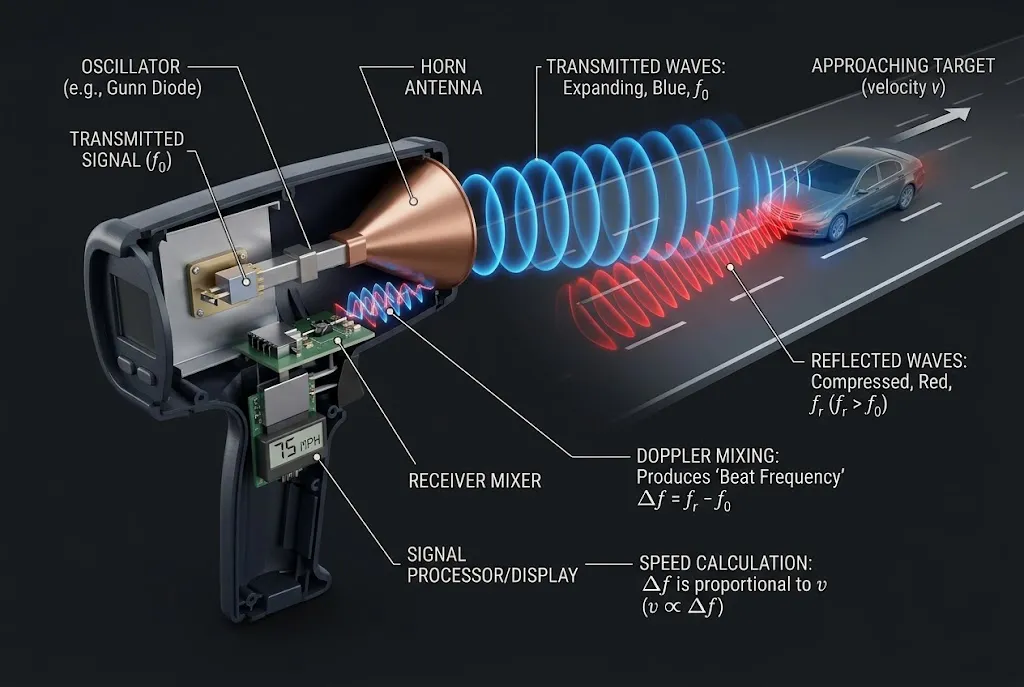
A traffic radar unit is essentially a miniature radio station paired with an ultra-sensitive listening post. When an officer pulls the trigger, an internal microwave source generates a continuous high-frequency electromagnetic wave. The gun doesn't broadcast an unfocused radio bubble in every direction. Instead, it pushes that signal down a hollow metal passage called a waveguide and directs it outward through a flared metal horn antenna. That horn shapes the radiation into a conical beam aimed down the asphalt.
### Radio Frequency Bands and Horn Antennas
Traffic enforcement hardware does not pick broadcast frequencies at random. The [Federal Communications Commission](https://www.fcc.gov/) assigns strict, narrow slices of microwave spectrum specifically for speed measurement. Decades ago, police relied heavily on X-band radar humming at 10.525 GHz. But X-band required bulky antennas and produced wide, sloppy cones that easily reflected off garage doors, metal fences, and nearby trees.
Today, highway patrols lean heavily on K-band (around 24.15 GHz) and Ka-band (spanning roughly 33.4 to 36.0 GHz). Ka-band is the standard tool for modern highway patrol. Its shorter wavelength allows engineers to build compact antennas that focus energy into a comparatively tight, disciplined cone.
#### The Circuitry Behind Microwave Generation
Generating thirty-four billion wave cycles every single second inside a handheld plastic shell requires specialized solid-state hardware. Standard silicon microprocessors cannot toggle quickly enough to produce signals at those gigahertz frequencies directly.
##### Gunn Diodes and Local Oscillators
To hit those extreme microwave frequencies, engineers traditionally relied on a Gunn diode—a specialized slice of gallium arsenide that exhibits negative differential resistance. When you feed steady direct current through it, the diode oscillates naturally at microwave frequencies. In modern units, microwave monolithic integrated circuits handle this task, feeding an unyielding carrier frequency into both the broadcast horn and a local reference circuit called a local oscillator.
###### Why Frequency Stability Matters at Highway Speeds
Frequency stability is everything here. If the internal oscillator drifts by even a fraction of a percent due to summer heat or freezing winter air, the resulting speed calculation falls apart completely. The gun must maintain a rock-solid baseline carrier wave to produce readings that withstand courtroom scrutiny.
```
+---------------+ Microwave Carrier (e.g. 34.7 GHz) +---------------+
| Speed Gun | ===========================================> | Target Car |
| Transmitter | | |
| & | <=========================================== | (Reflects |
| Receiver | Compressed Doppler Echo (34.7000067 GHz) | Compressed) |
+---------------+ +---------------+
```
When that steady microwave pulse travels across the highway, it strikes everything in its path: guardrails, road signs, pavement, and oncoming vehicles. Because modern automobiles are stamped out of sheet steel, aluminum, glass, and chrome, they act as massive electromagnetic reflectors. Much like the reflection challenges covered in [how stealth jets become invisible to radar](/blogs/how-do-stealth-jets-become-invisible-to-radar-1856), sharp body panels and metallic radiators scatter incoming pulses into the surrounding scenery. Yet a tiny sliver of that reflected energy bounces straight back into the gun's receiving horn.
That returning echo carries the vehicle's speed encoded in its wave geometry.
## The Doppler Frequency Shift: How a Speed Radar Calculates Motion
The returning microwave echo holds the entire secret.
If a car sits completely stationary on the road shoulder, the wave bouncing off its bumper returns at the exact same frequency the gun fired. Thirty-four billion seven hundred million cycles per second outbound, thirty-four billion seven hundred million cycles inbound. Zero difference.
Move the vehicle, though, and physics takes over.
### From Sound Waves to Microwaves: The Doppler Principle
This wave deformation relies on the [Doppler effect](https://en.wikipedia.org/wiki/Doppler_effect), first identified by Austrian physicist Christian Doppler in 1842. We hear this phenomenon whenever an emergency vehicle screeches past an intersection. The siren's pitch sounds noticeably higher as the ambulance races toward you, then suddenly drops to a lower, groaning tone as it pulls away. The siren is not altering its acoustic output. The vehicle's forward motion physically squashes sound wave crests closer together ahead of it while stretching them out behind.
Electromagnetic waves do the identical thing.
As your vehicle rolls toward the **speed radar**, its front bumper hits incoming microwave crests faster than a parked barrier would. Each successive wave crest bounces off sheet metal that has rolled slightly closer than where the preceding crest struck. The reflected crests end up physically crammed together.
Inside the **radar speed gun**, a mixer diode combines a tiny sample of the original unshifted outbound transmission with the returning compressed reflection. Because the two radio waves possess slightly different frequencies, they interfere with one another. They beat against each other.
On a standard 34.7 GHz Ka-band unit, every single mile per hour of vehicle speed shifts the reflected signal upward by roughly 103.4 hertz. If you are cruising down the turnpike at 65 mph, your bumper compresses the return signal by roughly 6,720 cycles per second.
A digital signal processor measures that beat frequency, runs a simple formula, and displays your speed on the screen in milliseconds. It never tracks where your car is in space. It only audits the deformation of light waves.
### Why Roadside Angle Warps the Reading: The Cosine Error
Here is something few motorists understand: a **speed radar gun** cannot measure your true speed unless you drive directly down the muzzle of the antenna.
#### Calculating Vector Angles Along the Shoulder
State troopers cannot park directly in the middle of a live travel lane for obvious safety reasons. They set up on highway shoulders, grassy medians, or overpass bridge ramps. This lateral distance creates an angle between your car's true path of travel and the radar beam. Traffic engineers refer to this geometric reality as the *cosine effect*.
##### Trigonometry That Favors the Driver
Radar units can only calculate relative velocity along their direct line of sight. Basic trigonometry dictates that the measured speed equals your actual road speed multiplied by the cosine of the angle between your car and the gun:
$$V_{\text{measured}} = V_{\text{actual}} \times \cos(\theta)$$
If an officer sits at a fifteen-degree angle relative to your lane, the cosine of fifteen degrees is approximately 0.9659. If your speedometer reads an exact 70 mph, the radar screen registers roughly 67.6 mph.
**This is why an officer parked forty feet off the highway shoulder clocks you slightly below your actual speedometer reading rather than above it.**
(And honestly, the first time I held a handheld radar unit and tested it against an onboard digital speedometer, watching the displayed speed sag as the target car drove closer and widened the approach angle felt bizarre, even though the math predicted it cleanly.)
In stationary enforcement, the cosine error always works in the driver's favor.
| True Vehicle Speed | Offset Angle (Degrees) | Measured Speed on Screen | Speed Difference (Favors Driver) |
| :--- | :--- | :--- | :--- |
| 45 mph | 0° (Dead-on) | 45.0 mph | 0.0 mph |
| 45 mph | 15° (Shoulder) | 43.5 mph | -1.5 mph |
| 65 mph | 10° (Shallow) | 64.0 mph | -1.0 mph |
| 65 mph | 25° (Wide Median) | 58.9 mph | -6.1 mph |
| 80 mph | 15° (Shoulder) | 77.3 mph | -2.7 mph |
## Moving Beyond Microwaves: How a Lidar Gun Replaces Radar
While microwave speed detection revolutionized highway monitoring, it suffers from an inherent physical constraint: radio waves spread out over distance.
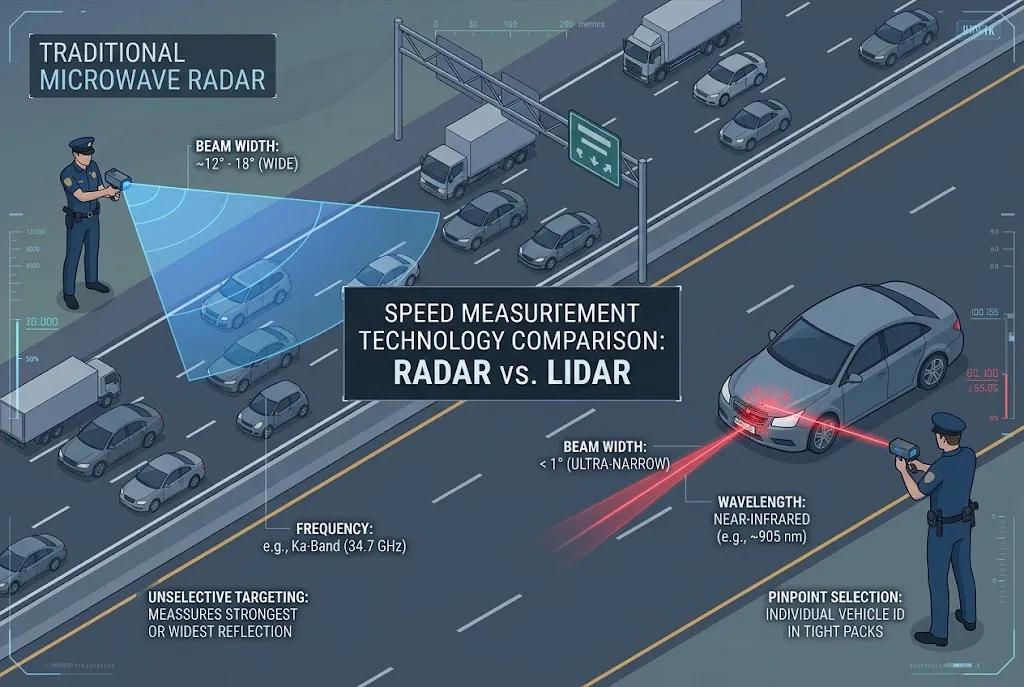
By the time a Ka-band radar beam travels 1,000 feet down an interstate, that cone has widened to nearly 250 feet across. It blankets four highway lanes, both shoulders, and nearby roadside signs.
In heavy traffic, that expansive beam creates serious ambiguity. The radar unit cannot always confirm which specific vehicle generated the return echo. It simply locks onto whichever vehicle presents the largest radar cross-section or highest relative speed—often an eighteen-wheeler trailing behind a sports car. For decades, that ambiguity fueled contested speeding tickets in traffic courts.
To eliminate that guesswork, modern law enforcement transitioned toward the **lidar gun**.
### Laser Speed Timing: Nanoseconds and Light Pulses
A police **laser radar** device—often called lidar (Light Detection and Ranging)—abandons frequency shifts entirely. It relies on direct time-of-flight telemetry, functioning very much like the optical sensors explored in [how self-driving cars see the road](/blogs/do-self-driving-cars-see-like-humans-the-truth-behind-autonomous-vision-5176).
Instead of broadcasting a continuous microwave beam, a handheld **lidar radar gun** fires rapid bursts of invisible infrared light, typically at a 905-nanometer wavelength. Each light pulse lasts only a few nanoseconds. The unit fires a pulse, starts an internal clock, and waits for the infrared reflection to return from your front license plate or headlight reflector.
Because light travels at roughly 186,282 miles per second in air, measuring the round-trip flight time yields exact distance:
$$\text{Distance} = \frac{c \times \text{Time of Flight}}{2}$$
A modern laser speed device doesn't fire just one pulse. It fires up to 400 pulses in roughly a third of a second. As your car advances, the distance shrinks between each consecutive pulse. By dividing that physical distance change by the elapsed time between pulses, the device calculates velocity:
$$\text{Speed} = \frac{\Delta \text{Distance}}{\Delta \text{Time}}$$
### Beam Dispersion: Why Police Shifted to Laser Radar
The decisive advantage of laser enforcement comes down to beam diameter.
While a microwave radar cone blankets entire highways, an infrared laser beam stays remarkably tight. At 1,000 feet, a police lidar beam is only about three feet wide.
That surgical accuracy allows an officer positioned on an overpass to aim an optical red-dot reticle directly at a single sedan bumper wedged inside dense commuter traffic. There is zero beam spillover onto adjacent lanes.
### Can Drivers Scramble a Modern Speed Radar Gun?
Over decades of highway patrols, motorists have dreamed up endless myths about defeating traffic enforcement. Drivers have coated license plates in clear lacquer, hung compact discs from rearview mirrors, and shoved aluminum foil behind radiator grilles.
None of those tricks work. Modern microwave and laser hardware easily pierce amateur optical gimmicks.
Consumer radar detectors do give motorists early warning against continuous microwave beams because radio signals bounce and scatter over hillcrests long before an officer has direct line of sight. But when an officer deploys instant-on radar or a lidar unit, the dynamic changes.
With instant-on radar, the officer keeps the transmitter in silent standby until your vehicle enters range, then pulses the beam for half a second. By the time a dashboard detector beeps, the gun has already recorded your Doppler shift.
With a lidar gun, it is even more decisive. The laser beam strikes your front plate, meaning a detector mounted high on your windshield might never catch the light beam. And even if it does trigger an alert, the instrument calculated your speed forty milliseconds earlier.
Whether measuring the compressed crests of microwave radio waves or timing the nanosecond round-trips of infrared laser photons, speed enforcement relies on predictable wave mechanics executed with solid-state precision. The machines never guess. They just measure the ripples cars leave in the electromagnetic spectrum.
Verified Expert
Alex Rivers
A professional researcher since age twelve, I delve into mysteries and ignite curiosity by presenting an array of compelling possibilities. I will heighten your curiosity, but by the end, you will possess profound knowledge.
Leave a Reply
Comments (0)
No approved comments yet. Be the first to share your thoughts!
 Join Us

 Unknown Author


































Leave a Reply
Comments (0)